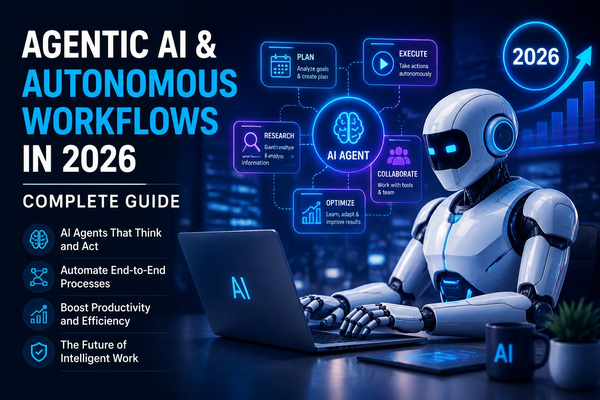
Do you know Agentic AI and autonomous workflows in 2026 stats has reached $10 billion approx and is expected to reach $50 billion by 2030. This is because businesses are jumping from basic automation to intelligent decision-making systems. The modern agentic AI includes autonomous AI agents, foundation models, semantic memory, and AI workflow orchestration to manage adaptive business operations. Earlier, robotic process automation [RPA] was used, but now agentic AI 2026 uses tools and reasoning, retrieval-augmented generation (RAG), and model context protocol (MCP) integration for better, quicker, and smoother operations.
Modern agentic AI platforms are now the mainstream for organizations, hence, they are focusing more on human-in-the-loop oversight, AI governance, prompt injection defense, and agent observability to make sure the deployment of AI is done responsibly. Enterprise agentic AI helps hyperautomation through vector databases, chain-of thought reasoning, and autonomous workflow automation across departments.
In 2026, success with autonomous workflows depends on structured data, plus a newer operational context, and clear measurable AI ROI measurement tactics that let digital workforce initiatives scale in a secure and efficient way. It’s not just “automation” either, because without those inputs the whole system feels less reliable.
What is the Agentic AI Market Size & Growth Forecast 2026–2030?
The global market for agentic AI and autonomous workflows is expected to see a rather big expansion between 2026 and 2030, since enterprises are rushing into intelligent automation technologies. And, as foundation models keep evolving, plus real-time reasoning systems and these AI powered orchestration tools, agentic AI and autonomous workflows are starting to sit right at the center of many enterprise digital transformation plans. In practice, companies are moving past the static kind of automation, and leaning toward more adaptive systems that can do decision-making and task execution, and also keep learning over time, even if things change.
Industry analysts think the agentic AI and autonomous workflows market will reach multi billion dollar growth by 2030. This is mostly because demand is showing up across healthcare, finance, manufacturing, logistics, retail, and customer service. More organizations are using AI agents for business, to tighten up operations, handle repeated work, and boost productivity while also lowering operating spend. Unlike older robotic process automation, these newer autonomous systems can interpret context, coordinate activities, and work across departments, with only minimal human involvement.
One major reason behind the growth is the increasing traction of AI workflow orchestration and multi-agent systems. These approaches let enterprises roll out linked AI agents that communicate, share information, and complete complicated workflows on their own. When you add retrieval augmented generation (RAG), semantic memory, and vector databases into the mix, businesses can build intelligent setups for contextual reasoning and more personalized responses, at scale.
The emergence of agentic AI, 2026 trends, also mirrors the way enterprises are getting more serious about scalable governance and security frameworks. When companies start folding autonomous technologies into mission critical operations, they tend to push hard on AI governance, prompt injection defense, and responsible AI policies, just to keep things transparent and reliable. And it’s not just about guardrails either, because many teams are moving toward human-in-the-loop, and human-on-the-loop style oversight models. That’s basically how they aim for accountability in those higher risk decision situations.
Another growth driver showing up a lot is the wider adoption of hyperautomation. Enterprises are pairing enterprise agentic AI with cloud computing , data analytics, and API ecosystems so they can assemble this sort of digital workforce that runs more or less continuously across different business functions. This shift is expected to boost customer engagement, speed up innovation cycles, and give more operational agility in markets that are always moving.
From 2026 through 2030, organizations that really focus on measurable AI ROI , structured data integration and scalable orchestration tactics are the ones that will likely pull ahead more competitively, sort of speaking. As the AI infrastructure keeps maturing, agentic AI and autonomous workflows will keep reshaping enterprise operations. In other words, businesses will gradually move toward intelligent, autonomous, and very adaptive operational ecosystems, even if at times it feels messy in practice.
What Is Agentic AI?
Agentic AI is advanced artificial intelligence that can make choices, perform actions, and wrap up tasks with little human hand-holding. But it is not like the old automation process, where everything is locked into fixed rules, agentic AI and autonomous workflows are built to sort things out on the fly , adjust, and answer as conditions keep shifting. Usually these systems lean on foundation models, memory layers, and real-time information, so they behave more like capable digital assistants, than like plain software scripts. Concepts: In this era of agentic AI and autonomous workflows, companies are starting to adopt smarter arrangements that can plan activities, scrutinize data, and coordinate across several tools at once. AI agents today can streamline operations, handle customer conversations, produce useful conclusions, and also line up with other systems, often via AI workflow orchestration. It’s a noticeable shift, because organizations seem to gain more speed, cut down on repetitive manual work, and end up with quicker decision cycles.
A big piece of agentic AI and autonomous workflows is multi-agent systems, where multiple AI agents work together to tackle harder problems. These setups often come with human-in-the-loop oversight, not just for accuracy, security, and for keeping responsible AI practices in check. Without that, things could drift.
And as the agentic AI 2026 landscape keeps evolving, enterprises are pouring serious resources into autonomous technologies that blend reasoning, memory, and adaptive automation. This next wave of AI is expected to reshape industries by making business operations more intelligent , faster, and more scalable overall.
How Agentic AI Differs from Generative AI, Chatbots & Copilots
As AI adoption grows, businesses are comparing agentic AI and autonomous workflows with generative AI, chatbots, and even copilots. Unlike the usual AI assistants, agentic AI and autonomous workflows can make decisions, carry out tasks, and also adjust on their own, so they are a big deal for the agentic AI 2026 era of intelligent automation, and AI workflow orchestration.
Generative AI creates content:
Generative AI mostly zeroes in on producing text, images, code, or other media from prompts. It’s less about direct step by step execution, more about generating what people ask for in the first place.It answers user instructions, but typically it does not really take independent actions, nor does it manage workflows in any serious way.
Chatbots, handle conversations
Traditional chatbots are built for customer interactions and scripted replies. Most of them run on predefined logic and they have only limited awareness of context.
Copilots assist human users
AI copilots help people finish tasks like drafting emails, condensing data, or generating code. Still, they lean a lot on human direction and sign-offs.
Agentic AI executes goals autonomously
Agentic AI and autonomous workflows can assess goals, decide what to do, coordinate tools, and finish work with pretty minimal human involvement. A lot of these setups use multi agent systems which collaborate across workflows, across different applications.
Adaptive decision-making
Unlike static automation, agentic AI and autonomous workflows keep improving by learning from data, context, and past interactions over time.
The future of enterprise automation seems to be intelligent systems that can sort reason, then act with independence. As organizations move toward smarter technologies, agentic AI and autonomous workflows will probably be central for scalable, responsive, and very efficient business operations.
What Is an AI Agent? How It Differs from a Chatbot
As businesses start using smarter automation tools more and more, it’s become important to understand what the heck the difference is between AI agents and chatbots. Especially now, in the era of agentic AI and autonomous workflows, AI agents are built to think, act, and finish real tasks by themselves. Meanwhile, the old-school chatbots tend to stay stuck on replying to people in conversation, mainly handling predefined questions and canned intents.
AI agents do actions
AI agents can look at a goal and make decisions, then execute tasks across different systems without someone constantly standing over them. Chatbots, on the other hand, usually just return text-based answers to customer questions, or to those simple requests that are already mapped out.
Chatbots stick to scripts
Most traditional chatbots run on preset rules and a pretty limited sense of context. AI agents tend to use foundation models plus reasoning abilities, so they can adapt in real time to situations that shift even a bit.
Autonomous decision making, the big deal
A defining trait in agentic AI and autonomous workflows is autonomous execution. AI agents can plan sequences, manage processes, and also reach out to software tools on their own, instead of only waiting for the next prompt.
Workflow management that actually works
Many newer AI agents enable AI workflow orchestration. That means they can connect multiple apps, APIs, and databases, then carry out complex business work automatically, end to end, with fewer handoffs.
Collaboration, via multi agent systems
And not like the simple bot experience where one bot just responds. Advanced AI setups can run multi- agent systems, where several agents coordinate, split responsibilities, and team up to solve problems and fine tune operations.
Enterprise level use cases
In the agentic AI 2026 world, companies are rolling out AI agents for customer support, IT operations, sales automation, plus analytics. The goal is to boost efficiency, and scale up without drowning teams in manual work.
The move from chatbots to intelligent AI agents is a big change for enterprise automation. As agentic AI and autonomous workflows keep improving, companies are drifting toward systems that can think, do, and adjust on their own. In other words this shift should start to transform digital operations too, so teams get decisions quicker, more operational efficiency, and automation that feels more “aware” across different industries.
Why 2026 Is the Inflection Point for Agentic AI?
The year 2026 is likely to become a kind of turning point for agentic AI and those autonomous workflows, since enterprises are moving past basic automation and toward more intelligent, self operating systems. At the same time, advances in reasoning models, wider enterprise AI adoption, and AI workflow orchestration are pushing the whole shift from AI assistants toward truly autonomous digital operations.
Rapid Enterprise Adoption
Across industries, businesses are putting more and more money into agentic AI and autonomous workflows, to boost productivity, make decision making more automatic, and lower operational costs. Now enterprises tend to treat AI like a strategic operational asset rather than just a “support tool” tucked somewhere in the background.
Advancements in Foundation Models
Newer AI systems can grasp context, reason through tasks, and carry out workflows more effectively than earlier model generations. And because of that, autonomous systems are becoming more consistent, also more scalable.
Rise of Multi-Agent Systems
Many organizations are rolling out multi agent systems, where several AI agents cooperate, to run workflows, examine data and then automate business operations in real time.
Improved AI Workflow Orchestration
Better orchestration tools are letting AI agents connect with APIs, enterprise software, databases, and cloud platforms. So the automation can stay smooth across departments, without all those manual handoffs and “wait for someone” moments.
Growing Demand for Hyperautomation
In the agentic AI 2026 era, enterprises are mixing AI with automation technologies to form adaptive digital workforces. Basically, teams that keep operating, even when the work keeps changing.
Focus on Governance and Security
Finally, companies are putting heavier attention on responsible AI practices, observability tooling, and governance frameworks so they can scale autonomous systems without losing control.
The convergence of advanced AI abilities, enterprise demand, and scalable automation infrastructure makes 2026 a bit of a defining moment for agentic AI, and autonomous workflows. As organizations start taking up smarter systems businesses that adopt autonomous technologies early are likely to secure major competitive advantages in efficiency, innovation and operational agility.
How Autonomous Workflows Actually Work — A Technical Breakdown
Modern agentic AI and autonomous workflows run on intelligent systems that can sift through data, weigh options, and push work forward on their own. But unlike the older “set it and forget it” automation style, these systems bring together reasoning, memory, and orchestration technologies to produce more adaptive enterprise operations, with only light human involvement in the mix.
Input and Context Collection
Autonomous systems pull in information from APIs, databases, enterprise software, and whatever users do at the moment. That collected signal becomes the context, which then feeds the whole decision process.
Foundation Models and Reasoning
More advanced foundation models take incoming requests, interpret the intent, and sketch out task strategies. In other words, agentic AI and autonomous workflows can shift in real time instead of grinding through fixed rules only.
AI Workflow Orchestration
AI workflow orchestration tools link apps, cloud resources, and automation pipelines. This setup makes it easier for AI agents to coordinate tasks across multiple business platforms, without the usual chaos.
Multi-Agent Systems Collaboration
In a lot of enterprise setups, multi-agent systems team up, split responsibilities, swap useful information, and tune execution while the workflow is still running.
Continuous Learning and Optimization
The agentic AI 2026 ecosystem is starting to lean more and more on feedback loops, semantic memory, and monitoring systems, so automation stays accurate and operational performance keeps getting better as time goes on.
So, as enterprises roll out smarter automation, agentic AI and autonomous workflows are getting more adaptive , more scalable, and more “thinking” overall. When orchestration, reasoning, and collaborative AI systems are combined well, businesses can automate tricky operations while also improving speed, efficiency, and the correctness of decision-making.
Top Real-World Use Cases for Agentic AI in 2026
In 2026 , agentic AI plus autonomous workflows are reshaping the way businesses work, because these smart systems can automate decisions, tune operations, and generally push efficiency higher. More enterprises are taking these tools on, to create scalable automation ecosystems that run on AI workflow orchestration plus adaptive decision-making, you know the deal.
Customer Support Automation
Companies are using agentic AI and autonomous workflows to handle customer inquiries, settle problems, and make interactions feel more personal, all without needing someone on standby all the time.
IT Operations and Monitoring
AI agents can catch system failures, refine infrastructure, and kick off troubleshooting steps in real time. Often this involves multi-agent systems working together, like a quiet squad.
Sales and Marketing Automation
Businesses use AI-powered setups to find leads, craft personalized campaigns, and automate customer engagement processes across several channels, without losing the thread.
Supply Chain Optimization
Autonomous systems study inventory levels, anticipate demand, and coordinate logistics to boost day-to-day efficiency and reduce wait times, and delays.
Financial Operations
Enterprises are rolling out intelligent automation for fraud detection, invoice handling, compliance monitoring, and financial forecasting. It’s basically a tighter loop for finance teams.
Healthcare Workflow Management
In the agentic AI 2026 era, healthcare providers are starting to adopt autonomous systems, for patient scheduling, clinical documentation, and operational coordination, so staff can stay on care instead of chasing paperwork , all day.
When organizations are hunting for smarter automation solutions, agentic AI and autonomous workflows are becoming important not just in one field but across multiple industries. By combining reasoning, orchestration, and real-time responsiveness, these technologies support businesses in boosting productivity, reducing operational costs, and building more intelligent digital operations, so that they are ready for what comes next.
The Leading Agentic AI Platforms in 2026 (Vendor-Neutral Comparison)
In 2026, agentic AI and autonomous workflows are being powered by new enterprise platform class, built to help teams create, ship, and supervise intelligent digital systems. These platforms let organizations step past the old, rigid automation style, and instead run dynamic goal-seeking execution, powered by AI workflow orchestration, reasoning models, and data systems that are already integrated. As adoption keeps spreading, enterprises seem to focus more on scalability, governance, plus interoperability across the wider AI ecosystems.
Agent Orchestration and Workflow Automation
These modern platforms enable agentic AI and autonomous workflows by coordinating tasks across apps, APIs, and internal enterprise environments. That coordination helps complex business processes finish without people constantly clicking around.
Multi-Agent Systems Support
Many top offerings support multi-agent systems where several autonomous AI agents cooperate, assign work, and tackle multi-stage problems in real time.
Foundation Model Integration
Platforms bring foundation models with enterprise data sources so reasoning, planning, and context-aware choices can happen inside workflows, not just in demos or isolated chats.
Memory and Context Engineering
Vector databases, along with semantic memory systems, help keep long-term context. This tends to improve accuracy and keeps continuity during autonomous execution, even when tasks stretch over time.
Governance, Safety, and Guardrails
In the agentic AI 2026 scene, platforms strongly emphasize AI governance, responsible AI practices, and prompt injection defense. The point is secure deployment, with less space for unexpected behavior, or unsafe inputs.
Human-in-the-Loop and Oversight Controls
Even so, enterprises still use human-in-the-loop patterns for validation, compliance, and risk-sensitive decision-making in autonomous systems. Basically, humans remain the final safety net, when it matters most.
The evolution of agentic AI and autonomous workflows is pushed forward by platforms that blend orchestration with intelligence and governance all in one. So when enterprises start to adopt these systems they end up with the ability to assemble scalable digital workforces which can boost efficiency, cut down costs, and keep that continuous innovation going across their business operations. In other words, orchestration is there , then the “smart” part comes, and governance follows after it, more or less, without much fuss.
How to Build an Agentic AI Workflow — Step-by-Step Implementation Guide?
Building agentic AI and autonomous workflows really needs more than just “simple automation”—it’s about shaping systems that can kinda reason, plan, and then actually carry out tasks with the least possible human presence. Around 2026, many enterprises are moving toward AI workflow orchestration, foundation models, and multi-agent systems so they can form intelligent digital workflows that shift in real time and, in the end, lift operational efficiency.
Step 1: Define the Business Goal
Kick off by picking a clear objective, like customer support automation, data processing, or financial reporting. Agentic AI and autonomous workflows often work best when the objectives are laid out in a structured, measurable kind of way, not just kind of blurry.
Step 2: Select Foundation Models
Choose foundation models that are capable of doing reasoning, actual tool usage, and contextual comprehension. Think of these models as the “brain” part, and yes they’re basically what powers the autonomous behavior, too.
Step 3: Design Workflow Architecture
Map out the tasks, the dependencies, and where decisions actually happen. Then bring in AI workflow orchestration so it can connect APIs, databases, and other enterprise tooling into one setup that feels coherent, even if it’s a little complex, or rather… unusually involved.
Step 4: Implement Multi Agent Systems
If the workflow starts looking tangled, break it into smaller bits , and let multiple AI agents take care of different parts of the work. Collaboration here gives you better scalability and higher throughput.
Step 5: Add Memory and Context Layers
Bring in vector databases and semantic memory so the system can hold onto longer-term context, even if it feels like it drifts over time. Usually this makes the outcomes steadier and way more accurate, especially once the workflow keeps running and compounding.
Step 6: Integrate governance and guardrails
Add AI governance, prompt injection defenses, and responsible AI policies, basically this is what keeps execution safe, compliant, and not too chaotic in the real world.
Step 7: Enable human in the loop oversight
Create approval gates for actions that are high-risk or more sensitive, so a person can step in before things go sideways. That keeps control, accountability , and reduces the chance of unwanted outcomes.
Step 8: Test, Monitor,and Optimize
Keep checking how things run with agent observability tools, then tune the workflows from what you learn in those feedback loops. It’s a loop back and forth, you know, until the outputs look right.
Building agentic AI and autonomous workflows that actually work takes a structured habit. You need orchestration, some real reasoning, and governance in the mix. If an enterprise does it well, they can end up with scalable digital workforces, less manual effort overall, and better operational efficiency in the agentic AI 2026 era.
Measuring the ROI of Agentic AI Deployments
In the era of agentic AI and these autonomous workflows, figuring out return on investment, like ROI, is critical if an enterprise is serious about adoption. Unlike older automation models, agentic systems don’t just run once and stop—they keep learning, shift, and actually execute across multiple business functions. So, ROI measurement becomes more dynamic, almost like it moves with the system. And in the agentic AI 2026 landscape, organizations seem to be leaning hard toward performance, cost efficiency, and scalable outcomes that are driven by AI workflow orchestration and the more intelligent decision systems.
Operational Cost Reduction
One of the big wins from agentic AI and autonomous workflows is cutting down manual work across repetitive processes. When labor hours drop, infrastructure usage steadies, and process delays shrink, that stuff adds up fast, and it shows in ROI.
Productivity and Speed Gains
Enterprises often look at how quickly AI agents finish workflows versus human teams. Shorter execution cycles and fewer bottlenecks are basically treated as real value delivery, not just speed for speed’s sake.
Accuracy and Error Reduction
Autonomous systems tend to reduce human errors in data handling, reporting, and decision making. When accuracy improves, business reliability goes up, and the remediation costs often take a visible dip too.
Scalability of Automation
ROI usually jumps when agentic AI and autonomous workflows take on heavier demand without costs climbing in the same proportion. This matters even more in enterprise environments, where scaling can get expensive, real quickly.
Revenue Impact and Conversion Improvement
For customer facing scenarios, AI agents can influence lead conversion, personalization, and engagement. And since those factors connect to revenue growth, they become part of the ROI story directly.
AI Observability and Performance Tracking
Agent observability tools help teams track workflow efficiency, decision paths, and overall system behavior. With that visibility, continuous optimization becomes easier, and the whole system can be tuned over time instead of guessed at.
AI Observability and Performance Tracking
AI observability and performance tracking, agent tools help watch workflow efficiency ,decision paths ,and how the system behaves, so teams can keep optimizing things as they go continuously.
Governance and risk mitigation
With strong AI governance, prompt injection defense, and responsible AI practices in place, compliance risks get pushed down, and that same effort tends to support long-term ROI.
To measure ROI for agentic AI and autonomous workflows you need a wide view, not just one angle, because it should cover cost reductions, productivity improvements, and actual business impact. In the agentic AI 2026 era, enterprises that follow performance using structured metrics, continuous optimization frameworks, are generally better set to turn that value into something bigger and scale intelligent automation without too many surprises.
Common Mistakes That Sink Agentic AI Projects
In the era where agentic AI and autonomous workflows move kinda fast, a lot of enterprises jump into deployment without doing the boring planning part, and then the systems fail or they just don’t perform as expected. Sure, agentic AI 2026 technologies bring serious automation powers, but the real outcome hinges on solid architecture, governance that actually gets followed, and a use-case definition that’s crisp, backed by an AI workflow orchestration layer that keeps everything from drifting.
Unclear Business Objectives
A project tends to stall when agentic AI and autonomous workflows are pushed out while business goals stay fuzzy, or when no one writes measurable targets and real success indicators.
Weak Data and Context Management
If the data is messy or thin, if vector databases are missing, or if there’s no semantic memory, the AI agents end up making decisions that sound confident but are quietly wrong.
Ignoring Governance and Safety
When teams skip AI governance, prompt injection protection, and responsible AI practices, security holes and compliance trouble show up later, often in unpleasant ways.
Over-Automation Without Human Oversight
Removing human-in-the-loop controls too early can mean errors slip through, unnoticed, right when the workflow is most critical.
Poor Agent Orchestration Design
Without proper AI workflow orchestration, multi-agent systems can become split-brain-ish, fragmented, and inefficient, so even good components don’t help much.
Avoiding those issues is, honestly, the difference between “we tried agentic AI” and “this delivers enterprise value.” In the agentic AI 2026 world, disciplined design, real governance, and continuous monitoring decide whether these AI projects actually pay off, or just look busy while underperforming.
The Future Beyond 2026 — Where Agentic AI Goes Next
The future past 2026 will redefine how enterprise operations work, once agentic systems get smarter and faster and also a bit more collaborative than before. In practice, many businesses will lean on agentic AI and autonomous workflows to streamline choices, cut down operational delays, and lift customer experiences across different departments. And as agentic AI 2026 keeps evolving, organizations will start rolling out adaptive digital teams that can plan, reason, and carry out tasks with minimal oversight.
More specifically, advanced AI agents for business will coordinate through multi-agent systems, so finance, marketing, logistics, and support can effectively collaborate in near real time. These setups won’t just take over repetitive chores, they will also sharpen strategic forecasting and enable more personalized services. Over the next decade, agentic AI alongside autonomous workflows should turn enterprises into responsive ecosystems, where humans supervise intelligent agents, instead of manually managing everyday processes.
Companies that adopt these technologies early may get efficiency, better scalability, faster innovation, and a long-term competitive edge in quickly shifting global markets, while still keeping security, and doing ethical governance the right way.
Why Choose Esferasoft Solutions for Your Agentic AI Initiative?
Let us know why you should choose esferasoft solutions for your agentic AI initiative:
Advanced Agentic AI and autonomous:
Esferasoft Solutions delivers advanced agentic AI and autonomous workflows, tailored to modern enterprise needs, so things stay scalable and intelligent in automation.
Post-launch Support:
They also point out the whole agentic AI 2026 trends angle, helping businesses remain ahead with future-ready digital transformation strategies, not just “now” but later too.
Seamless Execution:
What they mostly specialize in is autonomous workflow automation, which supports seamless task execution with minimal human intervention, meaning fewer delays and less friction.
Operational Efficiency:
By building enterprise-grade AI agents that fit real business needs, Esferasoft helps raise operational efficiency, improve customer engagement , and speeds up decision making in a sort of fast way, across teams quickly.
Secure development:
Their crew is skilled in weaving secure and adaptive multi-agent systems with strong AI governance habits, so results stay dependable even when things get complicated a bit.
Also , they offer customized deployment, continuous support, and innovation-driven solutions, to accelerate long-term business growth and competitive advantage.
Frequently Asked Questions:
What is agentic AI in simple terms?
An agentic AI is more than just a bot to answer, it is not restricted with answers and instructions, Agentic Ai uses tools to execute the task.
What is an AI agent and how is it different from a chatbot?
An AI agent is an autonomous system built to perceive the surroundings, make decisions on its own, and carry out multi-step actions to reach a particular objective. Instead of acting like usual chat tools, agents can jump into workflows, use outside utilities, and iron out problems without always needing a step by step human involvement.
How is agentic AI different from generative AI?
Generative AI spits out content when someone gives a prompt , like text, images, or code. But Agentic AI does its own thing, it autonomously carries out tasks. Instead of just generating, it first breaks down big, multi-step goals, then it can pull in external tools, and it keeps adjusting as things change in real-time. You don’t always need constant human nudges, which is the point.
What is an autonomous workflow?
An autonomous workflow is a business process driven by AI agents that can start, carry out and adjust to finish multi step tasks without any human involvement, and honestly it just keeps moving along in the background until it gets it done.
Why is 2026 considered a turning point for agentic AI?
In 2026, agentic AI hits a huge turning point because it moves away from those passive generative tools, to autonomous digital workers. Not just answering prompts anymore—those AI agents can plan end to end tasks, link into software platforms, and carry out workflows without the usual constant human oversight. It’s a bit like shifting from a reactive helper, to something that’s actually proactive and does the whole job, step by step, even if it feels a little unsaid at first.
Will agentic AI replace human workers?
No, agentic AI cannot replace human workers but yes, they can help them upgrade.
What are the best agentic AI platforms in 2026? The best agentic AI platforms in 2026 are categorized by their specialization, ranging from enterprise ecosystems to developer frameworks and automation tools
What does it cost to deploy agentic AI — from pilot to enterprise scale? It may take around $15000 to $1,00,000. The cost depends on the complexity, depth of integration, and strictness of the government.
What is the Model Context Protocol (MCP)?
The Model Context Protocol, MCP is an open source standard made by Anthropic , it helps AI models link in a secure way with outside stuff like data sources, apps ,and services , basically giving a more reliable path for context.
How do you handle security risks in agentic AI?
We handle security risks in agentic AI with our multi-layered security defense.
What is the difference between RPA and agentic AI?
Robotic Process Automation (RPA) and Agentic AI feel like two different ways to get business work done, sort of. RPA mostly handles the explicit, rule-based steps it is given, so it automates the “ how ” part, right. Meanwhile Agentic AI leans on strategic reasoning and language models to work toward shifting objectives on its own, so it takes care of the “ what ” side. In other words, one follows clear directions, the other figures out the aim in real time.
Can small and mid-sized businesses use agentic AI?
Yes, small and mid-sized businesses can obviously use agentic AI.
What industries benefit most from agentic AI in 2026?
The industry benefits most from agentic AI in 2026- Customer Support Automation, IT Operations and Monitoring, Sales and Marketing Automation, Supply Chain Optimization, Financial Operations, and Healthcare Workflow Management.
How long does it take to deploy an agentic AI workflow?
It takes around 1-6 weeks for an MVP, but it will take around 4-6 months for a complete enterprise production.
What is human-in-the-loop vs human-on-the-loop?
Human-in-the-loop means an AI setup needs direct human okay or input, to finish certain actions. On-the-loop or “human on the loop” points to an AI system that mostly runs on its own, meanwhile people keep watch and can step in if the system makes a mistake, or if it hits something unusual or abnormal .
What regulations apply to agentic AI in 2026?
The regulations applicable to agentic AI in 2026 are a mix of regional AI acts, sector-specific laws, and “Policy-as-Code” guardrails.
How do you measure the ROI of an agentic AI deployment?
The formula to measure the ROI of an agentic AI deployment is to deduct total cost of deployment from total value generated divided by total cost of deployment and the result is multiplied by 100.
What is the biggest reason agentic AI projects fail?
The biggest reason agentic AI projects fail is the lack of structural governance and flawed system design.
Can agentic AI integrate with legacy systems like SAP or Oracle?
Yes, agentic AI integrates with legacy systems like SAP or Oracle.
How can Esferasoft Solutions help my business adopt agentic AI?
Esferasoft Solutions helps companies adopt agentic AI, by building tailor made autonomous AI agents that run multi step workflows, make data driven choices, and carry out tasks, without needing constant human supervision. They basically focus on end to end execution, not just simple chat.