In this rapidly evolving world, the demand for fitness apps is increasing as individuals seek more tailored, data-driven, and health-focused solutions. However, in Dubai, the DHA (Dubai Health Authority) platform exemplifies an endless fusion of fitness and health tech that can enhance the user experience in medical fitness applications. Such platforms enable patients’ health records, which can also access numerous additional features, such as monitoring health data, connecting with healthcare institutions, and scheduling appointments for smart platforms.
The successful project initiated by the government in Dubai has generated significant entrepreneurial interest, encouraging other driven investors to start similar projects, including the development of a medical fitness app like DHA.
Such initiatives not only work towards the advancement of holistic healthcare accessibility but also make inroads to highly profitable revenue streams within the rapidly growing health tech economy. So are you also interested in making investments in this proven business idea? If yes, read this blog to know various steps to develop a DHA-inspired platform that has the potential for long-term market relevance.
All About DHA App
The Dubai Health Authority (DHA) App provides an all-in-one health and fitness service across Dubai. Residents trust the platform as a reliable and user-friendly medical test booking app, which offers great usability, easy navigation, and convenience for accessing health services. The ability to check the status of a health fitness test, blood donation, or receive a personalized health feed will encourage continued use and satisfaction.

How does a Fitness App Like DHA Work?
DHA is a top-notch fitness application that offers the best features of health data and advanced tracking, all within a seamless experience. Users log in to customized workout programs, activity log, and wellness tips, often with sync capabilities with wearables to track steps, heart rate, or calories; suggestions are given with adaptations based on personal user goals and progress, while dashboards show great visibility of improvements over time.
Furthermore, DHA is designed to motivate users, provide data, and ensure convenience, creating an ecosystem that empowers them to maintain consistency in their workouts and make informed decisions without complicating their daily routines.
Unique Features to Integrate in a DHA-Like App
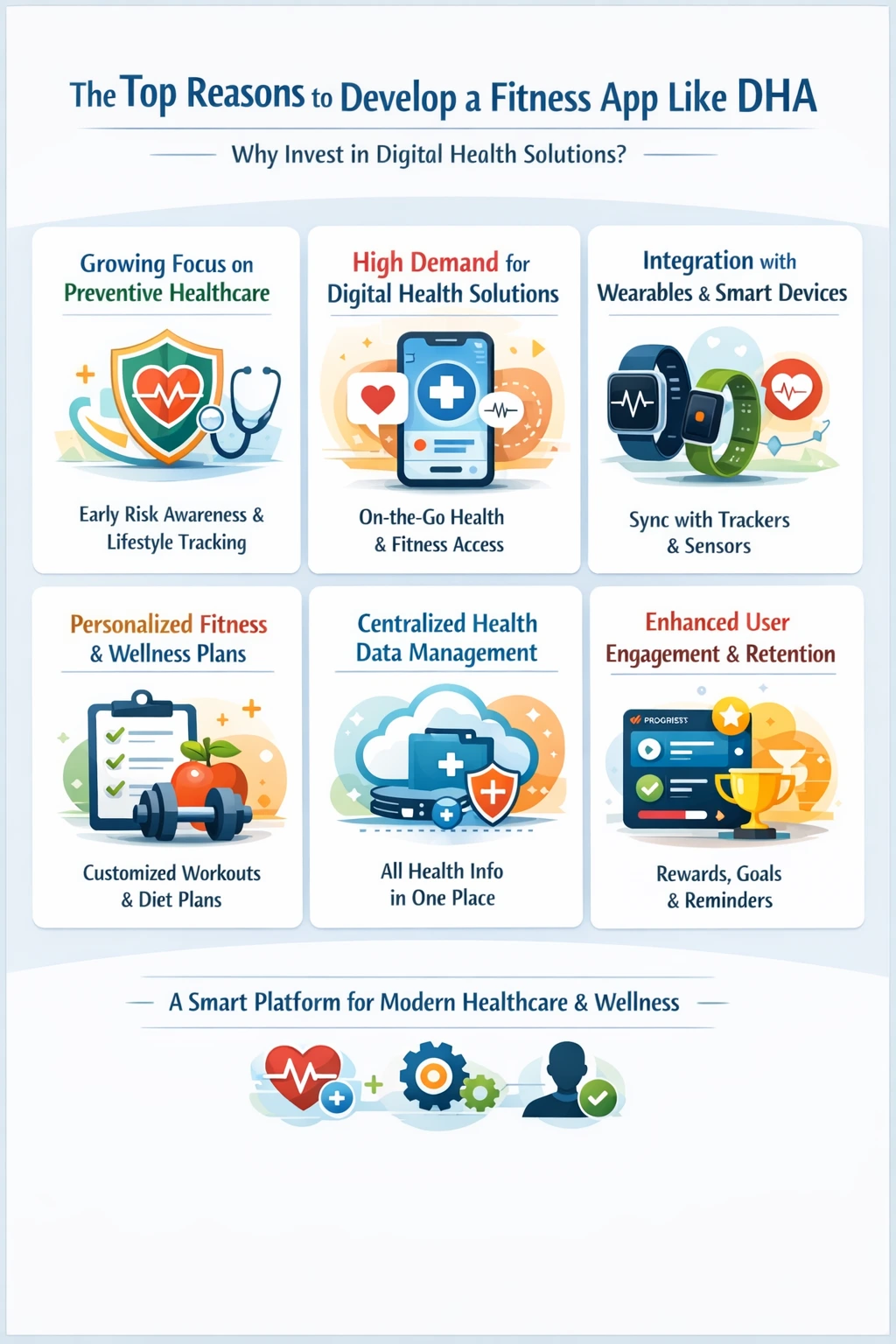
To build a high-impact fitness and healthcare platform similar to the DHA app, it is essential to integrate features that prioritize usability, data accuracy, and security. The following components form the foundation of a reliable and scalable digital health ecosystem.
Health Profile of Users
Each user should have a comprehensive digital health profile that includes personal details, medical history, allergies, vaccinations, and current medications. This profile acts as a centralized health record that can be securely accessed by both users and authorized healthcare providers for informed care decisions.
Appointment Scheduling
The app should offer a smooth appointment-booking system that displays doctor or clinic availability, allows users to select time slots, and supports bookings for medical fitness tests or general consultations. Real-time confirmation and calendar integration improve convenience and reduce missed appointments.
Fitness and Vital Signs Tracking
Integration with wearables and IoT devices enables tracking of steps, heart rate, sleep quality, oxygen levels, and calories burned. This allows users to monitor daily habits, detect health trends early, and maintain a preventive healthcare approach.
Telemedicine and Video Consultations
Video consultations enable users to speak with healthcare professionals from any location. This is especially valuable for follow-ups, mental health consultations, and general medical advice. The system must ensure high-quality video, secure communication, and compliant session handling.
Online Prescriptions
Following digital consultations, doctors should be able to issue electronic prescriptions directly through the app. Users can download or forward prescriptions to pharmacies, eliminating paperwork and accelerating the medication collection process.
Vaccination Records and Reminders
The app should store vaccination history and send timely reminders for upcoming doses. This feature is particularly beneficial for residents and expatriates who must meet health requirements related to residency, travel, or employment.
Access to Medical Test Reports
Users must be able to view and download medical reports such as blood tests, imaging, and diagnostic results directly within the app. Instant access improves transparency, supports informed decision-making, and reduces dependency on physical documents.
AI Chatbot Assistance
An integrated AI chatbot can answer frequently asked questions, assist with navigation, guide appointment bookings, and provide basic symptom insights. This enhances accessibility while reducing user friction and administrative workload.
Multi-Language Support
Given the diverse population in the UAE, the app should support both English and Arabic as standard languages. Multilingual accessibility ensures ease of use for citizens and the expatriate community, improving adoption and engagement.
| Sr. No. | Modern Technology Stack | Description |
| 1 | Front-End Development | For creating a small, responsive, and cross-platform user interface, Flutter or React Native would be the best choice. |
| 2 | Back-End Development | You can create the data process, user management, and server communication on the server side using Node.js, Django, or Firebase. |
| 3 | Database | You can choose databases like MongoDB or PostgreSQL to securely and efficiently store user data. MongoDB gives outstanding flexibility and scalability. |
| 4 | API Integrations | Multiple integrations would thus be required for the most enhanced functionalities of a medical fitness app:The Google Fit and Apple HealthKit APIs are necessary for synchronizing data with wearable devices.The DHA integration facilitates the loading of official medical records and testing results.The UAE Pass API is utilized for secure user authentication and identity verification. |
Step-by-Step Development Process of a Fitness App like DHA
Crafting a premium medical fitness app includes a series of development steps that are much more than just coding. Furthermore, it requires a well-planned hierarchy that considers user needs, feature selection, and real-world integration. If you are curious about how to develop a robust and successful fitness app like DHA in the UAE, here is a detailed look at the development process:
Phase 1. Complete Market Research
Begin the app development process by gaining a deep understanding of the fundamental principles of apps like DHA, which will help in identifying the currently demanded critical features, defining the target audience, and strategizing according to their needs. Analysis of competitors is to fill the gaps between them and their services against the backdrop of the unique medical fitness app services they offer.
Phase 2. Clarify App’s Objective
The decision will now depend on whether your app will be a general fitness app or a more specialized tool for official health management solutions related to healthcare. In turn, it has integrated reports that emulate DHA medical fitness systems and make things easier for patients.
Phase 3. UI/UX Design
Your medical fitness app should now have a clear and attractive user interface to encourage use, and our developers keep this requirement in mind. Furthermore, an immersive and easy-to-understand UI is advantageous for patients who want to log into the DHA platform. It will include checking health data and accessing reports, all from simple UI designs that will not hamper navigation for patients when using your app.
Phase 4. App Development
Now, the development team is working on your app’s backend and frontend. Focus on integrating the API with data encryption. The completion of the entire app creation process should be in sync with the government health portals to acquire certifications concerning the mobile-enabled use of the app.
Phase 5. QA & Detailed Testing
Once the app is built with AI-powered features, it’s time for rigorous testing, and our testers will do a final check on everything before launching and testing all functions. Most of them will include the login facility of DHA for fitness tracking by Telemedicine & fitness app solutions. A security check should also follow functionality and performance tests, as these procedures will guarantee that everything works according to plan.
Phase 6. App Deployment and Support
The launch of the app on both the iOS and Android platforms is completed. Offering regular updates and user support will ultimately build trust, and app excellence improves application performance and features to run flawlessly on any platform without lagging issues.

Top Perks of Building a Fitness App Like DHA
Creating an all-in-one fitness app, like DHA, is not that convenient for patients. It is moving towards an advanced, patient-friendly, and scalable health care system that will match the expectations of UAE residents and ever-growing expats.
Greater Access to Healthcare
On mobile devices, the user can book appointments, view medical records, and consult doctors. This becomes extremely useful for remote locations or for people with very busy schedules.
Better Patient Engagement and Retention
Real-time alerts, individual health insights, and fitness tracking make the user more inclined toward her wellness journey, which would translate into better health outcomes and long-term app loyalty.
Scaling the healthcare business model
The application will easily scale whether you target individual users or work with clinics. You can easily introduce tiered services, subscription modes, or corporate health packages without overhauling the core system.
Reduction of Cost through Telemedicine
The offline visitation is expensive and time-consuming. With integrated teleconsultation features, you reduce overhead and offer patients an easier way to connect with healthcare professionals.
Real-time Data Makes Decisions for a Healthy Lifestyle
It goes hand in hand with integration with wearables and health trackers, allowing users to receive instant feedback on their performance. Over time, the system reveals their unhealthy habits and empowers them to modify their lifestyle.
Pricing Model for Fitness App Development
There are multiple elements involved when it comes to calculating the cost of developing a fitness app like DHA: a set of features, app complexity, custom UI/UX, and developing team expertise, including some additional expenditure for maintenance, place, and hourly rates.
Here is an average cost breakdown for developing a medical fitness app for your business.
| App Complexity Level | Estimated Cost (In USD) | Estimated Cost (In AED) | Timeline |
| Basic-level App | $12,000 to $26,000 USD onwards | 40,000 to 60,000 AED | 2–4 months |
| Moderate-level App | $30,000 to $47,000 USD onwards | 100,000 to 140,000 AED | 4–7 months |
| Advanced-level App | $51,000+ USD | 175,000+ AED | 6–12 months |
Future Trends in Medical Fitness Apps
The future of healthcare is now and is rapidly moving towards smart, immersive, and unique digital experiences. Please have a look at how this industry will look in the upcoming years:
| Sr No. | Future Trends | Description |
| 1 | AI-enabled Symptoms Checkers | AI tools will assist users in self-evaluating symptoms and suggest next steps, lowering unnecessary clinic visits and improving early detection. |
| 2 | Remote Patient Monitoring <RPM> | Wearable gadgets will do more than just count steps. Blood pressure, glucose, and ECG data will be monitored in real time, allowing timely alerts to the patient and the provider in case of abnormalities. |
| 3 | Predictive Analytics for Chronic Illness | The application will use the data collected to diagnose risk and issue alerts for hypertension, diabetes, and similar issues. |
| 4 | AR/VR for Rehab & Therapy | Augmented and virtual reality will play an increased role in:Guided physiotherapy sessionsRehabilitation after surgery |
Therefore, adopting these trends will keep your app more personalized, immersive, and future-proof.
Why Partner with Esferasoft Solutions for Mobile App Development in Dubai?
If you are considering a reliable fitness app development company like Esferasoft Solutions to develop a DHA-like fitness app, this section is for you. We discuss some relevant pointers that can offer you a strategic edge. Here’s why:
- In-depth knowledge of Local Regulations
- PDPL Compliance
- Compelling Arabic-first UX Design
- Adequate time zone Aligned Support
In a market like the UAE—where precision, compliance, and user trust are everything—a local development partner offers speed, insight, and peace of mind.
Conclusion
Lastly, we can say that building a medical fitness app like DHA, i.e., Dubai Health Authority, isn’t just a business opportunity, but it’s a golden chance to be a part of this transformative shift he healthcare delivery. Hence, from 24/7 health access to AI-powered results and fitness tracking, these apps offer unmatched convenience, safety, and personalization. With the UAE government actively supporting digital healthcare innovation, now is the ideal time to seize this opportunity. Whether you are a startup, entrepreneur, or healthcare provider, a well-designed app can help you stand out, scale faster, and make a decent impact on people’s lives.
So, what are you waiting for? Get in touch with us if you have any queries related to DHA, like fitness app development.
FAQ
Do you have an estimated range of costs for developing the application, similar to DHA for medical fitness?
The development cost for medical fitness apps like DHA usually lies between $30,000 and $150,000, depending on features and intricacies. The basic applications for monitoring health have a cost estimate in the range of $30,000–$50,000. Advanced applications usually have features such as AI diagnosis, telemedicine, or integration with wearables, and such costs may exceed $100,000. The final prices vary based on the chosen platform (iOS, Android, or both), complexities in design, third-party integrations, and compliance requirements like HIPAA or regional healthcare regulations.
What are the core attributes of a medical fitness app?
A medical fitness app must include the ability for user registration and management profiles, health metrics (heart rate, blood pressure, glucose levels), fitness activity monitoring (steps, calories, workouts), appointment management with health-care providers, telemedicine consultation through video, medication reminders and prescription management, personalized health insights and recommendations, secure storage of medical records, SOS emergencies, and integration with devices such as fitbit or apple watch. Therefore, it should define an all-around health management platform that users can depend upon every day.
What is the estimated timeframe to build a compelling fitness app like DHA?
Generally, it may take anywhere from 4 to 9 months on average to make an app like that of DHA, which typically entails the whole process from figuring out an idea all the way down to user launch. For example, a basic MVP with core features will typically take about 4-5 months, whereas a full-fledged application with advanced features such as AI-powered health insights, telemedicine integration, and reporting would approximately require 7-9 months. Estimates consider all phases of the project, specifically discovery and planning (2–3 weeks), UI and UX design (3–4 weeks), development (12–24 weeks), intensive testing (3–4 weeks), and deployment. Important things that may affect the turnaround time include the complexity of features, compliance with regulations, and integration with healthcare systems or third-party APIs.
What are the latest technologies for developing medical fitness applications?
The ideal technology stack for medical fitness is React Native or Flutter to cover both iOS and Android platforms while avoiding duplicate code maintenance. We primarily use Node.js, Python Django, and Ruby on Rails for server-side development to establish a robust and secure server infrastructure. MongoDB or PostgreSQL databases perfectly manage health data.A HIPAA-compliant infrastructure on AWS or Google Cloud enables cloud hosting.
How can the medical fitness application achieve data safety and compliance with HIPAA?
Incorporating end-to-end mechanisms is crucial for safety in medical fitness applications. They include: – end-to-end encryption of data during transmission and storage – secure user authentication by using multi-factor authentication (MFA) – restricting the amount of data visible to any user by implementing role-based access controls Routine security audits and penetration testing, – HIPAA-compliant cloud hosting with encrypted backups Secure APIs with token-based authentication. local laws concerning access to health care data (GDPR in Europe, Privacy Act in Australia). – Effective data security and compliance require implementing audit logs for data access, establishing appropriate business associate agreements (BAAs) with third-party services, and conducting routine staff training on data privacy.
Can telemedicine functionality be integrated into my medical fitness mobile app?
Of course. Telemedicine is a feature that can complement modern medical fitness applications to a tremendous extent. Some of the most notable telemedicine functionalities include HD video consultations with healthcare providers, in-app messaging and chat options, appointment scheduling, management of calendars for consultations, generation and delivery of e-prescriptions, and sharing of secure documents related to medical reports and test results, including e-prescriptions.
A payment gateway integrated for consultation fees and post-consultation follow-up reminders complements the functionalities delivered by telemedicine. The telemedicine would also have to be compliant with local telehealth regulations, establish a secure HIPAA-compliant video infrastructure, connect its applications to healthcare provider networks, and have all the features mentioned.