
|
Getting your Trinity Audio player ready...
|
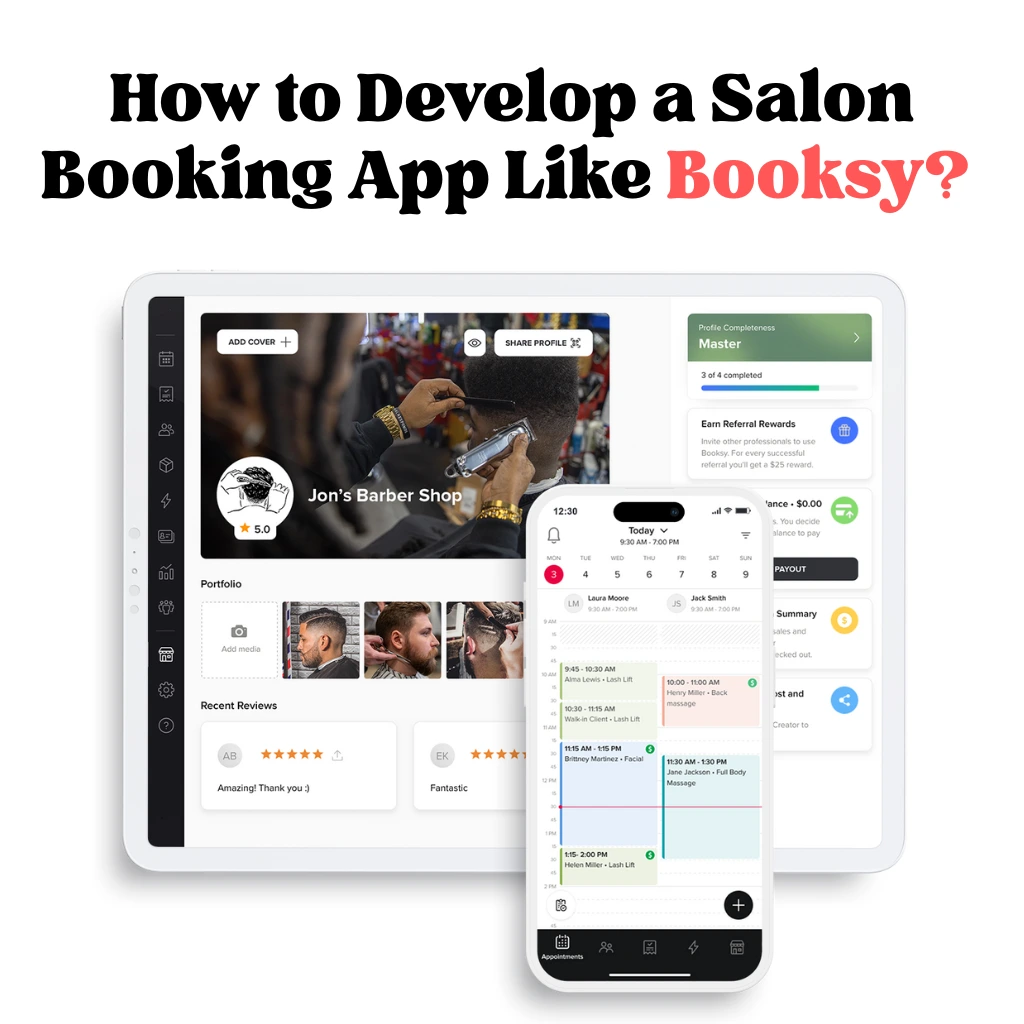
In 2026, the salon and beauty services industry underwent a rapid digital transformation, enabling consumers to make bookings with ease. Booksy has proven that there is room for improvement in niche markets and feature-rich alternatives in this particular area. The booking system, real-time availability features, and salon management tool Janus have transformed how beauty businesses operate and how their clients interact with them.
Here is your entire guide to developing a salon booking mobile app like Booksy. Read more about the essential features and technology suggestions, a step-by-step development process, monetisation models, cost estimates, and so much more. Whether you are an entrepreneur,s a salon chain owner, or a tech start-up, this guide is the one that holds all the necessary insights and strategies to make your dreams come true.
Market Overview and Trends
One expert predicts that the potential expansion of global salon booking apps will cross $700 million in sales by 2026 alone. This increased demand would naturally arise from consumers’ sensitivity toward hygiene and convenience, thereby making digital booking channels hotter than ever. In addition to the main saloon booking system, the Booksy and Fresha chapters also organise quite complicated management solutions to accompany simple appointment scheduling in salons.
More importantly, their growth has brought about a very rapid increase in smartphone penetration, and the move to online or digital solutions for SMEs is accompanied by a strong interest in personal experiences. Consumers do indeed now want immediate access to stylist availability, clear pricing information, and simple appointment bookings – all through an app.
Target users are primarily three broad categories: clients searching for convenience, salon owners eager for operational efficiency, and independent stylists trying to expand their client base. Each of these has a unique need and monetisation opportunity.
Even in quasi-commercial scenarios, entrepreneurs can claim a global niche, leaving ample room for local and niche opportunities. You can give your app a distinct edge by offering complex services, such as mobile salons, multilingual support, or integrated e-commerce for beauty products.
Entrepreneurs who identify their target audience and innovate user experience will find significant opportunities in this growing digital segment.
Essential Features of a Salon Booking App
Design to provide an intuitive and solid working environment for their clients on one hand and salon professionals on the other. Comfortable use begins with a clean, intuitive user interface backed with robust functionality beneficial for every detail in the salon experience.
Core Features
User Registration and Profiles: Allow users to create an account using either an email or social login. Profiles should contain preference settings, appointment history, and payment information.
Search and Discovery: Allow users to find salons or services based on filters such as location, price, speciality services, and ratings.
Service Catalogue: Display services offered by the salon with descriptions, pricing, stylist information, and an estimated time for service.
Booking System: Real-time calendar synchronisation ensures there are no double bookings and presentations of availability are accurate.
In-App Payments: Cashless transactions are secure with integrated payment options through major payment gateways.
Advanced Features
Push Notifications: Periodically send appointment reminders, promotions, or reminders to book again.
Stylist Profiles and Reviews: Encourage the faith of users by providing ratings, comments, and portfolios.
Loyalty Programs and Referral Programs: Encourage return visits with point systems or bonuses for referring friends.
Analytics Dashboard: To help salon owners keep track of bookings, revenue, staff performance, and customer trends.
Marketing Tools: For offering discounts, creating bundled packages, and promoting new services.
The more you mix utility with personalisation, the more your app becomes a full-service digital assistant that helps salons and clients.
Recommended Technology Stack
Simply put, the tech stack determines performance, scalability, and user experience from the very beginning. For instances of a salon booking app like Booksy, below are the best possible technologies:
Front-End Development
For cross-platform mobile development, opt for Flutter or React Native. Rapid iteration, aesthetic efficiency, and a similar user experience across Android and iOS are not a small contribution of these frameworks.
Back-End Development
- Real-time features, such as calendar sync, are best supported by Node.js.
- Ruby on Rails has rapid development capabilities for apps that rely heavily on a database.
- Django (Python) offers easy frameworks for applications where security compliance is paramount and complex admin panels are involved.
Database Management
- PostgreSQL efficiently manages relational data, including user accounts and appointment information.
- MongoDB is useful for holding more flexible data, which may include portfolios of stylists’ or users’ behaviours.
Cloud Infrastructure
AWS, along with Google Cloud Platform, allows well-scalable server hosting, bringing secure storage with automatic backup, whereas services like AWS Lambda or GCP Cloud Functions also help with cost-optimized scaling.
Payment Integration
Almost everyone uses both Stripe and PayPal; however, depending on your customer base, you’ll want to support other local payment gateways like Razorpay (India) or MercadoPago (Latin America).
Additional Integrations
Integrate the Google Maps API for geolocation services, Twilio or Firebase for push notifications and messaging, and Google Analytics for behaviour tracking. Choosing technologies based on scalability, security, and developer familiarity leads to better implementation and simpler future refinements.

Step-by-Step Development Process
Building a salon booking app requires more than just coding from the outset; it necessitates strategic planning and phased approaches to reduce risks and optimise output.
Phase 1: Research & Planning
The core of the salon booking app starts with extensive market research. Analyse competitors, feedback from customers, or trends to find gaps and opportunities. Define the features of your MVP and your unique selling proposition. Set out your budget, milestones for the project, and a feasible timeline.
Phase 2: UI/UX Design
Work out user journeys for clients and salon staff. Create wireframes to achieve a visual understanding of the app layout and flow. Develop interactive prototypes and conduct usability testing for their navigation and functionality refining before development begins.
Phase 3: Development
Use Agile development sprints to manage iterations. Front-end and back-end teams have to work together to develop and integrate calendars, payment gateways, and authentication features. Implement APIs for any third-party services like maps and notifications.
Phase 4: Quality Assurance
This involves testing for functionality, performance, and security. Test for devices, screens, and operating systems. Tests are done in beta mode with a small group of users to get feedback on the real-life application, and amendments are made subsequently.
Phase 5: Launch & Post-Launch Support
Prepare your app for deployment by performing optimisations, such as titles, descriptions, and keywords in the App Store and Play Store (ASO). Continue analysing statistics, user feedback, and crash reports after the launch to provide instructions for any updates. Offer solution-orientated support to help address user concerns while continuously improving the overall experience.
Each of these phases is crucial for manufacturing a product that is reliable and competitive in the market. Missing any steps or rushing through execution often leads to a lot of rework, costing money.
Monetisation Strategies
The creation of a salon booking app goes beyond service delivery – the app is a platform for generating revenue. Here are some monetisation strategies that will allow you to turn your app into an income-generating enterprise:
- Commission-based Model: Charge salons a percentage of every booking made through your platform. This is a widely accepted mode of operation amongst apps such as Booksy, which makes it highly scalable and easy to use.
- Subscription Plans: Create tiered plans for salons, from basic to premium, allowing access to amenities like analytics, marketing tools, or extended booking slots. This kind of model relies on steady revenue and customer commitment.
- Premium Listings: Give salons the option to pay for a premier placement in search results. This increases their visibility, driving higher booking potential.
- In-App Advertising: Partner with beauty brands or local vendors for ads targeting your user base. Ensure the relevance and minimalism of these ads to prevent any negative impact on the user experience.
- Add-On Services: Let users elevate their experience with priority booking, limited stylist access, or home services. This upsell can improve average order value significantly.
- Data Insights & Reports: Provide salon owners with high-end business intelligence tools for a fee every month. Visual dashboards, customer behaviour reports, and forecasting tools are all things that could be extremely beneficial for them.
The best avenue usually combines more than one strategy in more flexible ways to meet the needs of different user segments.
Development Cost & Influencing Factors
The cost of developing a salon booking app like Booksy depends on multiple variables such as feature complexity, design sophistication, integration requirements, and the location of your development team.
Here’s a general breakdown:
- UI/UX Design: $5,000–$15,000
- Development (MVP): $30,000–$70,000
- Testing & QA: $5,000–$10,000
- Deployment & Maintenance: $5,000+
Total Estimated Budget: $40,000–$100,000+
You have to factor in many costs that vary depending on whether it is a native application (one for iOS and the other for Android) and whether it is a cross-platform application such as Flutter. Advanced technical features such as real-time analytics, payment gateways, and multi-location support draw much of the budget.
You can save money and not compromise quality by outsourcing the office development to expert hands in Eastern Europe or South Asia. The phased approach, starting with MVP and building upon it, is great in resource management and risk.
Common Challenges & Solutions
Developing a salon booking app is an exciting journey, but it also presents significant challenges that ultimately determine its sustainability.
- Real-time booking conflicts: Without proper calendar integration and buffer time logic, double bookings could occur. Two-way sync with either Google or Apple calendars and lock time slots upon selection.
- Data Security: Users share personal and payment data, making GDPR compliance, SSL encryption, and tokenised payments a must. Privy has designed their structure from day one.
- User retention: Downloading it doesn’t mean they will use it for a long time. Loyalty programs, personalised offers, and seamless rebooking flows can keep users engaged with the app.
- Scalability: There might be performance glitches with the increasing number of users. Scalability would require cloud services with auto-scaling, sturdy database capabilities, and performance monitoring tools.
Addressing the above at the early stages will ensure your app is swift, secure, and friendly to users, even through expansion.
Why Choose Esferasoft for Your Salon Booking App?
Esferasoft is a leading provider of development services for entrepreneurs and enterprises planning to create booking applications, particularly those that are high-performing and user-centric. Building efficient software solutions for wellness and on-demand industries is what our company specialises in. Our proficient team has plenty of experience on platforms, such as Booksy.
We cover the whole lifespan of development – from product discovery and UI/UX design to scalable backend development, as well as post-launch support. We offer our deep technological expertise and market experience, regardless of whether you are starting with an MVP or a fully loaded platform.
Our clients rave about us for our seamless processes, timely delivery, and infectiously high-quality service. Our portfolio features successful applications like real-time bookings, dashboards for multi-user in-app payments, and personalised analytics tailored to fit specific business goals.
You’ll have a dedicated team that regularly communicates, prioritises milestones, and provides ongoing support.
The Future Is Booked: Your Salon App Journey Starts Here
The salon booking business is on the rise, and the existence of such platforms as Booksy has already demonstrated the demand for digital solutions capable of heightening convenience and streamlining salon operations. A feature-packed, user-friendly app can help your nascent business thrive in this growing market.
From the very beginning of the app development process to the end, covering areas such as ideation, tech stack planning, monetisation, and support, every stage is important. This guide has walked you through a few critical steps, so you can proceed feeling clear and confident.
Ready to turn your idea into a market-leading app? [Contact us now at +91 772-3000-038] to start your project consultation today.
