
Today, we are living in a digital-first world where mobile experiences become the best definition of what users really want. And it’s under this form that Augmented Reality (AR) starts to rise as the most potent driving force for innovation in any mobile app. AR does just that: it incorporates the digital with the physical world and brings immersive experiences just using smartphones and tablets—rather than requiring special devices such as VR headsets.
What exactly is Augmented Reality (AR)? It augments the real-world environment by overlaying virtual elements—images, sounds, or information—on top of it. In contrast with VR, which is taking you out of your surroundings, AR complements what you already see. A good example would be Pokémon GO or Snapchat filters – both are very well-known in the world of AR.
The Rise of AR in the Mobile Application Sector
Starting at $14.7 billion in 2020, the AR market is expected to exceed $88 billion by 2025. While a large part of this growth will be enabled by augmented reality in mobile apps, AR is becoming an everyday phenomenon in commerce, education, navigation, and enterprise solutions, thanks to the increasing power of smartphones and the sophistication of camera technology.
Key sectors will adopt AR:
- Retail: Virtual try-ons and product previews.
- Education: Interactive content for more profound learning.
- Real Estate: AR walkthroughs and staging of homes.
- Gaming & Entertainment: Immersive gameplay and storytelling.
- Health Industries: AR training, diagnostics, and assistance.
Need to explore AR integration for your industry? [Talk to our team].
Benefits of Adding AR Mobile Apps Features
No investment in augmented reality is nothing more than a fad; rather, it generates legit profits through augmenting business value.
Facilitated User Engagement
AR has turned an experience into engagement for app usage instead of a passive consumption experience, making it difficult for users to go away from the app. More importantly, engaged users are more likely to convert, share, and return.
Memorable Brand Experiences to Enhance Recall
AR creates meaningful brand experiences, whether someone is trying on the shade of a lipstick or exploring a 3D model of a certain car. This, in turn, contributes to brand retention and fosters customer loyalty.
Realistic Visualization and Personalization
Users can visually experience a piece of furniture being placed in te living room or modify features of their desired product in real time. Such AR mobile app features boost confidence around purchasing and hence lower returns, which are crucial for eCommerce.
Differentiation from the Competition
The first players who adopt AR are sure to get a large competitive lead, and they will have shown innovation and responsiveness to user expectations.
Do you wish to increase user interaction with AR? [Let’s build your roadmap].
Popular Use Cases of AR in Mobile Apps
AR is flexible and adapts perfectly to all kinds of businesses. Here are a few real-world applications that are just as intriguing:
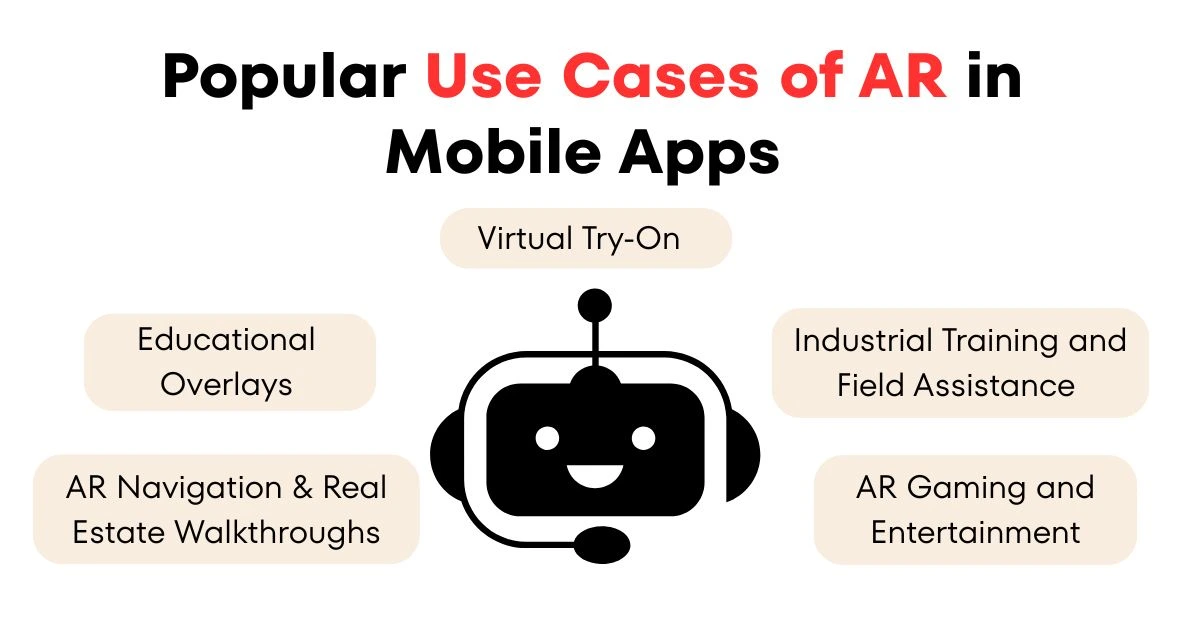
Virtual Try-On
L’Oréal and Warby Parker use AR to allow the user to virtually try on makeup, glasses, or clothing, which increases conversion rates and avoids returns.
AR Navigation & Real Estate Walkthroughs
Apps like Google Maps Live View use augmented reality to provide navigation overlays. Real estate apps offer interactive home tours without having to step inside the property.
Educational Overlays
Fun learning through augmented reality. Applications such as Merge EDU are turning classrooms into live environments that make history, science, or geography come alive.
AR Gaming and Entertainment
Augmented-reality games such as Pokémon GO and Harry Potter: Wizards Unite have made exercise truly come alive with the virtual worlds. Future titles can be expected to carry even deeper narratives and more spatial interaction.
Industrial Training and Field Assistance
AR provides step-by-step guides, overlays, and live instruction to increase productivity and reduce errors in Manufacturing and Healthcare.
Have an innovative use case in mind? [Validate it with our experts].
Types of AR Technologies Used in Mobile Apps
AR tech stack understanding helps make informed decisions.
Marker-Based AR
The system requires predefined visual markers, both QR codes and images; the common use of the technology is print advertising and packaging.
Markerless (Location-Based) AR
The technology primarily depends on GPS, accelerometers, and compasses bearing virtual context in real life; it is most useful in travel and outdoor activities as well as city tours.
Projection-Based AR
It’s often used in museums or very high-end shops; it projects light onto surfaces and detects human interaction.
SLAM (Simultaneous Localization and Mapping)
It builds a map of an environment while tracking the device’s location; it is especially important for precise, instantaneous overlays in complicated or indoor settings.
Face and Gesture Tracking
Beauty apps, as well as some gaming and social filter applications, use this technology to track face movements.
Not sure which AR type suits your needs? [Let’s figure it out together].
Tools and SDKs for AR Mobile App Development
The right AR app development tools will make a marked difference in the accomplishment of your AR application.
ARKit (iOS)
Apple’s AR SDK is known for its features like plane detection, motion tracking, face tracking, and lightning estimation. It’s tailored mainly for iPhone- or iPad-specific applications.
ARCore (Android)
AR-rich applications hosted on the Android platform are run on this Google-powered mobile engine, which boasts support for motion tracking, environmental understanding, and light estimation.
Unity + Vuforia
This combo satisfies cross-platform apps with the highest supplies for 3D models, image recognition, and SLAM.
WebAR platforms like 8th Wall allow users to experience all AR in the browser—there is no need to download an app. Spark AR is also a popular place for social filters (Instagram, Facebook).
How Esferasoft Chooses the Right Tech Stack
We have analysed your target audiences, budgets, platform choices, and use cases for AR to select the most effective SDKs and frameworks for scale and performance.
Need help choosing tools? [Book a tech consultation with our team].
Development Process for AR-Enabled Mobile Apps
All it takes to create a good-quality augmented reality experience is not just the programming.
Ideation and Validation of the Use Case
We brainstorm AR experiences that help users derive real value, anchoring all of this with a deep dive into your business goals.
UI/UX planning for AR interaction
Intuitive gesturing, visual cues, and responsive environments are what underlie AR interfaces. Thus, from the very outset, we create immersive and friendly user interactions.
3D Modeling and Content Creation
These are critical for making any experience realistic. We create/supply optimised, lightweight 3D models optimised and designed for performance on mobile devices.
SDK Integration and Backend configuration
Whether it is ARKit or Unity, free and easy ties to your app architecture – via real-time data, analytics or even eCommerce systems – come with SDK integration.
Testing Under Different Environmental Conditions
We do this to ensure stability, latency, and visual consistency. We ensure that testing is done across devices, lighting conditions, and network scenarios.
Are you in search of a partner in development that holds end-to-end expertise? We’re all set.
Challenges in AR Mobile App Development
While experiencing AR is thrilling, it does have some drawbacks.
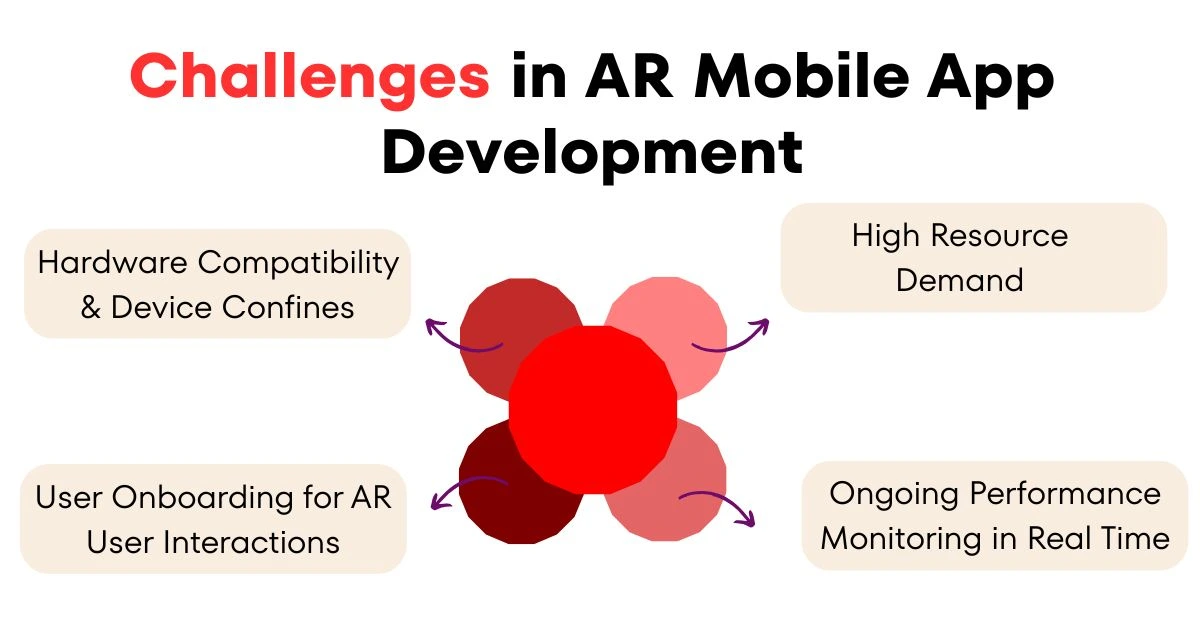
Hardware Compatibility & Device Confines
Previous models could not be armoured with adequate processing power or sensor input for AR functions. Graceful fallbacks help ensure accessibility.
High Resource Demand:
AR blows CPU/GPU power caps off. We optimise every asset for indelible performance and minimal power consumption.
User Onboarding for AR User Interactions:
AR is not always intuitive for users. Our UX team designs onboarding tutorials and in-app guidance to help people understand AR mobile app features.
Ongoing Performance Monitoring in Real Time:
Performance is continuously profiled, and even with complex interactions, the response is real-time, ensuring minimum lag.
Are you concerned about tech constraints? [Let’s assess your app’s readiness].
Cost Breakdown for AR Mobile App Development
Understanding the AR development cost drivers can help you plan better.
Factors Affecting Cost
- Platform (iOS/Android/WebAR)
- Complexity of AR features
- Custom 3D asset creation
- Backend integrations
- SLAM or advanced gesture tracking needs
Estimated Cost Ranges
- Basic AR Filters/Try-Ons: $10,000–$25,000
- AR Navigation/Walkthroughs: $25,000–$50,000
- Advanced AR Games or Enterprise Tools: $50,000–$150,000+
Cost-Saving Approaches
Using pre-built libraries, 3D asset marketplaces, or web-based AR can significantly reduce development time and cost.
Need a detailed quote? [Request a personalised estimate now].
How Esferasoft Helps Build Future-Ready AR Mobile Apps
At Esferasoft, we’re not just developers—we’re AR problem-solvers.
Expertise in Cross-Platform AR App Development
We bring years of experience building iOS, Android, and WebAR solutions that perform at scale.
Use of Best-in-Class AR SDKs & Tools
Our team works with Unity, ARKit, ARCore, Vuforia, and 8th Wall—selecting the right tools for your unique needs.
Support from Concept to Post-Launch
From ideation to post-launch analytics, we walk with you at every step—ensuring your app evolves as your business grows.
Sample Case Study
We helped a leading eyewear brand launch an AR try-on feature that increased user session time by 38% and conversion rates by 22% within 3 months of launch.
Want similar results? [Schedule your free AR prototype demo].
Conclusion: AR Is No Longer Optional—It’s a Growth Catalyst
Augmented Reality (AR) is no longer a novelty imagined for the future. Today, it is a strategic weapon that engages, immerses, and entertains users by personalising their experiences with mobile applications. From retail to education and enterprise training, AR is already evolving industries—and its scope continues to grow.
Why AR Matters Now
In the fight for mobile real estate, augmented reality in mobile apps enables companies to make deeper connections with users, enjoy higher conversions, and create unforgettable customer journeys. Studies show that AR features can create 2-3 times the engagement, upwards of a 40% increase in conversion rates, and far better brand recollection.
Hence, all the more reason why now is simply the best time to invest in AR solutions that are ready for the future, with mobile devices becoming more AR-capable while development is made easy with frameworks like ARKit, ARCore, and WebAR.
How Esferasoft Helps You Stay Ahead
Is Esferasoft helping out with how to stay ahead in the competition?
We at Esferasoft combine strategic thinking with technology know-how to enable businesses to fully harness AR’s potential. From concept validation through scalable development to post-release support, we deliver solutions that are in alignment with your aspirations and user expectations.
Whether it’s a simple AR trial feature or a complicated SLAM-based enterprise app, we customise each project to help maximise ROI along with long-term value.
AR is shaping the future of mobile apps. Let’s build something extraordinary—together.
[Start your AR development journey with Esferasoft; call now at +91 772-3000-038].