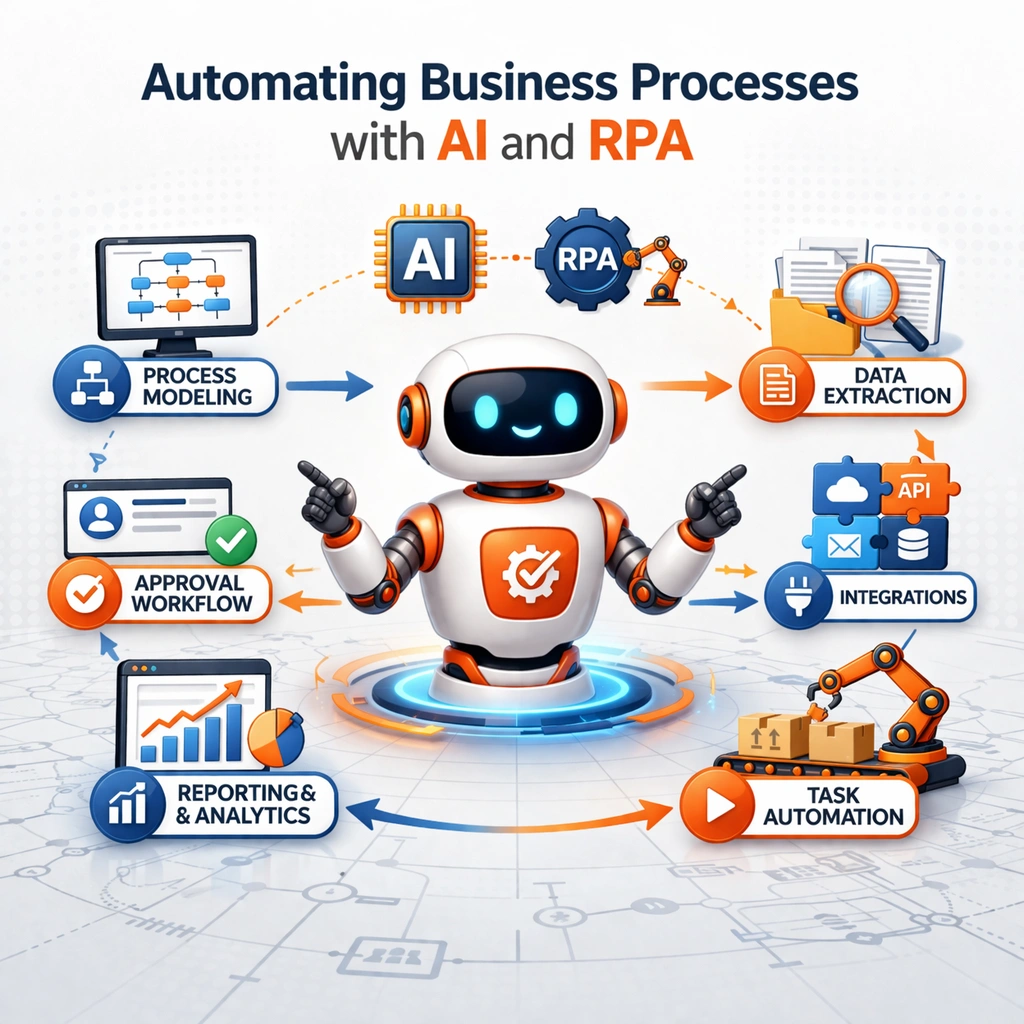
Businesses, whether small or large, are consistently looking for ways to work smarter, but not in a harder way, in today’s fast-paced digital landscape. However, the two transformative technologies (AI) & (RPA) are setting the trend and reshaping the working structure of the organizations. If you are curious about how businesses can enhance their operations through AI and RPA Automation, read this comprehensive guide as we uncover some relevant insights that can revolutionize businesses in the modern age in terms of sustainable growth, automated processes, and efficiency. Let’s get started!
What AI and RPA Mean for Modern Business Operations
The current business environment demands that organizations deliver immediate results while working with their limited resources. All types of businesses now use AI and RPA technologies as their transformational tools for operational improvement. The technological systems provide businesses with direct methods to improve their operational efficiency and achieve higher productivity levels. So, let’s understand what exactly these technologies are:
RPA uses software robots or “bots” that function as digital workers to perform repetitive tasks that follow specific rules. The RPA system operates as a digital workforce that runs continuously without taking breaks to deliver tasks with complete accuracy. The bots operate across various systems by accessing applications to perform login tasks while they transfer files, extract data, fill forms, and carry out their regular duties.
AI enables machine automation through its ability to perform cognitive functions. AI systems acquire knowledge from information through their ability to recognize patterns, make decisions, and understand human language. AI technology enables organizations to manage unstructured data while delivering intelligent business insights through its ability to learn new information.
The advanced technologies create AI-powered workflow automation solutions, which experts describe as systems that combine basic task management with advanced decision-making capabilities. The agency that uses these solutions achieves 25-50% cost reductions and faster processing times and maintains human resources at 99% accuracy for strategic work.
The impact spreads throughout various economic sectors. Financial institutions use AI-powered RPA systems to detect fraudulent activities during the loan application process. The automated patient scheduling system of healthcare organizations streamlines their operations, while their claims processing system uses automated technology.
Key Differences Between Robotic Process Automation and Artificial Intelligence
The two technologies of artificial intelligence and robotic process automation work together, yet organizations need to comprehend their separate characteristics to achieve successful implementation.
-
RPA operates on predetermined rules and logic.
The system executes business process automation with AI according to its predefined operational rules and its technical system framework. RPA works best when it moves data from emails to spreadsheets, processes invoices according to set rules, and updates customer information across multiple systems.
Also, RPA bots execute tasks by following if-then statements, which require them to perform task B after condition A is met. The system produces identical results when presented with identical input because it follows a deterministic design.
-
AI contributes to learning and adaptability.
The adaptive learning function of AI systems enables them to acquire new abilities, which create a base learning capacity. Machine learning algorithms can identify patterns in historical data and improve their performance over time. Natural language processing technology allows artificial intelligence to understand human speech and writing. Computer vision enables artificial intelligence systems to understand visual material and textual content. AI systems operate beyond RPA (Robotic Process Automation) capabilities because they can process ambiguous situations and analyze unstructured content, which includes emails, social media content, and scanned documents.
-
Deployment timelines can be measured in weeks.
The implementation process presents two distinct routes that organizations can take. RPA typically requires less technical expertise to deploy. Business users can build automation workflows through many RPA platforms, which provide low-code or no-code interfaces that do not require programming expertise.
The system needs weeks to complete its deployment procedure. Organizations need both data science expertise and extended training data, plus extended development time for their AI implementation process. The learning process of AI systems transforms them into more valuable assets, while RPA (Robotic Process Automation) technology maintains its existing operational capabilities, which means it automates routine tasks without changing its core functions.
-
Cost considerations vary, too.
The funding requirements exhibit two separate financial patterns. RPA projects need less initial funding, which results in a rapid return on investment for their implementation. AI projects demand substantial initial investment to build infrastructure, hire talent, and create data, but they deliver superior long-term benefits because of their adaptive intelligence capabilities.
The optimal outcome occurs when both elements collaborate effectively. RPA needs handling because it performs all tasks that depend on established rules, while AI handles machine operations for difficult decision-making procedures.
Business Processes That Can Be Automated First
While AI and RPA complement each other, enterprises can effectively deploy them by understanding their unique characteristics.
-
Data Entry and Migration
This business tops the chart as employees spend long hours transferring data between systems while working manually. So, it’s a perfect candidate for RPA, which stands for Robotic Process Automation, a technology that uses software robots to automate repetitive tasks. Chatbots can easily fetch data from emails, documents, or databases and boost system efficiency with 100% accuracy, working 24/7 hassle-free.
-
Invoice Processing
This approach, along with accounts payable (the department responsible for managing a company’s outgoing payments), offers immediate ROI (return on investment) to businesses. On the other end, traditional invoice processing includes receiving invoices, extracting information from them, flagging exceptions, and managing payment workflows.
-
Customer Service and Support
The entire customer service and support operation benefits from intelligent process automation, which brings about substantial advantages to their business operations. The AI chatbots manage basic questions by directing customers through the process of fixing problems, while they solve complex situations through their explanations for human agents. RPA technology enables backend systems to retrieve account information, handle customer requests, and conduct record updates during the waiting time.
-
HR Onboarding and Offboarding
The process requires multiple instances of creating user accounts and assigning equipment, scheduling training, and setting up access rights. The RPA solution handles business tasks through automatic operational execution, which prevents both operational failures and the extended time required to complete onboarding from taking multiple days.
-
Report Generation
Departmental operations spend excessive time on creating reports. The bots can gather data from different sources and process it to produce formatted reports, which will be delivered to stakeholders according to their scheduled delivery times—this process changes from taking multiple hours to complete into a task that needs only a few minutes.
The identification of processes should begin with operations that present high-volume workloads that require adherence to established rules and consume extensive time while having few exceptions. The organization can achieve immediate benefits through these low-hanging fruit opportunities, which will help build confidence and provide funding for future automation projects.
How AI Enhances Traditional RPA Workflows
RPA excels at structured tasks, and adding AI capabilities turns outstanding automation into exceptional intelligent automation. However, handling unstructured data represents AI’s most significant contribution. Also, traditional RPA struggles with variations in different invoice formats, handwritten notes, or emails with an irrelevant structure. AI-powered optical character recognition (OCR) and NLP (natural language processing) enable bots to easily extract meaning from diverse formats, understanding context instead of just following rigid templates.
Decision-Making and Judgment Calls
The process of making decisions now uses AI assistants instead of complete human operation. The loan approval process uses traditional RPA to gather application details while AI evaluates credit data by finding patterns, which it uses to calculate risk and decide on loan approval. The bot processes the application through AI-based intelligence and RPA-based speed of execution.
Predictive Abilities
This approach enables agencies to use predictive capabilities to shift their operations from reactive to proactive mode. AI examines previous data to estimate future demand, equipment breakdowns, and customer turn rates. RPA carries out automatic safety measures through its system, which includes inventory restocking, machine maintenance planning, and customer retention activity initiation.
Continuous Learning and Improvement
AI-powered systems use their continuous learning ability to reach advanced levels of operational performance. AI systems achieve better accuracy when they process greater amounts of data. The document processing bot develops better skills to manage different document types. The customer service system uses successful customer interactions as a learning tool to create better future responses.
Exception Handling
The process of handling exceptions now uses intelligent methods instead of fixed solutions. The system will enter alert mode when it detects an unforeseen situation. AI systems use exception analysis to evaluate whether exceptions meet designated standards, which they use to decide between autonomous handling and expert-based solution methods.
Natural Language Interaction (NLP)
This enables users to operate automation systems without specialized training. Users can use ordinary language to show the activities they want to automate instead of having to build workflows. AI shows RPA bots their operational tasks through intent interpretation, which enables all employees to build automated systems.
The two elements together create exponential value through RPA’s dependable and fast operation, which works with AI’s flexible and intelligent systems to automate repetitive tasks using AI eventually exceeding human performance capabilities.
Building an Automation Roadmap for Your Company
Random automation creates chaos, as strategic automation brings a competitive edge. Thus, your roadmap needs three major phases, as stated:
Phase 1. Quick Wins
This phase focuses on achieving quick wins that can have an immediate impact. Just think automated reporting, simple data transfers, and email workflow. Such early victories build stakeholder confidence and fund future projects.
Phase 2. Core Operations
This tackles department-level processes such as customer service routing, inventory management, and even HR workflows. This phase requires cross-functional collaboration and change management.
Phase 3: Strategic Transformation
This phase involves completely redesigning business models, using predictive maintenance systems that analyze data to foresee equipment breakdowns, creating customer experiences driven by AI, and optimizing supply chains automatically with technology, eliminating the need for human involvement.
Also, keep in mind this roadmap checklist
- Prioritize by ROI and execution complexity
- Assign clear ownership and accountability
- Set measurable milestones
- Assign a budget for tools, training, and talent
Note: Your roadmap is not permanent. Market conditions shift, technologies evolve, and business priorities change. Please review it every quarter and make adjustments as needed
Measuring Productivity Gains and Operational Efficiency
Measuring the RPA workflow automation ROI requires looking beyond simple time savings. But it’s better to track these key characteristics:
- The formula Time Reclaimed calculates savings through hours saved multiplied by the hourly cost. The next step requires you to observe how workers use their recovered time. The situation remains unresolved because workers continue to find inefficient methods
- Manual data entry reaches an error range between 1 and 5 percent. The accuracy of automated processes reaches more than 99.9 percent. The reduction of errors results in decreased customer complaints, decreased need for rework, and decreased compliance risks.
- The automation system performs tasks at a speed that exceeds human capabilities by between 5 and 10 times. Rapid results lead to direct revenue consequences for operations, which need immediate solutions such as fraud detection and customer service.
- The measurement of employee happiness requires both survey results and employee retention statistics. Teams that receive freedom from tedious work demonstrate better dedication and decreased employee departures.
The customer experience metrics show that quicker response times, together with customized customer interactions and round-the-clock service, lead to improvements in NPS and CSAT scores.
The formula for real ROI calculates net benefit by subtracting implementation costs and ongoing maintenance from cost savings, revenue gains, and risk reduction.
Security, Compliance, and Data Handling in Automated Workflows
The speed of AI and RPA automation exceeds the speed of security breaches, while automated
We should design processes with security in mind.
The non-negotiables:
- Access Controls: Implement role-based permissions with least-privilege principles. Your marketing automation system should not have access to financial system resources.
- Encryption: All data requires protection during both its transmission phase and its storage phase. No exceptions, no excuses.
- Audit Trails: The system requires complete logging of every automated action to record who activated it, which data elements were accessed, and which system elements were modified. This logging is essential for tracking changes and ensuring accountability. Organizations must fulfill this requirement for both GDPR and SOX compliance purposes.
- Data Governance: Where does automation-collected data live? Who owns it? What is the duration of its retention period? The organization must provide answers to these questions before proceeding to operational workflow execution.
- Vendor Due Diligence: Third-party automation tools access your systems. Verify their SOC 2 compliance, data residency policies, and breach response procedures.
- Human Oversight: Full automation does not serve as the best option for every situation. Human checkpoints should exist in critical decision-making processes, which include credit approvals, medical diagnoses, and legal determinations.
The biggest mistake? People believe that security responsibilities belong entirely to cloud providers. The cloud provider secures infrastructure, while you are responsible for securing your data and access and usage controls.
Regular security audits aren’t optional. The quarterly review process identifies configuration drift issues before they develop into serious breaches, which make news headlines.
Common Implementation Challenges and How to Overcome Them
Even well-versed automation processes halt and encounter multiple challenges. So, anticipating the most common AI-powered workflow automation challenges and preparing mitigation strategies likewise boosts the success probability. Please have a look:
Challenge 1. Resistance to Change
The employees fear that their jobs will disappear because of automation. The resulting anxiety causes employees to stop working together and to fight against their assigned tasks.
Key Solution
The organization needs to explain the role of automation technology, which will help workers complete their tasks instead of taking their jobs. The organization needs to involve employees in the automation process from the beginning. The organization needs to show employees how they can advance their careers through higher-value work. The organization should recognize employees who have successfully transitioned into positions that require higher-level strategic work. The company should provide training in advance to help workers acquire the necessary skills for future automated environments.
Challenge 2: Underestimating Complexity
Initial assessments fail to identify edge cases and system dependencies together with integration challenges, which causes projects to extend their timelines and exceed their allocated budgets.
Key Solution
<p>Conduct a thorough process discovery, including all variations and exceptions. The organization requires all teams to create formal documentation that defines all their different process variations. The organization needs to create backup plans that will protect against unexpected events that can delay project timelines and budget requirements. The organization should use pilot projects to learn which methods are effective before they expand their operations.
Challenge 3: Poor Process Documentation
The existing employee knowledge about operational procedures makes it impossible to create automated processes because there are no documented procedures.
Key Solution
The organization needs to dedicate time to process discovery together with documentation work before they start developing its automation system. Process owners and performers must participate in the documentation creation process. The existing documentation process will reveal opportunities for process improvement, which organizations should optimize before they start their automation work.
Challenge 5: Lack of Governance
Departmental teams develop automations that don’t work together, and their duplicate work results in security holes because there’s no central coordination.
Key Solution
The company needs to create a Center of Excellence, which will define operational standards while they work together on various projects. The organization needs to create reusable components that can help speed up its product development process while maintaining product consistency. The organization requires all new automation projects to undergo approval processes before they can proceed. The organization requires all new architectural designs to undergo architectural examinations before the production process can start.
Every company should analyze its implementation process to gain operational insights through active post-deployment evaluation, which includes all operational evaluations together with success stories, all challenges they faced, future improvement areas, and all lessons learned. All in all, organizations that employ learning accelerate automation maturity.
Conclusion
Last but not least, automating business processes with AI and RPA represents one of the most significant opportunities for competitive advantage in today’s digital economy. Companies that successfully execute intelligent automation reduce costs and accelerate operations. Improve quality and free employees to focus on smart innovation and strategic initiatives. Success requires more than technology deployment. The process needs strategic vision and thoughtful planning, stakeholder engagement, robust governance, and continuous improvement dedication. Organizations should begin with their business goals and select their operational methods, system connections, and performance assessment methods to create a system that learns from its achievements and failures.
FAQS
What are AI and RPA in business process automation?
AI (Artificial Intelligence) uses human intelligence to learn from data and establish patterns, which it uses to make choices. The software robots of RPA (Robotic Process Automation) execute tasks that they repeat according to established rules. The two systems function together to automate workflows because RPA takes care of normal duties while AI supplies the intelligence needed for challenging decision-making tasks.
How does robotic process automation differ from artificial intelligence?
RPA executes its tasks according to established procedures, which it follows in a step-by-step manner that resembles following a cooking formula. The AI system uses its data-based learning ability to create predictions while managing different scenarios. RPA functions as an assistant who completes tasks with perfect accuracy throughout all periods, while intelligent process automation operates as the solution finder who determines appropriate actions during unexpected events.
Which business processes are best suited for AI and RPA automation?
RPA operates best with these functions: The tasks of processing invoices, entering data and generating reports, onboarding employees, and resetting passwords all require RPA.
AI functions perfectly for these tasks: These tasks include customer sentiment analysis, fraud detection, demand prediction, document classification, and chatbot conversation management.
Both systems operate best with these functions: These functions include the processing of claims, managing customer service operations, and enhancing supply chain operations.
Can AI and RPA work together in the same workflow?.
The answer is yes! Intelligent Automation uses this combination because it possesses strong capabilities. RPA bots gather invoice information, while AI verifies the information and sorts it, and RPA sends it for approval. The system uses AI for intelligent processing and RPA for operational work. The two systems work together to complete processes that require both intelligent thinking and physical execution.
How does automation improve operational efficiency in organizations?
Automated systems provide organizations with three main benefits, which include faster procedures, more precise results, and reduced operational expenses. The bots operate continuously throughout the day, which enables them to complete tasks without interruptions, and they maintain accuracy in performing repetitive functions.
The employees of the company now focus on important strategic initiatives instead of doing basic repetitive tasks. The outcome resulted in operational costs decreasing by 30–50 percent, processing times decreasing by 80 percent, and team members becoming more satisfied with their work.
What industries benefit most from AI and RPA adoption?
The banking and finance industry depends on RPA for loan processing, compliance verification, and fraud detection purposes
The healthcare industry depends on RPA for the processing of insurance claims, the scheduling of doctor appointments, and the management of patient information.
The retail industry depends on RPA for inventory control, order handling, and customer support activities.
The manufacturing sector uses RPA for supply chain management, quality assurance, and preventive maintenance tasks.
The insurance industry implements RPA for the processing of claims, the assessment of risks,, and the management of insurance policies.
How long does it take to implement an AI and RPA solution?
RPA projects that require basic functions will take 2 to 6 weeks to complete. The implementation of RPA systems with complicated operational processes requires 2 to 4 months. The development of AI-powered solutions takes between three and six months. The process of transforming an entire company will take between 6 months and more than 12 months.
The initial steps of a business should begin with a small pilot project, which will demonstrate ROI before expanding further. The organization uses quick wins to create momentum, which builds stakeholder trust in their abilities.
Do you need relevant coding knowledge to deploy RPA tools?
Modern RPA platforms such as UiPath Automation Anywhere and Blue Prism offer users low-code and no-code interfaces that operate through simple drag-and-drop features. Developers can build basic bots. The coding skills of Python and .NET enable users to solve complex problems, implement custom integrations, and conduct advanced troubleshooting.
How does AI help RPA handle unstructured data like emails and documents?
AI technologies bridge this gap by employing the following methods:
- NLP (Natural Language Processing) reads and understands email content, extracting intent and key information
- OCR (Optical Character Recognition) converts scanned documents and images into machine-readable text
- Machine Learning automatically classifies documents, invoices, and forms
- RPA, or Robotic Process Automation, uses this structured data to perform actions while building complete automated processes.
What are the security risks associated with process automation?
The primary risks include:
Credential exposure: Bots storing passwords insecurely
Unauthorized access: Bots with excessive privileges
Data breaches: Sensitive information in automation logs
Compliance violations: Bots bypassing approval workflows
The agency must use credential vaults to implement role-based access control, data encryption, audit trail creation, and ensure regulatory compliance with GDPR and HIPAA.
How can companies measure ROI from AI and RPA projects?
You can calculate ROI using these parameters:
Cost Savings: Labor hours saved multiplied by the hourly cost
Time Savings: Process duration reduction multiplied by the volume
Error Reduction: Fewer mistakes = lower rework costs
Productivity Gains: Employees redirected to higher-value work
Use this formula: ROI = (Benefits – Costs) / Costs x 100.
Also, you can monitor metrics such as processing time, accuracy rates, cost per transaction, and employee satisfaction for a detailed ROI.
What are the common challenges during automation implementation?
When you implement automation, certain critical challenges arise; a few of them are listed:
Challenge 1: Selection of process- Streamlining the wrong processes first
Challenge 2. Change resistance- Employees fearing job loss
Challenge 3. Lack of governance- No clear ownership or standards.
Challenge 4. Integration problems- Scale success not translating enterprise-wide
Challenge 5. Unrealistic expectations- Expecting an overnight transformation
Bonus Tip: Start with clear goals, engage stakeholders early, and establish a center of excellence for governance.