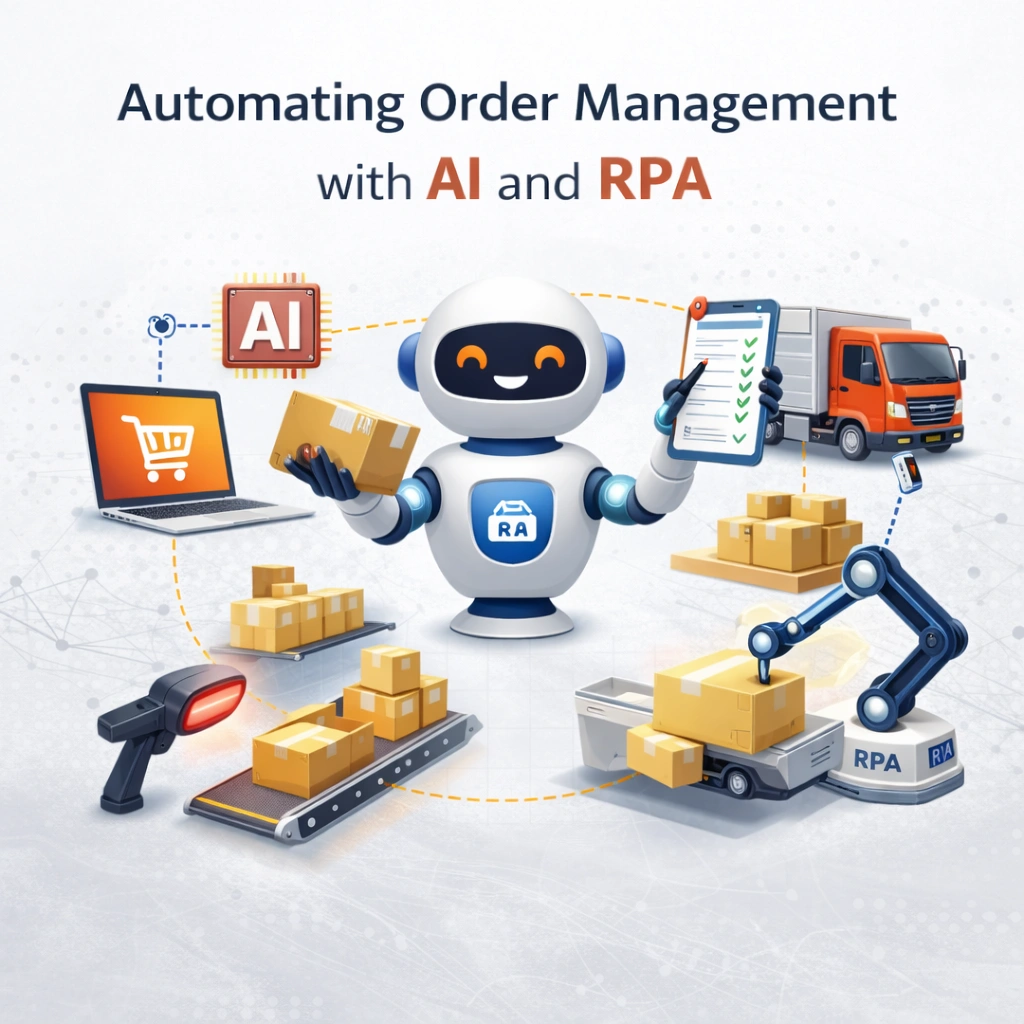
The business world of today requires fast delivery because customers need their products delivered on time, while companies need to match their delivery performance with customer demands through accurate and affordable order fulfillment. This is where an AI-powered order management system comes into play, as it makes the overall procedure more efficient and helps companies achieve better workflow outcomes.
The ultimate combination of Artificial Intelligence (AI) and Robotic Process Automation (RPA) technologies establishes a contemporary order management system that replaces outdated operational methods. The combination of AI technology for predictive purposes, along with its ability to handle routine tasks, enables companies to enhance both their operational performance and customer satisfaction levels.
This blog post will explain the benefits of AI and RPA for order management while showing why traditional systems do not meet current needs and how businesses can successfully implement these technologies. Organizations of all sizes, from small businesses to large enterprises, can gain a competitive advantage. The implementation of AI and RPA technologies for order management provides a significant market advantage.
What is Order Management?
The order management system controls the complete process, which starts with customer order entry and continues through all steps until the order delivery reaches its final destination. The process involves multiple stages, which begin with order placement and continue through the final delivery of products. The traditional order management system requires businesses to complete all operational tasks at high speed while maintaining proper inventory levels and delivering products to customers according to their scheduled order times.
The procedure requires different departments to work together because they need sales, warehousing, logistics, and customer service teams to function properly. Inventory management Automation systems provide advantages to businesses, but their operational efficiency is restricted because they fail to meet current business requirements, which results in customer service issues.
The rising complexity of global supply chains, customer requests for quicker delivery, and the rise of multi-channel sales require companies to implement new order management systems because traditional systems become insufficient. The business needs a system that combines data from different sources while automating manual tasks to create processes that provide real-time order delivery updates for continuous operational performance.
Why Traditional Order Management Can Be Inefficient
As the studies show, traditional order management heavily relies on manual processes and other systems, which most often result in inefficiencies like human error, a lack of real-time visibility, slow processing times, and siloed systems. Let’s explain all these pointers one by one.
|
Reasons |
Description |
|
Human Error |
Manual data entry is time-consuming, and processing is prone to mistakes, leading to inappropriate orders, poor inventory, and delivery delays with an irrelevant customer experience. |
|
Lack of Real-Time Visibility |
Traditional systems might not provide real-time data on inventory, shipments, and, more importantly, order status, making it difficult to monitor the order lifecycle. |
|
Slow Processing Time |
Order handling manually can be hectic and incur longer processing times, resulting in delayed shipments and leaving customers in frustration. |
|
Siloed Systems |
A normal order management system often operates in silos, making it difficult for teams to collaborate and share valuable data such as customer preferences, inventory levels, and order status. |
The rising customer expectations and the increasing complexity of worldwide supply chains demonstrate that traditional order management systems lack the capacity to meet current business demands. The solution to this problem lies in the business transformation with AI and RPA technologies, which provide organizations with tools to enhance operational efficiency while creating resilient order management systems for future challenges.
Understanding AI and RPA
The examination of AI and RPA benefits for order management requires first understanding the operational details of these two technological systems.
Artificial Intelligence (AI)
AI refers to machines or software systems that can simulate human intelligence. AI systems possess the capability to conduct multiple operational activities, which include learning, reasoning, problem-solving, and decision-making processes. The order management system utilizes AI technology to examine extensive data sets, which produce trend forecasts and operational insights that enhance business decision-making capabilities.
AI technology enhances customer experiences through its ability to create personalized product recommendations and provide chatbots for customer service, and to use predictive analytics in Order management, which enables businesses to maintain readiness for upcoming needs.
Robotic Process Automation (RPA)
This technological framework uses software robots that automate all repetitive tasks that follow established rules and normally need human workers to handle them. The order management system uses RPA technology to perform data entry, order verification, inventory updates, and invoice processing tasks without requiring any human assistance. RPA robots possess the capability to interact with multiple system components, which include applications and websites, to finish their operational duties.
AI systems learn from data to achieve intelligent decision-making, while RPA systems automate their designated operational processes, which have established procedures for accurate task repetition. The integration of AI with RPA creates an effective solution that automates complex operational processes within the order management system.
How AI and RPA Improve Order Management
To achieve seamless business transformation with AI and RPA, it is essential to streamline both repetitive tasks and decision-making in order management. To know the actual worth of these technologies in improving the efficiency in order management:
Benefits of Adding AI and RPA to Order Management
The AI-powered order management systems offer numerous perks through AI and RPA integration, which include:
- Boost Efficiency: The efficiency of an enterprise improved because the automation software handled all order data entry tasks and inventory update tasks. The employees now spend their time on work, which creates more value. The process improves supply chain productivity and order delivery speed.
- Minimized Human Error: The AI and RPA systems operate in the order processing loop because they remove all chances of human errors, which result in costly shipment mistakes and order processing failures.
- Improved Customer Satisfaction: The combination of quicker processing times and tailored customer interactions produces superior customer experiences. Customers receive constant updates through order tracking, real-time status information, and fast response times.
- Cost Savings: Business automation of daily operations enables companies to cut down on labor costs while they achieve better resource distribution and reduce their chances of facing stock shortages and overstock situations, which lead to revenue loss and inventory spoilage.
- Scalability: The AI and RPA systems enable businesses to handle their increased order volume because these systems can adapt to new business requirements without needing extra staff or new operational facilities.
Use Cases of AI and RPA in Order Management
When AI regulates order management systems across various industrial applications, it can yield optimal results. Here are a few of the compelling use cases
-
E-commerce
AI enables product recommendations to customers through its analysis of their browsing and purchasing history, while RPA handles inventory updates by monitoring product sales.
-
Retail
AI has transformed retail through its ability to quickly evaluate consumer demand patterns, which enables retailers to set optimal prices and manage their inventory. RPA serves as an effective tool that organizations use to manage their daily operations by processing returns and fulfilling customer orders.
-
Manufacturing
AI technology in manufacturing enables production schedule optimization through its analysis of customer orders and prediction of supply chain restrictions. RPA enables departments to achieve operational efficiency by automating their data entry and communication needs.
-
Healthcare
AI, together with RPA systems, ensures that medical suppliers maintain a continuous stock of vital equipment while their ordering processes achieve speedy and precise results.
How to Implement AI and RPA in Order Management
Implementing AI and RPA in order management requires careful planning and execution. Here’s a step-by-step guide to ensure success:
- Assess Your Current System: Before implementing AI and RPA, evaluate your current order management system and identify areas that would benefit from automation.
- Choose the Right Technology: Select an AI and RPA solution that integrates well with your existing systems (ERP, WMS, CRM). Look for platforms with proven success in your industry.
- Define Clear Objectives: Set clear goals for automation—whether it’s improving order accuracy, reducing processing time, or enhancing customer experience.
- Pilot the Solution: Test the AI and RPA system with a small set of orders to identify any issues before full-scale implementation.
- Train Your Team: Ensure that your employees are trained to work with AI and RPA systems, especially for monitoring and managing exceptions.
- Monitor and Optimize: After implementation, continuously monitor the performance of the AI and RPA systems and make adjustments as necessary.
Challenges to Consider in Automating Order Management
While AI and RPA offer substantial benefits, businesses should also be aware of the potential challenges:
- Integration Issues: Integrating AI and RPA into existing systems can be complex, requiring customization and additional IT resources.
- Data Privacy Concerns: The use of AI and RPA involves collecting and processing large volumes of data. Ensuring that data is handled securely and complies with regulations like GDPR is crucial.
- Employee Resistance: Employees may be resistant to change, fearing that automation could lead to job losses. Clear communication and proper training can help ease these concerns.
- Initial Investment: The cost of implementing AI and RPA systems can be high, especially for smaller businesses. However, the long-term benefits typically outweigh the initial investment.
Cost Breakdown
The total expenses for implementing AI and Robotic process automation technologies in order management systems depend on multiple factors, which include business size, system complexity, and the selected technology provider. The total expenses include three primary cost elements:
- Software Licensing: Enterprises must pay for AI and RPA software platforms to obtain their required licensing rights.
- Integration Costs: Organizations must spend money to connect their AI and RPA systems with their existing infrastructure.
- Training and Support: The organization needs to spend money on both employee training and system maintenance, which follows the system’s implementation phase.
The initial costs of automation systems become justified through their ability to reduce long-term expenses, which arise from labor costs, operational errors, and productivity losses.
The Future of AI and RPA in Order Management
The future of order management will depend on the ongoing development of AI and RPA technologies. Here’s what to expect:
- More Advanced AI algorithms. The development of AI will reach a new level of sophistication, which will enable it to produce predictive insights that improve the quality of order fulfillment decisions.
- Smarter Automation RPA will continue to evolve, with bots becoming capable of handling increasingly complex tasks and integrating seamlessly with other enterprise systems.
- Increased Use of Autonomous Systems. The workforce will have to work less because AI and RPA will drive the growth of autonomous delivery and warehouse systems.
The upcoming timeframe will see AI and RPA achieve full order management automation from order placement to post-delivery customer service, which will create a completely automated supply chain system.
Conclusion
Lastly, we can say that AI and RPA are revolutionizing the way businesses handle order management systems and can lead to enhanced efficiency, accuracy, and customer satisfaction by successfully streamlining repetitive tasks and enabling intelligent decision-making. Therefore, these technologies help businesses stay highly competitive in this fast-paced marketplace.
For organizations looking to automate their order management processes, integrating AI and RPA is no longer optional, although it’s a necessity. By overcoming implementation challenges and adopting these emerging technologies, businesses can position themselves to gain future growth and success.
In case you are planning to automate your manual tasks through an AI-powered order management system, don’t hesitate to connect with the technical experts of Esferasoft Solutions today.