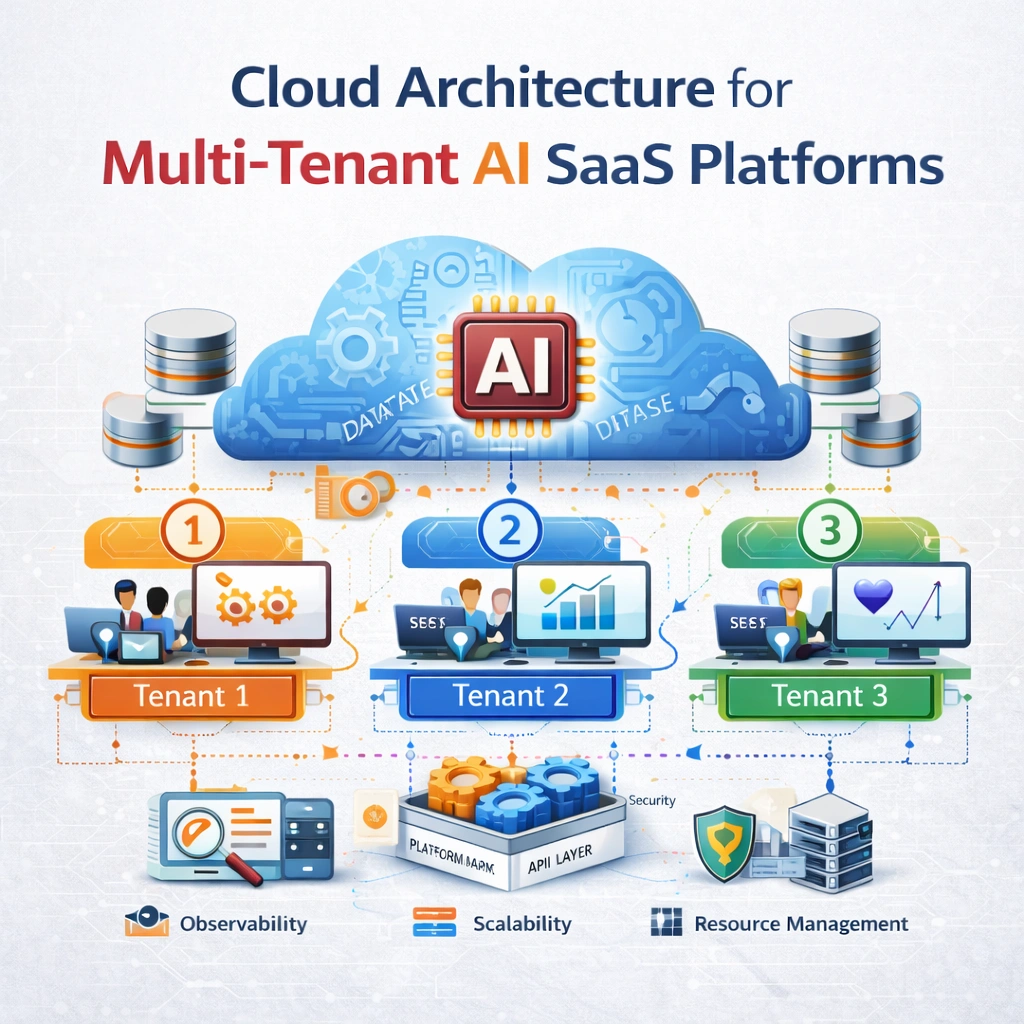
SaaS is no longer a software delivery model, even though it has become an infrastructure powerhouse in today’s digital economy. This results in an extensive boom/interest in a multi-tenant AI SaaS architecture. While the SaaS model delivers software applications over the internet, multi-tenancy allows multiple users to share assets to speed up and automate scaling. The system improves cloud service efficiency while decreasing operational expenses and delivering permanent service access. Furthermore, the multi-tenant system enables all users to use the new features, which begin to operate after their introduction. Major technology companies, including Microsoft, Salesforce, Oracle, IBM, and others, develop their software products through SaaS multi-tenancy architecture.
According to the recent report, the global SaaS market is expected to exceed $1 trillion by 2027. On the other hand, we expect nearly 70% of small- and large-sized agencies and enterprises to launch their AI-powered apps by the end of 2026. Therefore, having these eye-opening stats directly implies more than growth; they mark an architectural reset.
So, the question arises: how can a business design a scalable AI SaaS platform? If you are looking for the best practices to do so, you are in the right place! We will cover all these points and discuss the best practices, which will surely help you choose the best architecture for your business.
What Multi-Tenant Architecture Means in AI SaaS Platforms
Typically, multi-tenancy in SaaS architecture means a single instance of your software operates on a shared infrastructure and caters to multiple customers, known as tenants. Rather than creating separate environments for every client, the app comprises the core resources while keeping every tenant’s data, configurations, and access controls logically separated.
Here, the SaaS provider hosts the app on a shared platform and is responsible for handling app maintenance, updates, and security. Customers can access the internet service through their web browser or mobile app.
Have you ever wondered how platforms such as Slack, Salesforce, AWS, and Zendesk serve multiple organizations? The company provides its clients with cloud-based software development and creates custom applications. The platforms create a shared environment that multiple organizations can access instead of building separate environments for each organization. The company operates its SaaS applications through a multi-tenant architecture, which works on any cloud platform that customers select.
Single-Tenant vs Multi-Tenant: Key Architectural Differences
Multi-tenancy constitutes the core of each cloud-enabled SaaS portal. Furthermore, it allows a single set of software to serve multiple customers. Having such core capabilities makes it simple, scalable, and cost-effectively viable. But the cloud architecture for AI SaaS and the deployment model design will align with everything. Let’s have a look at the key architectural differences between single- and multi-tenant architectures:
| Characteristics | Single-tenant SaaS Architecture | Multi-tenant SaaS Architecture |
| Definition | This architecture gives every customer their infrastructure, like having their own home. | Multi-tenant architecture shares resources across customers, such as living in an apartment building. |
| Cost | Here, the pricing hikes up. | Multi-tenancy reduces infrastructure costs by 60-70% through resource sharing |
| Isolation | Single-tenant offers complete data separation. | Multi-tenancy requires careful isolation |
| Scalability | Single-tenant demands per-client provisioning | Multi-tenant scales horizontally with ease. |
| Maintenance | Single-tenant needs individual deployments | Multi-tenant updates once for all; |
Core Components of a Cloud-Based AI SaaS Architecture
Every cloud-based AI SaaS system relies on five foundational layers:
API Gateway: It is used to handle incoming requests while it authenticates users and implements rate limit controls.
Application Layer: The system operates business functions through its application layer, which handles tenant-specific workflow management.
AI/ML Engine: The architecture delivers inference capabilities through its trained models, which use TensorFlow and PyTorch for their operational framework.
Data Layer: Here, the user data is stored together with model parameters and training data sets.
Infrastructure Layer: The system controls all computing resources, which include GPUs, CPUs, storage space, and networking through its Kubernetes framework.
Pro tip: You should implement a microservices architecture to separate AI inference from your application logic, which will result in better scalability capabilities.
Single-Tenant vs Multi-Tenant: Key Architectural Differences
Multi-tenancy constitutes the core of each cloud-enabled SaaS portal. Furthermore, it allows a single set of software to serve multiple customers. Having such core capabilities makes it simple, scalable, and cost-effectively viable. But the cloud architecture for AI SaaS and the deployment model design will align with everything. Let’s have a look at the key architectural differences between single- and multi-tenant architectures:
| Characteristics | Single-tenant SaaS Architecture | Multi-tenant SaaS Architecture |
| Definition | This architecture gives every customer their infrastructure, like having their own home. | Multi-tenant architecture shares resources across customers, such as living in an apartment building. |
| Cost | Here, the pricing hikes up. | Multi-tenancy reduces infrastructure costs by 60-70% through resource sharing |
| Isolation | Single-tenant offers complete data separation. | Multi-tenancy requires careful isolation |
| Scalability | Single-tenant demands per-client provisioning | Multi-tenant scales horizontally with ease. |
| Maintenance | Single-tenant needs individual deployments | Multi-tenant updates once for all; |
Core Components of a Cloud-Based AI SaaS Architecture
Every cloud-based AI SaaS system relies on five foundational layers:
API Gateway: It is used to handle incoming requests while it authenticates users and implements rate limit controls.
Application Layer: The system operates business functions through its application layer, which handles tenant-specific workflow management.
AI/ML Engine: The architecture delivers inference capabilities through its trained models, which use TensorFlow and PyTorch for their operational framework.
Data Layer: Here, the user data is stored together with model parameters and training data sets.
Infrastructure Layer: The system controls all computing resources, which include GPUs, CPUs, storage space, and networking through its Kubernetes framework.
Pro tip: You should implement a microservices architecture to separate AI inference from your application logic, which will result in better scalability capabilities.
Designing Scalable Storage for AI Models and User Data
AI workloads require high-performance storage for models and datasets. To get an efficient storage architecture, perform these best practices:
- Model storage: Make use of object storage (S3, GCS) with CDN caching for quick model loading.
- User data: Separate hot data (SSD/NVMe) from cold data (HDD/archive storage)
- Versioning: Enable S3 versioning for model rollback and A/B testing
- Sharding: Partition datasets by tenant_id to distribute load across storage nodes
Pro optimization tip: Compress models with quantization (8-bit/4-bit) to reduce storage costs by 80% without compromising accuracy.
Managing Compute Resources for AI Inference Workloads
AI inference requires heavy computational power, but resource management efficiency prevents budget excesses. Resource Allocation Strategies
- GPU sharing: Use NVIDIA MIG or MPS to split A100 GPUs across multiple tenants
- Auto-scaling: Configure Horizontal Pod Autoscalers (HPA) based on queue depth or latency
- Batch inference: Group requests to maximize GPU utilization (80%+ target)
- Spot instances: Use preemptible VMs for non-critical workloads to save 60-80%
Cost optimization: Deploy edge cases with BERT-base models, which achieve 90% accuracy at 3x lower cost than BERT-large models.
Database Architecture Options: Shared DB, Schema, or Separate DB
Selecting the right database isolation model equally balances cost, security, and complexity. Here is a quick overview of it:
| Architectural Model | Isolation Level | Cost | Scalability | Use Cases |
| Shared DB | Row-level | Lowest | High | Startups |
| Schema DB | Schema-level | Medium | Medium | Regulated industries |
| Separate DB | Database-level | Highest | Low | Established enterprises |
The initial recommendation for AI SaaS applications should use a shared database with RLS protection. The process of migrating high-value customers to dedicated schemas will begin after their need arises.
Using Containers and Kubernetes for Multi-Tenant Deployments
Kubernetes enables the orchestration of containerized artificial intelligence workloads through its built-in support for multiple user environments.
Feature. Multi-Tenant Kubernetes Setup
Namespaces: One namespace per tenant or tier helps to separate tenant workloads from each other.
Resource quotas: The system uses resource quotas to stop CPU and memory usage from exceeding predefined limits in each namespace as a way to control resource consumption.
Network policies: The system uses network policies to stop pods from different tenant groups from establishing communication links with each other.
Priority classes: The system uses priority classes to ensure that high-value clients will always receive their required resources, even when multiple clients are trying to access the same ones.
Deployment tip: Use Knative for serverless inference—scales to zero during idle periods.
Monitoring, Security, and Access Control Across Tenants
The Multi-tenant AI SaaS architecture requires precise tenant-aware observability along with zero-trust security. Your task involves executing the optimal monitoring procedures, which you should follow:
- Per-tenant metrics: Track latency, error rates, and token usage by tenant_id
- OpenTelemetry enables distributed tracing through its request tracing capabilities, which extend across microservices.
- Anomaly detection: The system will notify users about unusual API usage patterns, which may indicate a security breach.
Security Essentials
All inter-service communication requires mTLS encryption to ensure encrypted protection.
- The JWT tokens will contain tenant_id information within their claims to enable context propagation.
- RBAC Policies The system will create access permissions through user roles, which include an admin user and a viewer for each tenant.
- Vault and AWS Secrets Manager serve as the approved methods for managing tenant API key rotation.
The compliance guideline requires organizations to document all data access activity, which serves as evidence for their SOC 2 and GDPR audit requirements.
Cost Management and Resource Allocation in Multi-Tenant AI SaaS Systems
The expenses for AI inference will increase indefinitely without the implementation of chargeback systems and optimization methods.
Cost Optimization Tactics
Usage-based billing: Charge tenants per API call, tokens processed, or GPU seconds. Tiered pricing: Offer basic (CPU inference) vs. premium (GPU inference) plans. Cost allocation tags: Tag all cloud resources with tenant_id for accurate billing. Model caching: Cache frequent inference results (Redis) to reduce redundant computation
FinOps metrics to track: Cost per tenant per month (CPTPM), GPU utilization rate (target: >70%), and Inference cost per 1K requests. Batch inference plus model quantization implementation resulted in 65% cost savings for a chatbot SaaS startup.
Conclusion
The SaaS landscape is moving fast, AI is accelerating innovation, enterprise expectations are rising, and scalability is no longer optional. In this environment, architecture defines success. Multi-tenancy drives cost efficiency, scalability ensures reliability, security builds trust, and operational maturity sustains growth. Building a multi-tenant AI SaaS architecture requires balancing cost efficiency, security, and scalability. Key takeaways:
Choose multi-tenant for cost savings (60-70% reduction)
Implement tenant isolation at the application, database, and infrastructure layers
Use Kubernetes for orchestration and auto-scaling
Monitor per-tenant metrics for performance and security
Optimize inference costs with batching, caching, and model compression
Begin your project with shared database resources and Kubernetes settings, then develop isolation methods to meet your growing customer requirements. The suitable architecture enables your organization to meet its business demands while maintaining stable costs for AI inference operations. Have any queries in mind? Feel free to connect with Esferasoft Solutions today!