
Artificial intelligence (AI) has become a dynamic interface for business innovation and efficiency, moving beyond its initial concept. The change brought about by such technology would involve AI agents being intelligent software entities capable of perceiving the environment, performing decisions, and taking actions autonomously or semi-autonomously.
With autonomous AI agents’ decision-making and intelligent automation trending in recent years, AI agents have become the most sought-after way for organisations—from customer service down to data analysis—to improve efficiency, scalability, and competitive advantage.
Startups and enterprise leaders have embraced the use of advanced custom-built AI agents to address niche problems that off-the-shelf products fail to address. Companies now create customised AI systems around specific workflows, goals, and even datasets, allowing powerful new functionalities that improve internal processes and customer experiences.
Looking to revolutionise your workflows? [Talk to our team about custom AI agents.]
What Are Custom AI Agents?
Custom-built AIs are intelligent software applications designed to carry out specified, unique tasks for a business, mixing AI technologies such as machine learning, natural language processing, and data analytics in reaching a goal opposite to that of an off-the-shelf solution, which is intended for the markets with predefined capabilities. A custom agent differs fundamentally from an off-the-shelf one in that it is specifically designed for a specific organisation, taking into account its unique objectives, challenges, and systems.
For example, a customer support AI agent trained on your historical support data and brand tone can provide accurate, brand-aligned responses across email, chat, and social media. A research assistant might summarise internal documents, pull in external data from trusted sources, and generate human-like reports; in the meantime, a smart data analyst might track performance metrics, detect anomalies, and deliver client-ready insights in real time.
Intelligence is the line dividing agents from traditional bots. The classical bots, being the ones that are strictly rule-based, implement an “if A, then B” formula. Such bots are useful for structured tasks that are performed repetitively; otherwise, they are typically the opposite in cases where ambiguity, nuance, or change in condition is involved. In marked contrast, AI agents—certainly those who equally use LLMs and other current architectures— are able to work with unstructured data, understand context, and learn through interaction, making them far more versatile.
There are many types of AI agents.
- Reactive Agents: They respond to stimuli or inputs, apparently in the absence of any memory about past interactions. Business cases that require simple responses made in real time benefit greatly from their use.
- Proactive Agents: The opposite is true in that these predict the future need or action. For example, an AI reschedules a meeting in case of a predicted conflict in the calendar.
- Goal-Based Agents: Concerned with attaining given goals, e.g., minimising inventory levels or churn.
- Multi-Agent Systems: Networks of cooperating agents that aim to solve more complicated tasks, such as the operational management of a logistics network.
Need a business logic solution? [We’ll build it for you.]
Use Cases of AI Agents Across Industries
AI agents have versatile use cases and are being used in almost every region. Let us look into how different industries are harnessing custom AI solutions for growth and innovation.
E-commerce
Undoubtedly competitive, the arena of online retailing places prime importance on customer experience. AI agents in e-commerce could be acting as personal assistants for shoppers, guiding users throughout their journeys, recommending products based on preferences and behaviours, or even generating customised bundles or upsells. Also, these agents could play a role in post-sale interactions such as processing returns or collecting feedback.
For example, an AI agent could examine a customer’s purchase history and add recent browsing behaviour and sentiment from earlier reviews to suggest products that are most likely to be bought, improving conversion rates and average order values.
Healthcare
In health care, accuracy and responsiveness are sometimes directly related to outcomes. AI agents serve as symptom checkers, providing preliminary assessments that depend on the information given by patients. They can schedule appointments, send reminders, and even interpret lab results or imaging with trained models.
These agents simultaneously lessen the load on medical staff while boosting patient satisfaction by providing prompt, accurate, and non-judgemental support. Integration with EHR (Electronic Health Records) systems allows for personalising care instructions and follow-up reminders.
Finance
The finance sector benefits tremendously from the precision and speed that an AI agent provides. Applications cover fraud detection agents continuously monitoring suspicious patterns or bots that recommend portfolios adjusting to user goals, market data, and risk tolerance.
Combining LLMs with financial models enables the agents to provide answers to complex queries such as “Why did my expenses spike last quarter?” or “Which of my investments are underperforming relative to industry averages?”
Real Estate
AI agents prove themselves to be virtual property assistants, holding the hands of buyers or renters by listing properties, suggesting alternatives, scheduling visits, and even answering questions concerning neighbourhoods, mortgages, or taxes.
This role is incredibly helpful during quick interactions in a time-sensitive market; therefore, AI agents provide interaction around the clock.
SaaS and IT Services
AI agents are automating everything in the tech world, from ticket triaging to allocation of cloud resources. The agent, for a SaaS company, might do anything from onboarding clients to navigating documentation to even troubleshooting issues for an end user.
On the other hand, DevOps agents on the IT side help by monitoring system logs, detecting anomalies, and initiating corrective actions that save engineering teams a lot of time.
Have a unique business challenge? [Let’s build an agent to solve it.]
Core Technologies Behind AI Agent Development
The real king in an AI agent lies in the technology stack powering it. Here are the primary core components powering today’s most developed agents:
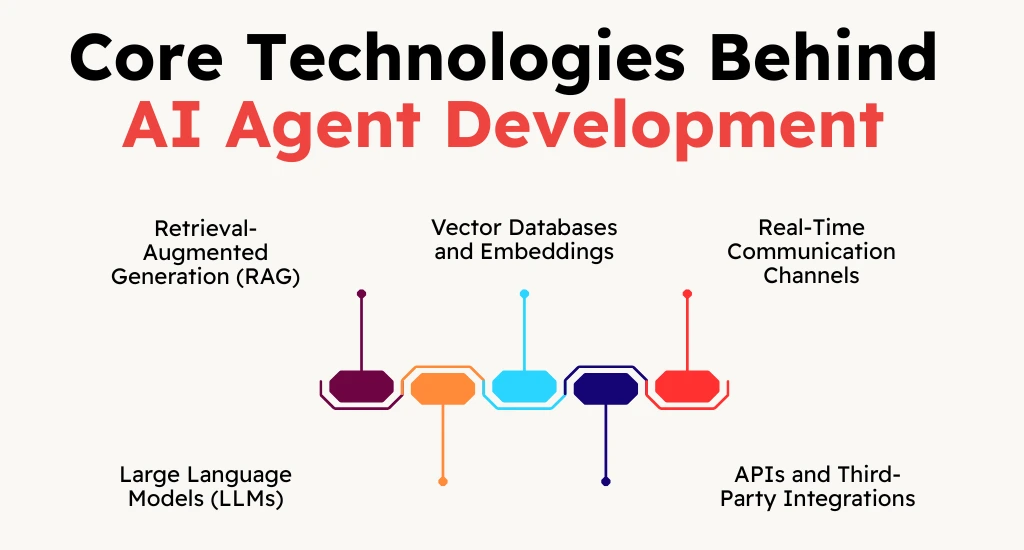
Large Language Models (LLMs)
By employing LLMs like GPT-powered agents by OpenAI, Claude by Anthropic, and LLaMA by Meta in agent designs, one can allow natural, real-time textual exchange, dynamic content generation, and intelligent, context-driven decision-making.
Retrieval-Augmented Generation (RAG)
AI agents use the real imbalance of retaining and on-demand report search by retrieval for responses to aversion to hallucination and greater pertinence.
Vector Databases and Embeddings
AI agents can, with the likes of Pinecone, Weaviate, and FAISS, retrieve results semantically from very vast unstructured datasets. Embedding data, which is translated into numerically represented vectors, captures meaning and similarity. similarity.
APIs and Third-Party Integrations
A well-appointed custom AI agent would interact with all these systems and add others such as CRMs, ERPs, payment processors, scheduling systems, and more. Effective API services are essential for enabling agents to be able to extend the functionality of your digital ecosystem.
Real-Time Communication Channels
AI agents deliver a consistent experience whether through chat, voice assistants, or automated backend workflows. They can reach different channels.
Want to explore which tech fits your use case best? [Chat with our engineers]
Benefits of Custom AI Agents for Businesses
The advantages of investing in a custom AI solution are both tangible and strategic.
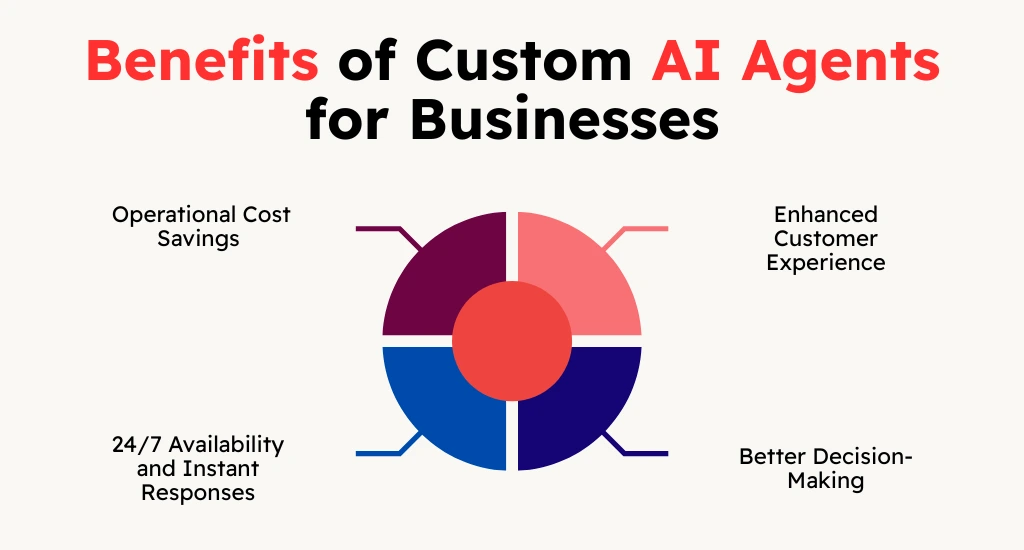
1. 24/7 Availability and Instant Responses
AI agents don’t sleep. They work around the clock, ensuring that customer enquiries, internal alerts, or data monitoring continue uninterrupted—even during holidays or off-hours.
2. Operational Cost Savings
By automating repetitive or complex tasks, companies significantly reduce overhead. A single agent can perform the work of several full-time employees, often at a fraction of the cost.
3. Enhanced Customer Experience
AI agents deliver faster, more personalised, and contextually aware interactions—leading to greater satisfaction and retention. They remember preferences, track issues, and deliver proactive value.
4. Better Decision-Making
Custom agents can surface real-time insights, flag anomalies, and support strategic decision-making. By acting as intelligent assistants, they empower leaders with information and foresight.
Curious how much time and cost you could save? [Let’s run the numbers together.]
Custom vs Pre-Built AI Agents
While pre-built agents offer speed and affordability, they often fall short when flexibility, branding, or complex logic is needed.
Custom AI agents, in contrast, are designed for your business alone. They reflect your brand, speak your language, and integrate seamlessly with your tools and teams.
| Attribute | Pre-Built Agent | Custom AI Agent |
| Setup Time | Faster | Moderate |
| Flexibility | Limited | High |
| Branding | Generic | Fully customizable |
| Cost | Lower upfront | Higher upfront, better long-term ROI |
| Learning | Minimal | Trained on your data |
| Integration | Basic | Deep and tailored |
Wondering which is right for you? [Book a strategic consultation]
Our Custom AI Agent Development Process
Esferasoft has a well-established process for transforming ideas into intelligent agents.
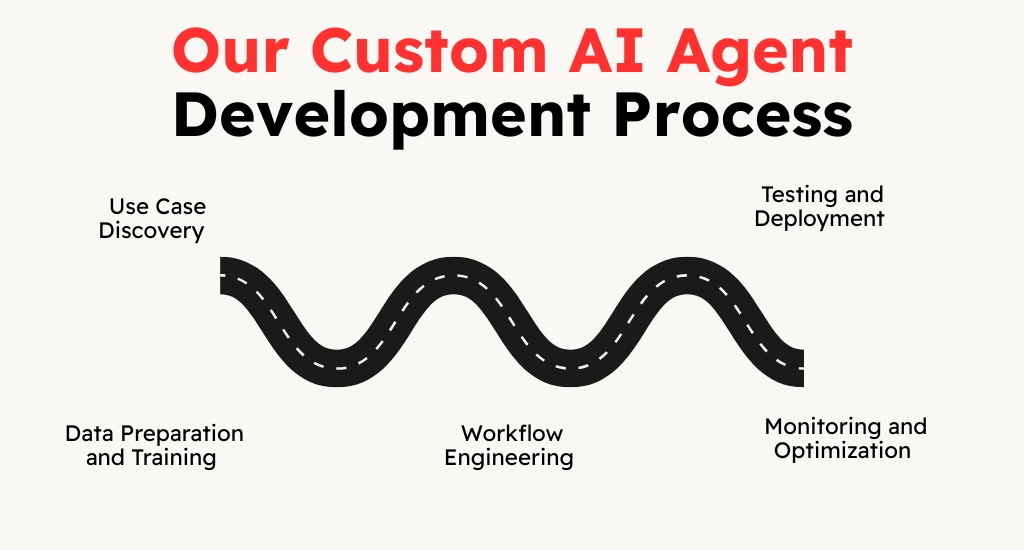
1. Use Case Discovery
We try to understand your business goals, pain points, and ideal scenarios. With all this information, we can develop an agent with measurable impact.
2. Data Preparation and Training
Relevant data is sourced and prepared for training your agent. Depending on the case, this process can involve fine-tuning LLMs, building custom classifiers, or setting up embeddings.
3. Workflow Engineering
Define the logic, decision tree, and multi-step processes that your agent must follow, including frequently integrating it with other systems to create a workflow.
4. Testing and Deployment
To test the agent’s robustness, we run simulations, edge-case testing, and performance benchmarks. After verification, we deploy the agent to the selected environment.
5. Monitoring and Optimization
After launch, agents will keep running, with constant feedback collection and retraining, aiming to keep agent performance optimal.
Let’s co-design an agent that fits your business perfectly. [Get started today]
Cost to Develop a Custom AI Agent
What Influences Cost?
- Use case complexity (simple chatbot vs. multi-system automation)
- Number of integrations (CRMs, databases, APIs)
- LLM usage (open-source vs. commercial models)
- Hosting (cloud vs. on-premises)
One-Time vs. Ongoing Costs
One-time costs include development, testing, and initial deployment. Ongoing costs may involve LLM usage fees, data updates, retraining, and support.
Estimated Ranges
- Basic MVP Agent: $8,000–$15,000
- Mid-tier Agent with RAG and API integration: $20,000–$35,000
- Advanced Enterprise Agent: $40,000–$75,000+
Need a ballpark for your idea? [Let’s discuss your scope.]
Why Choose Esferasoft for AI Agent Development
1. Deep AI/ML Expertise
We have outfitted ourselves with expertise spanning over a decade in AI and ML, specialising in LLM, NLP, and RAG pipelines, as well as end-to-end AI automation services.
2. Tailored Approach
These custom AI solutions are bespoke and not copy-pasting. Every agent that we build is based on your data, goals, and customer expectations.
3. Full Lifecycle Support
From the beginning to the end of the deployment—and afterwards—we offer development, monitoring, and optimisation services.
Ready to partner with a team that gets results? [Let’s build something exceptional.]
Conclusion: Harness the Power of Custom AI Agents
Custom AI agents are now approaching necessity for the enterprises that require intelligent AI automation services, scalable efficiency, and competitive advantages. These agents even add to the definition of smart bots: they use cutting-edge technology like LLMs, RAG, and vector databases to produce contextual, accurate, and scalable delivery solutions that transcend industries.
While improving customer interaction, AI agents also reduce the time required to automate complex workflows and provide real-time decision support. And they can integrate deeply into your system. Their scope is only your unique business logic that differentiates them from yet-to-be-developed tools that could be generic.
At Esferasoft, we customise AI solutions for clients that map directly to their business goals and have measurable impacts for those businesses. With a full-service approach that includes strategy, development, deployment, and support, Esferasoft enables clients to transform AI capability into business value.
Are you ready to leverage what a custom AI agent can do for your organisation? Schedule a free consultation at +91 772-3000-038 with us and start your AI journey today.