The rapidly evolving healthcare landscape is rapidly integrating AI agents to meet the increasing patient demands for convenient, efficient, and patient-focused care. The press and pull of consumer expectations today—wanting instant responses and highly personalised treatment—will consider pushing healthcare services to the edge—that is, if they are not already pushed. Unfortunately, healthcare service channels—such as traditional phone lines, emails, and even outdated portals—often fail to provide timely empathy in their support delivery.
Now, imagine the normal ordeal of trying to schedule an appointment or clarify a prescription. After sitting on hold for hours, patients are bounced from one department to another with little input. These service hurdles frustrate patients and burden already overworked medical staff, assailing scarce resources away from actual patient care.
AI agents stand to dramatically turn around this inefficiency. Beyond mere healthcare automation, these smart agents are transforming patient encounters into seamless, intuitive, and proactive experiences. For illustration, imagine a patient reporting symptoms and receiving triage, consultation, and prescription assistance – all mediated by one AI interface available to the patient 24/7.
This blog aims to educate healthcare startups, clinics, and healthtech innovators about the transformative possibilities presented by AI agent-based chatbot development in healthcare. We will elaborate on how these technologies work, their use cases in practice, the healthcare chatbot development cycle, and how to create a HIPAA-compliant chatbot that actually makes a difference in patient care.
What Is a Healthcare Chatbot Powered by AI Agents?
On the surface, one would be inclined to think that a medical chatbot app is simply a digital assistant responding to specific questions. However, in healthcare, the standards expected are far more intense. A rule-based system cannot answer the complex, sensitive, and risky questions that patients ask.
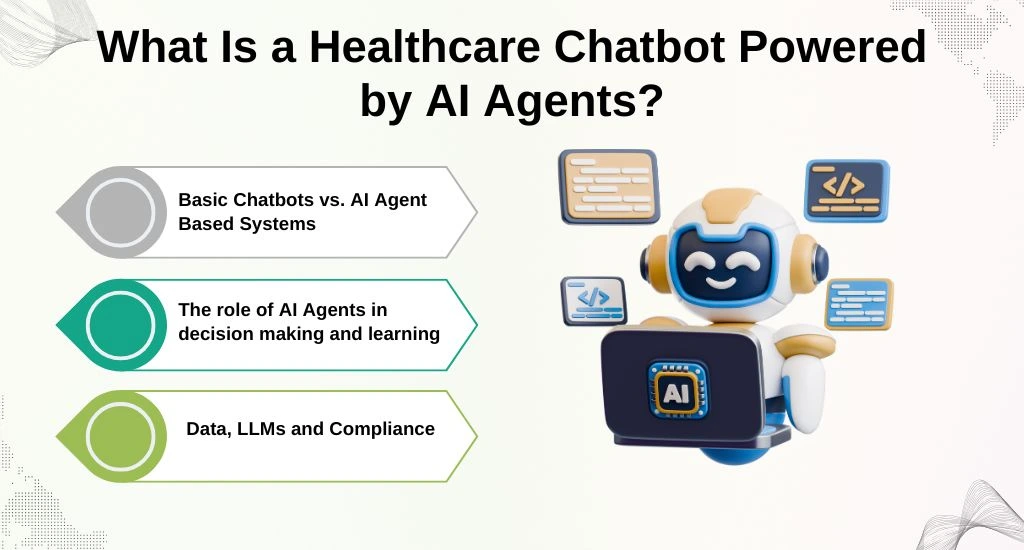
Basic Chatbots vs. AI Agent Based Systems
Traditional scripted flow chatbots can accomplish booking appointments and popular questions somewhat effectively. However, when faced with ambiguous queries or multi-fold complex tasks, they fail disappointingly.
However, the ecosystem of intelligent agents that comprises the AI agent-based chatbots is a specialised capability delivery system. One extra agent may be designated for symptom evaluation, one may answer queries related to medications, and yet another may oversee the insurance process from the end of the user’s perspective. Such agents are not only going to follow scripts but also diligently interpret, learn, and develop over the course of evolving based on so much data and context.
The role of AI Agents in decision making and learning
Healthcare AI agents rely on frameworks that enable autonomous reasoning. Being LLMs such as GPT-4 or Med-PaLM, they can understand a natural language, infer the intent, and show decision-making on the basis of structured data, like EHRs, and unstructured sources, such as clinical guidelines.
In addition, with reinforcement learning and feedback loops, these agents are capable of constantly improving their responses as they adjust to learning specific clinical practices, specific patients’ behaviours, and regulatory environments.
Data, LLMs and Compliance
An industry of intelligent systems would require access to specific kinds of data, e-de-identified patient records, pathways of diagnoses, protocols for treatment and models of linguistic characteristics in medically defined contexts. Compliance is non-negotiable. Organisations must follow HIPAA, GDPR, or regional data protection laws to ensure secure data handling, maintain audit trails, and establish patient consent protocols.
Top Use Cases of AI Healthcare Chatbots
There is no doubt that AI chatbots are evolving beyond typical virtual receptionists and becoming very much involved in the delivery of care itself. Here are some current applications of AI chatbots in healthcare delivery:
Symptom Checker and Triage Assistant
AI chatbots can aid patients with an assessment of their symptoms using clinically validated decision trees and probability reasoning. These capabilities will enable prompt triage and prioritise emergency cases, diverting others to virtual care for non-urgent attention.
Appointment Booking and Reminder Systems
The integrated chatbots in the hospitals’ systems allow real-time appointment booking, cancellation and rescheduling. These can send SMS and in-application messages as reminders, cutting no-shows by up to 30% in some deployments.
Prescription Management and Refill Requests
Patients request refills of their drugs, dosage enquiries, or possible drug interactions. The chatbot communicates with the pharmacy systems and advises the physicians to give the approvals for speed and safety in drug delivery.
Mind Therapy and Mental Health Support
One of the most promising areas for AI chatbots in developing countries is mental health support. It can employ cognitive behaviour therapy’s CBT framework-based training to provide PAT-guided conversations, coping mechanisms, and emergency de-escalation, which is especially important when there are few professionals in the area.
Insurance and Claims Assistance
Eligibility checking and the status of a claim are a few of the features that AI chatbots have to offer as they demystify the world of convoluted medical billing. They walk patients through the forms, verify coverage, file claims, and subsequently reduce administrative costs for providers and confusion for patients.
Multilingual and Multidisciplinary Patient Enrollment
Delays in entering care or impediments to it are related to language barriers. AI chatbots with translation attachments will be able to cater to a wide range of populations as they translate medical forms, explanations about procedures, and consent forms in real-time.
Need a use-case-specific demo for your healthtech platform? [Talk to our team].
Benefits of AI Agent Chatbots in Healthcare
Operationally and strategically, the adoption of AI agent chatbots is advantageous to every aspect of a healthcare workflow.
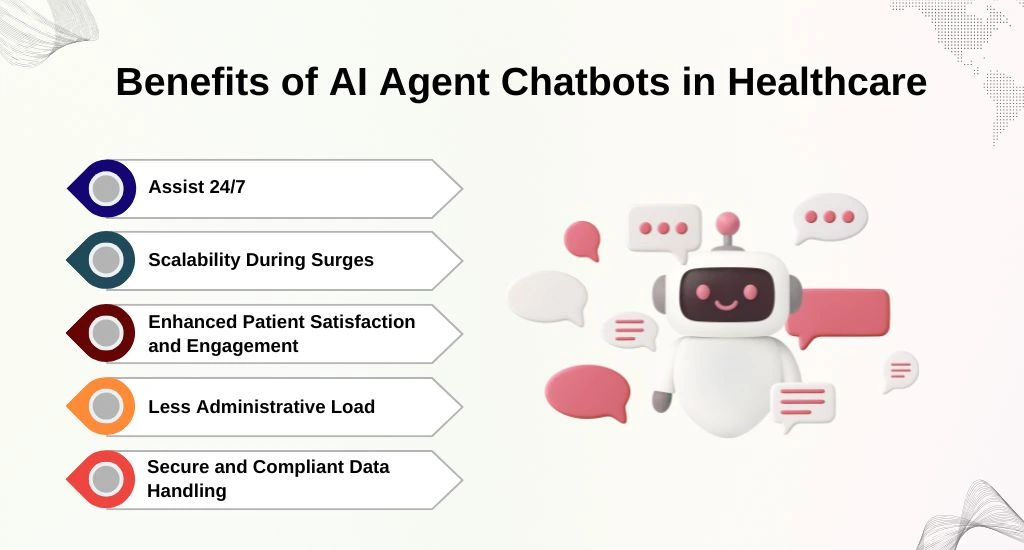
Assist 24/7
Chatbots provide round-the-clock support on pressing matters, such as urgent concerns, queries with medication, or following postoperative instructions, whereas their human counterparts are limited by working hours.
Less Administrative Load
Chatbots help automate repetitive tasks such as intake processes, preliminary evaluations, and follow-ups, thereby allowing staff to devote their energies to value-added care activities that improve staff efficiency and morale.
Enhanced Patient Satisfaction and Engagement
Personalisation, expediency, and proactive nudging (e.g., “Time for your flu shot!”) significantly enhance patient satisfaction and loyalty and greatly induce patient engagement.
Scalability During Surges
These systems can scale infinitely during pandemics or health crises—triaging thousands of queries every minute while ensuring there’s no loss in quality.
Secure and Compliant Data Handling
Modern AI medical chatbot apps come with role-based access, encryption, data minimisation, and full audit trails—ensuring safety and compliance.
Must-Have Features in Healthcare AI Chatbots
To ensure both functionality and compliance, your chatbot must include:
Advanced NLP and Intent Recognition
Patients are free to pose their varied questions, from “Can I take ibuprofen with this med?” to “What does my MRI mean?” It is capable of giving very specific answers.
Integration with EHR/EMR Systems
Real-time responses offer contextual situations such as reminding diabetic patients to track their glucose levels or to let them know of their lab results.
Voice and Accessibility Features
Inclusion of voice input and output would allow for the inclusion of the elderly and users with visual impairment or motor disabilities into the fold of equitable health care.
Human Escalation
When AI does not have enough confidence, it is necessary to ensure a seamless hand-off to a live agent or clinician for the sake of building and sustaining trust.
Analytics and Continuous Feedback
Data pertaining to usage, along with sentiment analysis and feedback collection, are aimed at tinkering with performance for on-the-go improvements.
Tech Stack for Building Healthcare AI Chatbots
Here’s a closer look at the most effective tools and technologies:
- LLMs: GPT-4 (general use), Med-PaLM (clinical decision support), Claude (interpretability)
- Agent Frameworks: LangChain, CrewAI, AutoGen for multi-agent orchestration
- Data Handling: AWS HealthLake, Azure Health Data Services
- Frontend Development: Flutter, React Native
- APIs: FHIR, HL7 for healthcare system interoperability
The Data Speaks: AI Healthcare Chatbots by the Numbers
The integration of AI-powered chatbots in healthcare is not just a futuristic concept—it’s a rapidly growing reality backed by compelling statistics:
Market Growth and Projections
- Global Market Expansion: The healthcare chatbot market was valued at $1.2 billion in 2024 and is projected to reach $4.36 billion by 2030, growing at a 24% CAGR.
- Conversational AI Surge: The broader conversational AI in healthcare market is expected to escalate from $13.53 billion in 2024 to $48.87 billion by 2030, reflecting a 23.84% CAGR.
Adoption Rates and Utilization
- Medical Practice Integration: As of April 2025, approximately 19% of medical group practices have implemented chatbots or virtual assistants for patient communication, indicating a growing trend in digital health adoption.
- Patient Comfort with AI: A survey revealed that 67% of patients with sensitive health issues prefer making appointments through online chatbots rather than human staff, highlighting AI’s role in breaking down barriers to care.
Cost Savings and Efficiency
- Administrative Task Automation: AI can automate up to 45% of administrative tasks. This could potentially save $150 billion annually in the healthcare sector.
- Physician Time Savings: Doctors using AI assistants report spending 64.76% less time on paperwork, allowing for more patient-focused care.
Mental Health Support
- AI in Mental Health: The global market for AI-driven mental health applications is projected to grow from $0.92 billion in 2023 to $14.89 billion by 2033, indicating a significant interest in AI’s potential to address mental health challenges.
Challenges and How to Overcome Them
Every innovation comes with challenges:
Data Privacy & Compliance
Use encrypted storage, ensure patient consent, and partner with HIPAA/GDPR-certified platforms.
Accuracy & Hallucination Prevention
Leverage RAG and fine-tuning on verified datasets. Provide disclaimers and always allow human oversight.
User Trust
Transparency, explainability, and empathy are key. Let users know how their data is used and when AI is responding.
Edge Case Handling
Use fallback flows and structured escalation protocols to avoid failed interactions in non-standard queries.
Cost of Healthcare AI Chatbot Development
Factors Affecting Cost
- Functionality (basic vs. advanced)
- Integration needs (EHR, pharmacy, billing)
- Regulatory hurdles
Cost Estimates
- MVP Chatbot: $25,000 – $60,000
- Full-scale System: $100,000+
Ongoing Expenses
- LLM usage costs
- Cloud infrastructure
- Security updates and compliance maintenance
Our Approach to AI Chatbot Development for Healthcare
Esferasoft not only builds bots; we build intelligent, compliant, and compassionate patient experiences.
Awareness
Map your workflows, requirements, and compliance landscape.
Construction of Custom Solutions
Architect a solution around your systems and goals.
Secure Development
We abide by DevSecOps processes and healthcare-specific best practices.
Real-Life Testing
Test with simulated patient flows and stakeholder feedback before going live.
Post-Launch Refinements
Monitor, tweak, and support the medical chatbot app as per the evolving patient requirements.
Looking for a long-term AI partner? [Let’s start with a discovery call].
The Future of Patient Engagement Is AI-Driven
Real-time, context-sensitive, and truly human experiences are the future, delivered by AI-incorporated platforms. In patient engagement, henceforth, we may witness no more than the shadow of face-to-face interaction and fragmentation of support systems, save a few.
Empowered by AI, chatbot technology has become more than just an additional tool in the digital world’s arsenal. These are the first patient-facing solutions that combine quick, intelligent, and massively scalable options. From chronic disease management with tailored nudges to supporting patients in national health emergencies, these chatbots are redefining the meaning of `support` in healthcare.
AI chatbots also represent a strategic differentiator for companies in the healthcare startup ecosystem, clinics, and healthtech platforms:
Operational Efficiency: By automating routine tasks, organisations save on overhead costs while decreasing wait times and allowing their teams to focus on higher-value care activities instead.
Competitive Differentiation: Innovative digital experiences build trust and loyalty in a market with increasingly brighter options for patients.
Data-driven Insights: Every user interaction is an opportunity for the chatbot to create data—data that is invaluable for insights into population health trends, operational decisions, and personalised care delivery.
Tech Today: Clinics are currently using the existing toolkit to automate reminders, thereby reducing no-show rates by 30%. The mental health apps are scaling up the support for thousands of users through AI therapy assistants. Hospitals are triaging patients faster, safer, and more accurately than ever.
However, to truly tap into the future potential of AI in patient communication chain, healthcare enterprises shall need not merely some technology but also a fitting partner in healthcare chatbot development: one with knowledge of regulatory frameworks, prioritising safety, with an empathy-led design.
At Esferasoft, we develop intelligent, HIPAA-compliant healthcare chatbots tailored for your workflows and patients. We help you deliver not just answers but better care, at scale, from ideation through deployment and beyond.
Are you ready to build the future of healthcare communication? [Let’s talk at +91 772-3000-038].