|
Getting your Trinity Audio player ready...
|
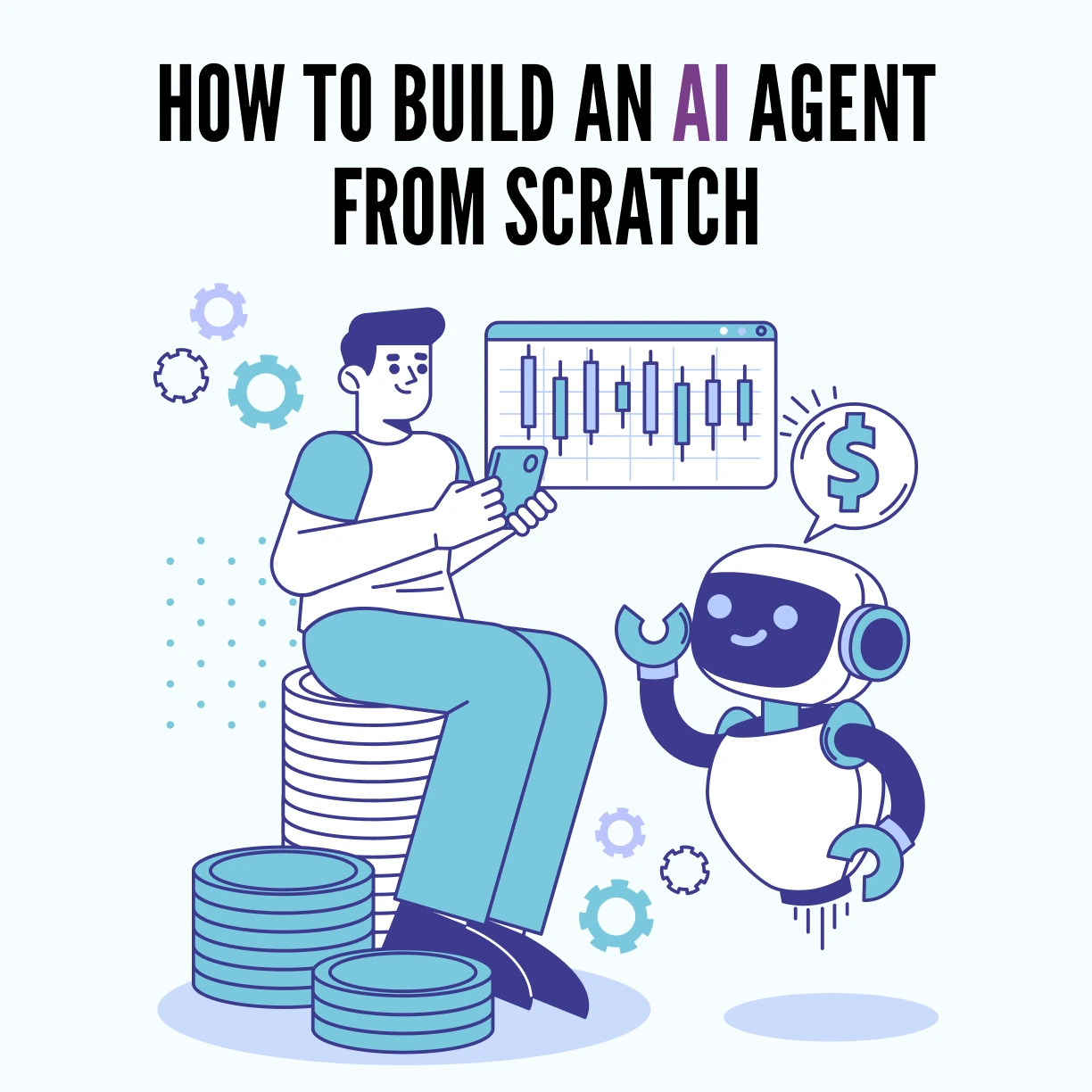
We are currently living in the era of intelligent software. Virtual assistants and autonomous data processors have made AI agents a necessity across industries. However, most of the out-of-the-box solutions would not be quite enough for some startups and tech teams looking to develop a custom-built, high-performance AI agent, especially for business needs.
From idea to deployment, this blog will be your guide toward creating an AI agent from scratch, whether such an agent will serve as an intelligent customer service representative, a sales intelligence bot, or an automation engine. This is a step-by-step AI agent guide on how you can demystify the AI agent development process through crafting smarter systems born of your productivity needs.
What is an AI agent?
In short, an AI agent is a software system that builds specific intelligence functions based on perceived environmental changes, data processing, behavioural decision-making, and action execution. It might be as simple as an email filter or as complex as a fully autonomous assistant booking appointments, reading documents, or analysing spreadsheets proficiently through natural language input.
Unlike working with rule-based software, an AI agent adopts machine learning, natural language processing, and decision-making frameworks to mimic human reasoning and learn through experience over time.
Why build one from scratch?
Prepackaged products can be restrictive in their degree of customisation, not fully integrated into internal systems, or inflexible when it comes to handling industry-specific processes. Making your own AI agent from scratch ensures control over its design, adaptability, and an avenue or outlet for innovation-critical features for teams intent on building a competitive edge.
Define the Purpose and Use Case
First—indeed, arguably the most crucial step—is selecting a mission for the AI agent. A navigation system without destination guidance is ineffective and so is an AI agent without an explicit mandate.
The category of AI agents is broad, with two major classifications. Goal-driven agents are designed with an eye toward long-term outcomes that may involve improving customer satisfaction or data accuracy, and they may adapt responsibilities across many domains. Task-oriented agents, however, are intent on achieving a predefined outcome, such as extracting data from a PDF or summarising a meeting transcript. For instance, the customer service agent handles basic requests and then forwards complex calls to human representatives. A data analysis agent, on the other hand, scans for fraudulent activities and generates ad-hoc reports from transaction records. A virtual assistant books meetings, sends follow-ups, and drafts emails, referring back to past conversation history.
A well-framed use case serves as the basis upon which everything else rests— the model, framework, memory, and evaluation.
Select the Right Architecture
Once you’ve established your purpose, it’s time to consider architecture. It is all about how an agent thinks, makes decisions, interacts with the environment, etc. Rule-based architecture, which governs behaviours by pre-defined rules, is suitable if the problem space is highly predictable. Such systems are fragile and do not scale well with increased complexity. In more dynamic environments, where tasks have less uncertainty, developers usually prefer goal-orientated architectures that allow agents to make their own decisions based on changing environmental conditions and evolving objectives. Then there’s the decision of whether you want a single-agent system or a multi-agent one. Single agents are easy to build intelligent agents and suitable for simple workflows, while a multi-agent system is composed of several agents that communicate between them and often act without the need for guidance, meaning they can be used for simulations, distributed decision-making, and very complicated systems, such as supply chain management tools or multi-user chatbots.
Choose the Language Model or Framework
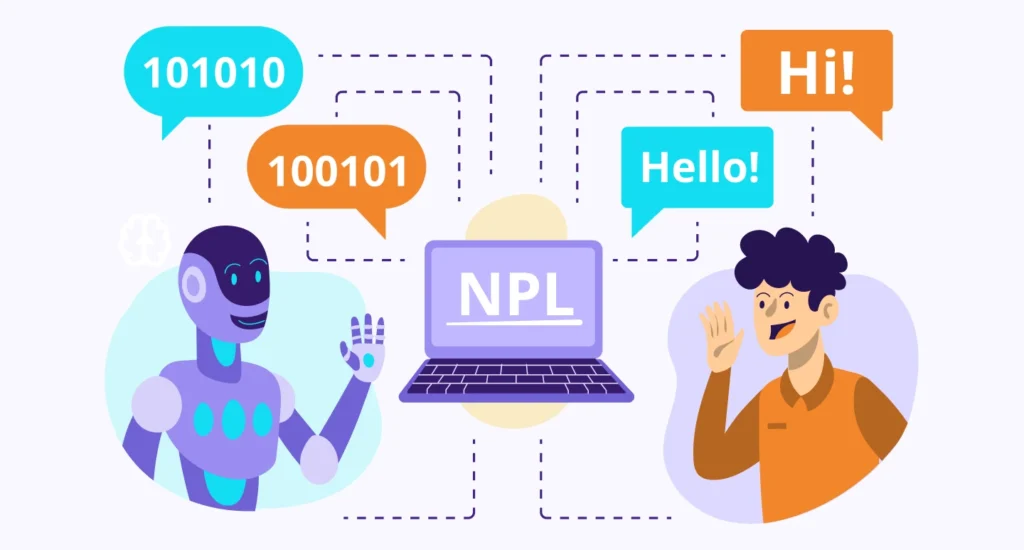
Your language model is the cognitive engine of your AI agent. Recent breakthroughs in large language models have made it possible to incorporate the marvellous faculties of understanding, reasoning, and generation into agent systems. In short, you have many more powerful options:
- OpenAI’s GPT-4o provides superior general-purpose performance and strong reasoning capabilities.
- Claude from Anthropic is renowned for its focus on security and comprehension of a long context.
- Both Mistral and Mixtral provide high-performance, open-source alternatives with even lower computational requirements.
- Another strong entry, especially for on-premise uses, is LLaMA 3 from Meta.
Frameworks help in orchestrating your model’s abilities. LangChain is by far the most prevailing framework right now, as it allows integration of tools and memory, along with reasoning pipelines for the current situation. Auto-GPT and AgentGPT are excellent choices for creating more autonomous and explorative agents; however, their performance may not be as stable in a production environment.
Choose a model and framework to use based on your use case, data constraints, and comfort level within your technical team.
Set Up the Development Environment
After finding the best tools for your project, it is time to set up your development environment. Python is one of the common programming languages for building most AI agents because of the mature ecosystem along with the ease of using many ML libraries. If the AI agent development process is to be heavily browser- or frontend-related, JavaScript or TypeScript could be a better choice.
You will probably need libraries and tools like:
- Hugging Face Transformers: For model access and fine-tuning.
- LangChain: For chaining prompts, managing memory, and tool usage.
- FastAPI or Flask: For building web endpoints.
- Docker: For containerisation and easy deployment.
- Jupyter or VS Code: For local development and debugging.
It is imperative to go modular. Think of each module (model, memory, tools, UI) as something you can swap in/out. This architecture will make testing, upgrading, and scaling much more understandable.
Knowledge Integration: Making Your Agent Informed
Even the mightiest LLMs have their limitations; either they weren’t aware of your internal documents or business workflows or real-time data. This is where knowledge integration comes in.
By using Vector Databases like Pinecone, Weaviate, or Chroma, one can build an intelligent agent equipped with an automated memory system that stores and retrieves documents, historical conversations, or domain-specific knowledge to provide accurate information for decision-making processes.
Indeed, Retrieval-Augmented Generation (RAG) is a powerful technique involving the retrieval of relevant content from a vector store and adding it to a prompt for the LLM. This provides additional factuality and domain alignment to the response.
You can make your AI agent a real, trustworthy representation of your brand’s expertise by using proprietary knowledge bases.
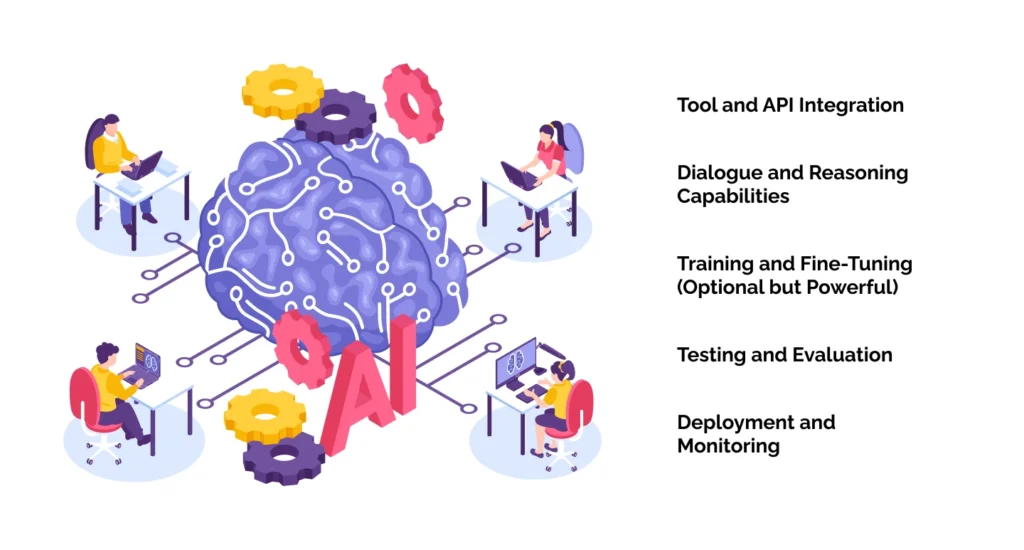
Tool and API Integration
The real strength of AI agents is not in understanding language but in acting on it. Therefore, we need to link these agents with APIs and tools to perform tasks effectively. To execute tasks, these agents require integration with APIs and tools. When you ask your virtual assistant to schedule a meeting, it should query the calendar API, send email invitations, and alert users. In the same context, it could be a research bot that scrapes webpages, analyses reports, or writes code – and does so without any manual effort.
The APIs for your email place requests for HTTP, database, CRM, browser, or any third-party plugins. Ensure that your agent is also accompanied by a decision engine to intelligently determine when and how to call these tools, such as an agent executor from LangChain.
Tool integration transforms your AI agent from a passive responder into an active participant.
Dialogue and Reasoning Capabilities
Intelligence is not just about having answers. It is also about reasoning. An intelligent AI agent must be capable of dealing with ambiguities, making decisions, and handling multi-step conversations. Frameworks like LangChain enable the creation of structured chains to make complex decisions.
It is possible to design prompt chains that include memory, tools, and functions such as validation and routing.
The ReAct (Reasoning + Acting) pattern is really the best for more adaptive reasoning – the method where agents reason through a problem step-by-step while calling tools mid-process and changing their minds based on observations.
Agents handling customer queries, internal help desks, or any scenario where information unfolds progressively will find it useful.
Training and Fine-Tuning (Optional but Powerful)
Thus, in most general-purpose scenarios, these LLMs perform well. However, modelling fine-tuning or embedding domain-specific behaviours can greatly enhance performance in specialised environments.
Fine-tuning is excellent when:
- Your model must convey a certain tone or style.
- Your model should pick up some very specific jargon.
- You wish to constrain responses to some limited context.
The fine-tuning can be done using tools like the Trainer from Hugging Face or the fine-tuning API from OpenAI. Besides, Low-Rank Adaptation (LoRA) is powerful in terms of cost efficiency for learning on small task-specific datasets.
Feedback loops can improve the accuracy of the agent’s responses over time, training the system along the way through user interactions.
Testing and Evaluation
Before going live, it is important to thoroughly test for reliability and safety. We should train it to handle edge cases, incorrect inputs, and occasionally malicious prompts without any failures.
Establish the design criteria necessary for creating a suite of automated and manual test cases:
- Accuracy: Is the information accurate?.
- Consistency: Is the agent behaving the same way in different sessions?.
- Latency: Are responses generated in a timeframe that’s acceptable to the user?.
- Recovery: Can it gracefully fail or ask for clarification?.
Real users should be involved early in the feedback cycle. Employ logging to track output and failures to achieve continuous improvement of the system.
Deployment and Monitoring
Be sure that your AI agent has passed through testing and is ready to enter its first phase of production. Depending on the risk appetite, user base, and compliance requirements, it may be deployed in a public cloud (such as AWS, Azure, or GCP), locally, or in a hybrid model.
The following are some of the important aspects regarding the deployment:
- Scalability: Does your architecture provide sudden spikes in usage?
- Latency: How near are your endpoints to your users?
- Security: Is data encrypted and access controlled?
We must monitor everything after deployment, including usage metrics, error rates, and API costs. Dashboards and alerts should provide visibility into performance exceptions, drift monitoring, and improvement opportunities.
Need help deploying and monitoring AI agents at scale? [Reach out to our team].
Partnering with Esferasoft: Accelerate Your AI Agent Development
As demanding an experience as creating AI agent from scratch is, it has both rewards and requirements, such as expertise in machine learning, advanced software architecture design, and thorough strategic business understanding of workflows, user experience, and data integration. Esferasoft will join you there.
What we, a trusted technology partner, do best is design and build intelligent AI solutions suitable to your business needs. It does not matter whether you are a startup testing AI can be utilised for customer support or by large enterprises seeking to automate their in-house operations. We support your business from inception to end as you transition to AI.
An experienced team of AI engineers, data scientists, and system architects makes Esferasoft enter into the arena:
- Domain expertise in integrating LLMs like GPT-4, Claude, and LLaMA into scalable, production-ready systems.
- Esferasoft possesses technology proficiency in LangChain, Auto-GPT, ReAct, and other advanced agent orchestration tools.
- Custom AI agent development process include UI/UX design, API integrations, and cloud/on-prem deployment.
- Post-launch support, including performance monitoring, ongoing enhancements, and model fine-tuning.
What differentiates us is neither technical capability nor the ability to translate business goals into intelligent systems that yield measurable results. Rather, theirs is a consultative approach that will ensure your AI agent doesn’t just work; it will excel, adapt, and truly add value to operations.
Thinking of building an AI agent tailored to your business? [Partner with Esferasoft and make it happen].
Your AI Agent Journey Starts Here
Building a completely new AI agent is more than just a technical endeavour; it is a strategic decision. This feature empowers the organisation to not just leave generic tools behind but also define something totally aligned with its unique goals, data, and workflow.
In this guide, we have covered the complete process of developing an AI agent, which includes identifying use cases, selecting architecture, choosing appropriate language models, integrating tools, and deploying a reliable solution. Each stage presents a clear opportunity to design clearly, innovate with an intentional goal, and solve real-world problems, beyond the match of pre-built systems.
But remember that this journey does not stop with deployment. The best AI agents evolve: they learn from user feedback, adapt to newer data, and become more valuable with time. Whether you are working on problems with a limited scope or building the foundation for wider-scale automation, beginning with a carefully considered, modular approach will ensure you achieve the success of tomorrow.
Don’t wait for the “perfect” time or the perfect dataset. Start building, iterating. Start small – but start smart. The insights you glean in these early stages will be those with which you build the intelligent systems defining your future.
Want to build a solution tailored to your industry or workflow? [Let’s build it together—connect with our AI team today at +91 772-3000-038].