
The taxi and ride-hailing industry is moving toward an intelligent future. By the year 2026, the basic booking application will no longer meet the expectations of either the user or the businesses. Instead, we are rebuilding platforms with the introduction of features in ai-powered taxi applications that help improve speed, safety, accuracy in pricing, and overall control of operations.
First, there are daily challenges such as long waits, unwanted routes, and unpredictable demand to deal with. AI has been integrated into ride-hailing apps whereby real-time analysis of data is done for optimizing driver allocation, making price decisions, routing by traffic, etc. This makes trip completion faster and more reliable.
Next, enhancing customer experience. Smart taxi app features assess user behavior, location patterns, and service preferences to provide a more personalized and consistent ride experience. This renders next-gen taxi app features a must-have for any platform operating in an overcrowded marketplace.
Last but not the least, growth is being supported at scale. AI-powered ride-hailing solutions are managing fleets, reducing risks, and optimizing operations. In AI-enabled taxi app development, features of the future taxi app 2026 are no longer options; they are being developed into the new industry standard.
What Is an AI-Powered Taxi App?
An artificial intelligence-AI-powered taxi app is an application with a ride-hailing platform where functions such as bookings, routing, fare setting, safety, and fleet operations are automated by machines. The app will use real-time data and predictive analysis rather than operate purely within manual rules or fixed systems in deciding various operations.
An initial segment of the trip begins with ride requests being matched with the correct driver by location, traffic, availability, and performance history of drivers. This method is therefore aimed at reducing the waiting time of drivers in search of fares while maximizing the use of trips. Then, routing will be done through live road conditions to guarantee quicker and cheaper flow.
Furthermore, dynamic pricing is in effect, depending on demand, locations, and market conditions. AI systems will also streamline, among other things, customer support, fraud prevention, and driver behavior.
An AI taxi app means smarter rides, better control on the side of operators, and overall reliability for the passengers and drivers. alike: talk about setting the stage for next-gen ride-hailing platforms!
Why Every Modern Taxi App Needs AI in 2026
Taxi apps will function in a highly competitive fast-moving digital space by 2026. Users’ expectations will continue to grow; operating costs become higher and urban mobility is more complicated. Therefore, modern taxi platforms should apply artificial intelligence in processing data, automating decision-making, and improving service performance at every stage of the ride experience to remain relevant and scalable.
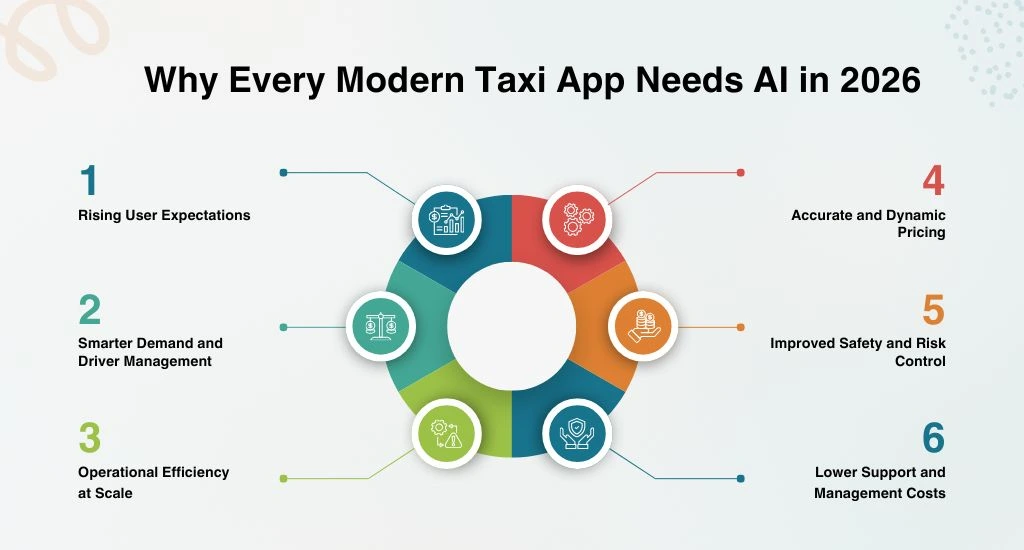
Rising User Expectations
Passengers now expect quick pickups, accurate ETA, bargain fares, and smooth rides; AI has allowed taxi apps to process live data, thereby making instant decisions in terms of service quality improvement and increased customer satisfaction.
Smarter Demand and Driver Management
Ride requests, traffic conditions, and driver availability are ever changing. AI real-time analysis of this given data optimizes driver-rider allocation, reduces waiting time, and increases ride completion rates.
Operational Efficiency at Scale
As soon as a taxi platform grows, managing its drivers, vehicles, and trips manually tends to become more time-consuming and expensive. With AI handling crucial tasks of dispatching, routing, and performance tracking, vehicles keep moving instead of idling, and operations run seamlessly as the demand rises.
Accurate and Dynamic Pricing
Fares should reflect the realities of demand, location, and traffic conditions. Constantly intervening manually, AI does real-time, live data-driven price adjustments with the aim to keep fares fair to riders, profitable to the business, and rewarding to drivers.
Improved Safety and Risk Control
Clearly, Safety is paramount for both passengers and drivers. All that AI does is monitor driving behavior, trip patterns, and suspicious actions through every trip from point A to point B. Early detection of risks will help action fraud reduction, incrementing on-road safety, and instilling trust on the platform.
Lower Support and Management Costs
Desperately needed are long hours and hundreds of people working in a support team to take care of customer queries and trip issues manually . Many of such tasks are automated by AI-injected tools that make for quicker responses and fewer mistakes thus enabling a reduction of operational workload whilst maintaining consistent reliable service.
Top 12 AI-Powered Features in Taxi Apps for 2026 to Include in Your Taxi App
By that time, all taxi platforms will have to meet greater and greater user expectations and business requirements by 2026. Hence, speed, intelligence, and, above all, precision will become increasingly important for them in the near future. Therefore, here is where the elements into which the taxi apps derive their functionality from artificial intelligence will begin to take shape.
AI provides intelligent matching of rides, live pricing, demand prediction, safety measures, and many automated systems. These days, modern taxi applications are being developed to foresee user call requirements, optimize driver performance, and effectively manage fleet resources, and that means lower cost, better scaling, and stronger control of daily operations for operators; faster pickup time, accurate fare, and seamless travel experience for riders.
In this section, the top 12 must-have features of a next-gen taxi application, to stay competitive, reliable, and ready for the demands arising in 2026, are discussed.
1. Smart Driver and Passenger Matching
AI matches drivers by location, traffic conditions, availability, and performance. As a result, the waiting time is minimized, trip acceptance is maximized, and a smooth interaction is created for both rider and driver.
2. Dynamic Pricing Optimization
They change fares dynamically according to demand, time of day, and traffic patterns. This allows the price to be fair for the customers without depriving the driver of his earnings while ensuring that the platform’s bottom line remains healthy.
3. AI-Based Route Optimization:
With live updates on traffic and closures on the roads, the AI chooses the quickest and cheapest options to minimize travel time, enhancing the experience for their customer.
4. Predictive Demand Forecasting
Artificially Intelligent systems analyze historical trips, weather, and activity in the cities to predict the places where demand would change, thereby positioning the drivers ahead of time and reducing the standing time for customer services.
5.Smart Dispatch Automation:
Means that ride requests are assigned based on real-time conditions instead of manual input.The result is that requests are booked faster, cancellations are less frequent, and the fleet is operated efficiently.
6. Driver Behavior Monitoring
AI in monitoring driving patterns in the format of speeding, sudden braking, and signs of fatigue. This is key to ensure safety, service-level conformity, and compliance control in a reasonably manageable risk level for the operators.
7. Fraud Detection and Passenger Safety:
Suspected activities, including ghost bookings, GPS manipulation, and payment misuse, are detected through fraud detection and passenger safety. If there are some unusual trip behaviors, the detection is done very early, and the passenger is protected, as well as sustains the trust toward the platform.
8. AI Chatbots and Voice Assistants:
Your virtual assistants can also do automated bookings, cancellations, and refunds as well as the usual support requests-they’re very fast considering that all these actions now ease up the workload for support, increases speed of responses, and overall improvement in user experience.
9. Sentiment and Feedback Analysis
In this case, the comments on customer reviews and in-app feedback serve to reveal any service concerns, the level of satisfaction by understanding the actual behavior of users, and adjustments in operations.
10. Predictive Vehicle Maintenance
Monitoring vehicles give advancement information on the needed maintenance from breakdown, reducing the time to be out of operations, improving fleet reliability, and bringing down long-term costs of repairs.
11. Fleet Optimization and Management
AI tracks vehicles, measures supply and demand, and minimizes idle time. This gives operators clearer visibility into performance, improves revenue control, and supports smooth scaling as the business grows.
12. Personalized Ride Recommendations
User habits, locations, and preferences are analyzed to suggest faster bookings, preferred pickup points, and scheduling options. This increases retention and customer loyalty.

Common Challenges Taxi Apps Face & How AI Solves
Among the issues that taxi applications seem to be struggling with most include extended waiting times, poor routing, pricing-related concerns, and fraud. AI solves problems such as these in ride-hailing apps, mainly through the methods of automatic processes, predictive analytics, smart dispatch systems, and real-time decision making for ensuring better performance.
Long Wait Times and Missed Pickups
AI matches riders with the most suitable available driver using real-time location, traffic, and availability data. This reduces waiting time and increases the likelihood of successful, on-time pickups.
Inefficient Routing and Higher Trip Costs
AI selects faster and more fuel-efficient routes based on live traffic conditions and road data. This helps drivers complete trips quicker while lowering fuel usage and operational expenses.
Unstable Pricing and Revenue Loss
AI’s dynamic pricing alters fares based on demand, time of the day, and location. This keeps fares competitive for the customer, protecting driver earnings and ensuring platform profitability.
Safety Risks and Compliance Issues
Through the monitoring of driving behavior and trip activity, it is AI that detects any risky actions at an early stage. This improves passenger safety and helps maintain regulatory compliance across operations.
Fraud, False Bookings, and Payment Abuse
AI identifies suspicious patterns such as GPS manipulation, duplicate accounts, and fraudulent transactions. This prevents system misuse and enhances customer trust in the platform.
High Support Costs and Slow Response Times
AI-powered chatbots handle common queries instantly. This reduces the workload on support teams and improves response speed for customer issues.
Poor Fleet Utilization and Downtime
AI captures the moment demand and supply changes in real-time and puts drivers optimally, such that it reduces idle time and maximizes productivity across the fleet.
How to Build an AI-Powered Taxi App With Esferasoft Solutions.
Creating a smart mobility platform is a complete process. Building a taxi application using AI is an end-to-end solution for Esferasoft Solutions, offering scalable, secure, and future-ready systems using AI in ride-hailing apps through advanced automation and data-driven architecture for long-term growth.
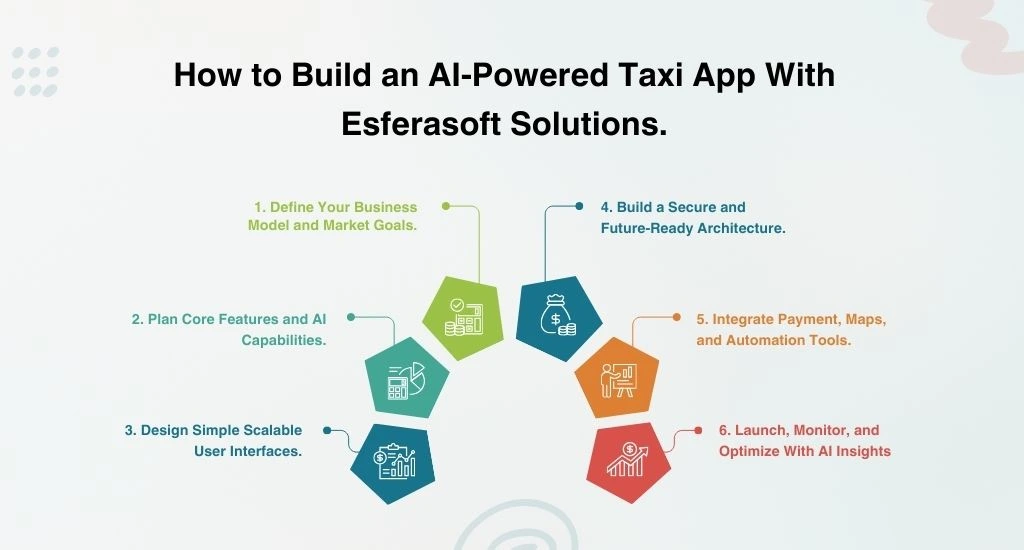
1. Define Your Business Model and Market Goals.
Esferasoft starts with an understanding of your service area, target users, revenue structure, and goals for growth. This alignment ensures that your AI taxi app will meet real business needs, right from day one.
2. Plan Core Features and AI Capabilities.
Mapping the core services of ride-booking, dispatching, payments, and analytics on a competitive platform requires AI capabilities such as smart matching, dynamic pricing, and demand forecasting.
3. Design Simple Scalable User Interfaces.
User pathways designed for speed, clarity, and ease of use among riders, drivers, and admin pave the way for smoother adoption and greater engagement across all users of the app.
4. Build a Secure and Future-Ready Architecture.
Backends built on a scalable infrastructure, secure APIs, and cloud integrations ensure rising demand and incoming high traffic for future AI enhancements without limitation of the system.
5. Integrate Payment, Maps, and Automation Tools.
Essential services such as payment gateways, GPS navigation, and notifications, along with AI automation, are integrated for real-time performance and operational efficiency.
6. Launch, Monitor, and Optimize With AI Insights
After deployment, performance, user behavior, and system data are continuously monitored. Esferasoft enhances features, improves AI models, and scales the platform based on real-world usage.
Conclusion
The future of taxi and ride-hailing platforms is in intelligent systems that are data-driven. AI is the foundation of modern mobility platforms, not a feature. As user expectations increase and competition heats up, AI will enable features such as smart driver matching, dynamic prices, fraud prevention, fleet optimization, and personalized experiences, changing how taxi apps operate, scale, and succeed.
AI technology delivers stronger control, better efficiency, enhanced safety, and higher customer satisfaction when incorporated into all layers of operations. Such features address the challenges of today but also equip the platforms for demands beyond 2026.
As much as possible, this investment is no longer an option for businesses that want to be up to date with this constantly changing transport environment where AI-driven taxi platforms become the ultimate solution to the riddle of success for the long term.
Faq’s
1. AI Powered features in taxi booking applications?
The intelligent systems in taxi applications measure up with AI-enabled feature applications which manage the functions of driver matching, pricing, routing, safety checks, and fleet management that make the overall system better to ensure smooth and dependable experiences for users.
2. In what ways does AI make riding more enjoyable with ride-hailing applications?
AI improves the ride experience by matching riders with the right drivers faster, predicting demand, and adjusting prices automatically. Smarter routing and improved safety also mean shorter trips, lower costs, and a more dependable service.
3. Will 2026 expect AI features in taxi apps?
By 2026, users will expect faster service, better pricing, and higher safety standards. Traffic conditions and competition will also increase. AI makes it possible to automate operations, scale efficiently, prevent fraud, and make real-time decisions that keep platforms competitive.
4. What are AI features that every taxi app should have?
The Modern taxi application must include intelligent driver-matching, dynamic pricing, optimized routes, prediction of demand, scam detection, behavior monitoring of drivers, fleet management tools, and AI chatbots for customer service.
7. How does AI work with fleet management in taxi apps?
AI manages fleets by balancing demand and supply in real-time so as to minimize vehicle down-time, predict maintenance, and maximize usage of vehicles.
8. Why choose Esferasoft Solutions for AI taxi app development?
Esferasoft Solutions creates scalable AI-driven taxi apps smartly automated, using predictive analytics and future-ready architecture with a secure, performance-optimized, and growth-oriented approach, thereby assisting businesses to establish reliable and highly competitive ride-hailing platforms.