
The current world, which has constant digital links, shows customers who interact with brands through different communication methods. AI chatbot services require customers to receive uninterrupted service from all available contact methods, starting from in-store service desks and continuing to email, phone calls, chatbots, and social media. The customer service industry has found its most effective transformation tool through conversational AI technology. Enterprises that use AI chatbots, virtual assistants, and automated systems create unified customer experiences through their digital channels. The system functions as an automated response generator, which can answer customer questions while it operates as a super-intelligent system that comprehends and processes consumer inquiries.
The blog post will examine how conversational AI improves omnichannel customer experience through its advantages, which businesses can use to enhance their customer service operations.
What is Conversational AI?
The technology of conversational AI enables machines to understand human language through natural language processing, which allows them to comprehend human speech and communicate with users through interactive dialogue. The foundation of conversational AI combines three technologies, which are natural language processing (NLP), machine learning, and deep learning, to create human-like interaction capabilities. The technology enables businesses to establish permanent customer connections through chatbots and virtual assistants and voice-activated AI tools, which function as round-the-clock customer service agents to improve cross-channel communication.
The primary benefit of conversational AI for businesses exists because it enables users to engage with the system through natural language while developing an understanding of contextual information. The ability of conversational AI to learn from fresh data empowers businesses to provide better customer service, which creates more personalized experiences for their customers.
What is Omnichannel Customer Experience?
The term “Omnichannel customer experience” refers to providing an endless and integrated customer experience across numerous channels. We recommend treating every point of customer interaction or engagement with your brand, including social media platforms, emails, and live chats, as a customer interaction. Thus, the two methods of handling customer interactions differ because multichannel strategies treat each contact point as a free entity, while omnichannel strategies for customer service create a logical customer journey through all interaction points.
The overall purpose of omnichannel customer experience is to create a system that permits customers to transfer between several channels while keeping their existing knowledge without requiring them to repeat information they shared. Moreover, users who start conversations over social media and progress to live chat and then move on to phone calls should experience an integrated journey within their interactions.
How conversational AI improves customer services ?
The inclusion of conversational AI is a big win for all sectors, whether it’s logistics, e-commerce, or retail. It can drastically improve customer service by enabling businesses to fine-tune responses. providing instant support and delivering a seamless customer experience. Here’s how it can elevate customer service:
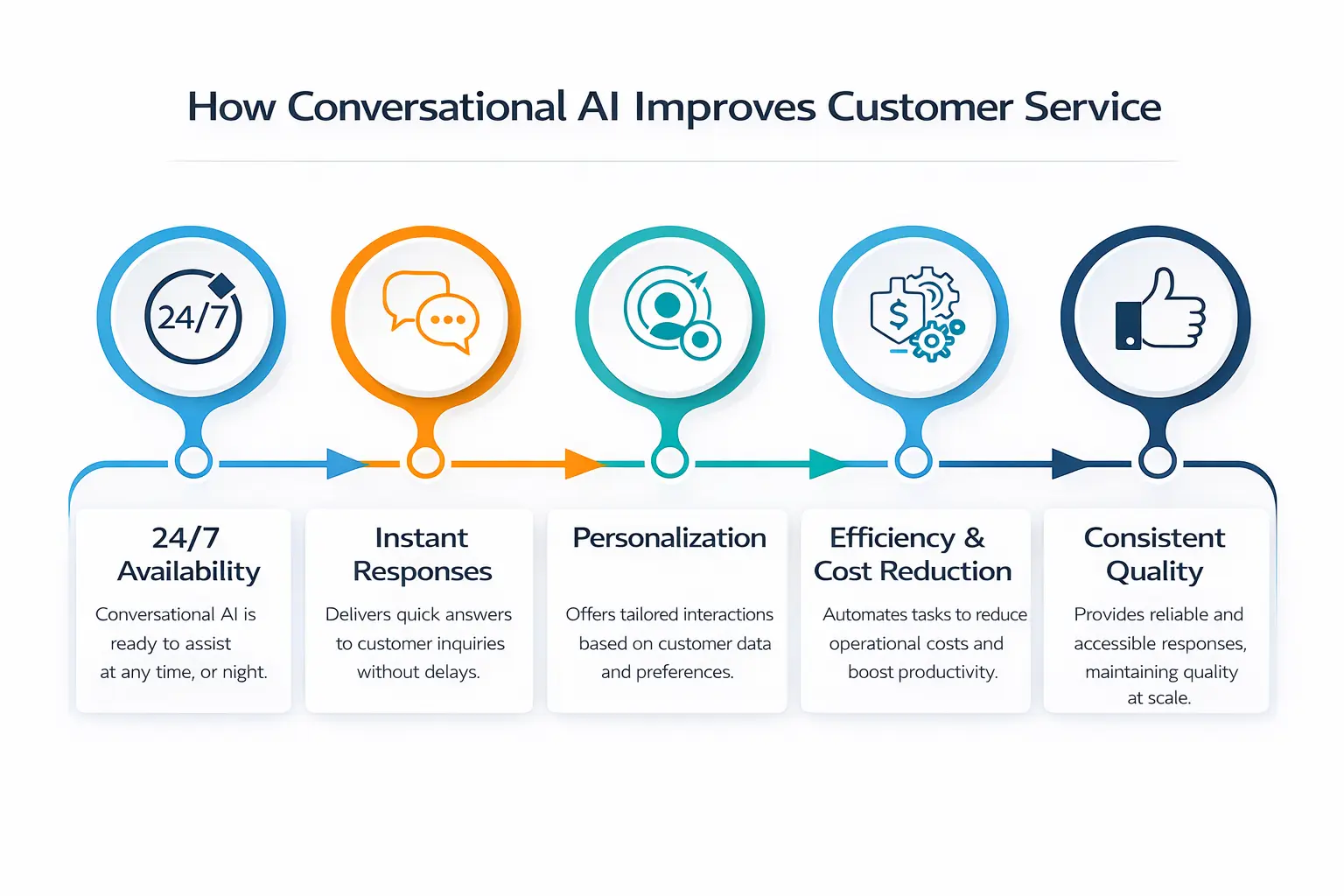
24/7 Availability:
The conversational AI system provides businesses with continuous support by enabling them to use conversational AI for 24-hour service. Customers can receive assistance at any time from any location because AI chatbots and virtual assistants operate without needing breaks.
Instant Responses:
In this fast-forward world, every customer expects prompt responses and conversational AI done exactly by providing instant replies, reducing wait times, and boosting customer satisfaction.
Personalization:
With data analytics and machine learning, conversational AI can easily cater to replies based on customer data, creating a personalized experience for each individual. Furthermore, it also remembers previous interactions, issues, and preferences, allowing for more relevant & targeted conversations.
Efficiency and Cost Reduction:
By digitalizing routine queries, this technology frees up customer service agents to focus more on complex issues. This improves efficiency and reduces costs linked with customer support.
Consistent Quality:
Unlike human agents, who may vary in their responses depending on mood or workload, conversational AI offers consistent quality in every interaction, ensuring that customers always get the same level of service.
What are the benefits of conversational AI for customer service?
The marketplace provides businesses and customers with multiple conversational AI benefits that result in a greater customer experience. The systems reach their maximum operational capacity by using automated procedures that leverage this cutting-edge technology throughout their entire infrastructure. Your customer service strategy requires this element because it delivers essential benefits that help your operations.
Enhanced Customer Satisfaction
The usage of quick response time, along with personalized customer interactions, directly leads to an enhanced customer satisfaction rate. Therefore, the brand maintains customer loyalty because it provides instant solutions to inquiries without requiring customers to spend extended time waiting for assistance.
Higher Efficiency
The implementation of conversational AI technologies enables customer service teams to automate minor tasks, which allows them to dedicate their time to more essential work. The brand eventually boosts its productivity by optimizing employee performance and fluent resource allocation.
Scalability
The need for customer support services will grow as your company expands its business operations. The software allows businesses to increase their customer service capacity by establishing new service points without hiring extra personnel. The AI systems utilize their capacity to manage multiple simultaneous user interactions.
Cost Savings
Companies that use AI to automate basic operations can decrease their need for human workers, which results in lower staffing expenses and better work processes.
Data-Driven Insights
The conversational AI tools create extensive data sets that organizations can utilize to understand customer preferences and pain points, and customer behavior patterns. The gathered information serves as a foundation for enhancing all product offerings and the overall customer satisfaction experience.
Increased Engagement
Through AI technology, brands can establish instant communication with their customers, which creates an interactive experience that keeps customers interested in their products. The process helps to develop stronger connections, which result in higher brand loyalty.
Real-World Examples of Conversational AI in Omnichannel CX
The implementation of conversational AI in Omnichannel CX has changed the entire landscape of industries. Here are some relevant real-world examples where conversational AI plays a crucial role:
Sephora:
The global cosmetics brand Sephora operates its virtual artist chatbot through its website and mobile application and its in-store services. The AI-powered chatbot helps customers select makeup products that match their skin tone and style preferences while showing product availability for different shopping channels.
H&M:
The fashion retailer H&M has implemented a Facebook Messenger chatbot that helps customers find their desired outfits while checking product stock and receiving tailored fashion advice. The chatbot system provides customers with a uniform experience through its operation in all online channels and physical store locations for the company.
Lufthansa:
The chatbot Mildred from Lufthansa assists customers with flight bookings and check-in procedures while enabling them to view flight information through web, mobile, and social media platforms. The bot guarantees that customers who interact with the airline through any channel will receive the same trustworthy and effective service.
How does conversational AI work in customer service?
The operational mechanism of AI chatbot services can be described through these particular steps.
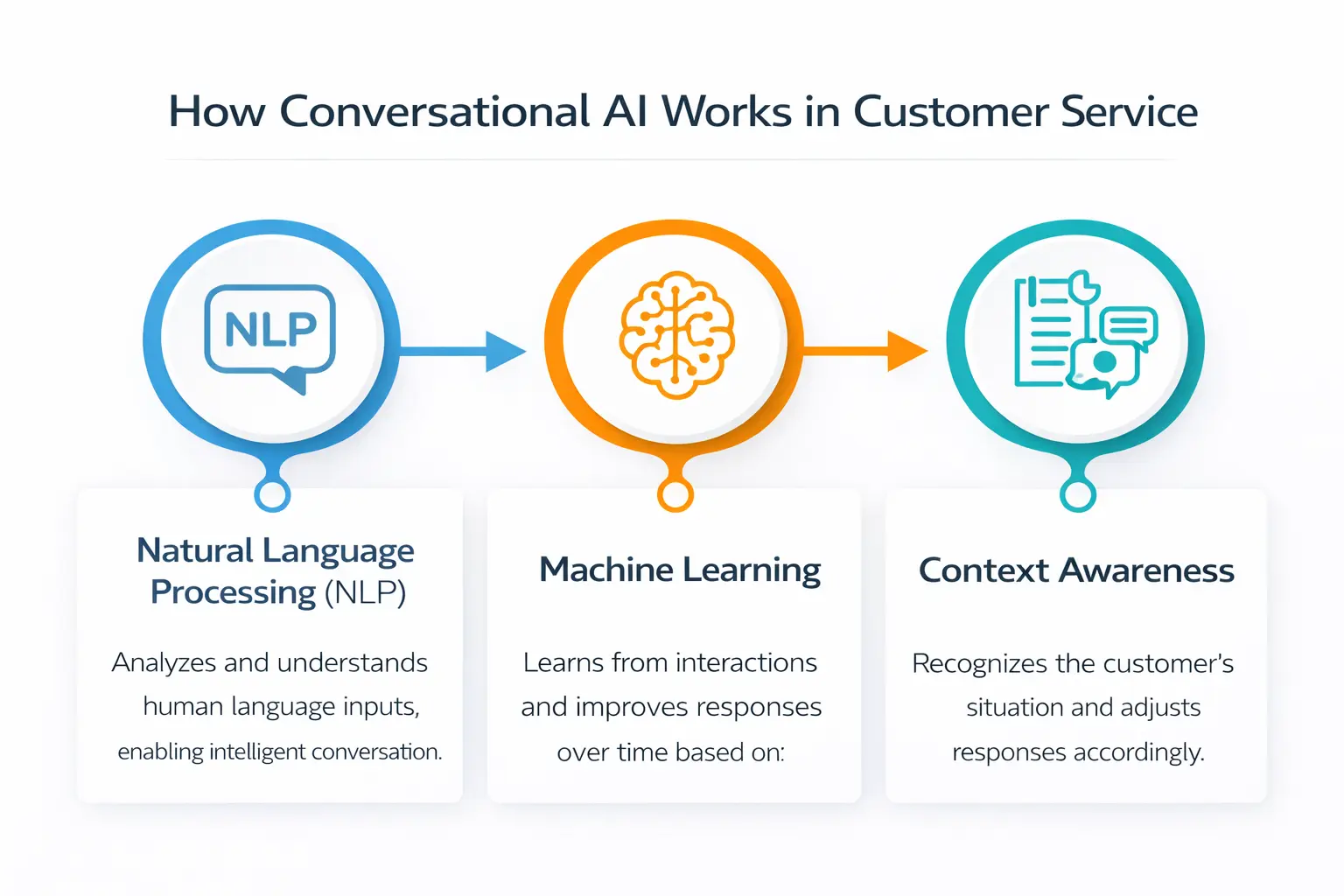
Natural Language Processing (NLP)
The AI system uses natural language processing to understand human speech. The AI system uses customer inquiries to generate operational insights, which enable it to reply through natural and intuitive methods.
Machine Learning
The AI system uses machine learning to enhance its response system because it gathers knowledge throughout each customer interaction. The system adjusts its answers to customer behavior, their preferred ways of doing things, and their established patterns.
Context Awareness
Conversational AI systems use advanced technology to identify the relationship between different parts of an ongoing conversation. The AI system applies its previously acquired knowledge to all customer contact points, which include web-based communication, voice assistant usage, and social media websites, to create tailored customer experiences.
Existing systems function together with conversational AI, which connects customer support systems, CRM systems, and database systems to obtain the required customer data. The AI and machine learning for CX create personalized answers that include account information and customized product suggestions
Types of Conversational AI for Customer Service
Numerous types of conversational AI are available for customer experience automation. A few of them are discussed below:
Text-based Chatbots
The chatbots use text messages to interact with customers. Users can access the system through websites, social media platforms, and mobile applications to receive assistance with their questions, product suggestions, and customer support needs.
Voice Assistants
The customer service sector increasingly depends on voice assistants, which include Amazon Alexa and Google Assistant. The AI assistants possess the ability to perform various tasks, which include scheduling appointments and providing answers to customer inquiries.
Virtual Assistants
Virtual assistants provide multimodal capabilities through their advanced functions, which allow users to communicate through text, voice, and video. The system offers multiple complex functions, which include travel arrangements and personalized shopping support.
AI-Powered IVR (Interactive Voice Response)
The AI system uses voice technology to direct customers through phone menu options, which enable them to resolve their problems without human contact.
Core Challenges in Implementing Conversational AI for Omnichannel CX
To gain an exceptional omnichannel customer experience, implementing conversational AI is a daunting task and brings many challenges. Here are a few examples of these challenges:
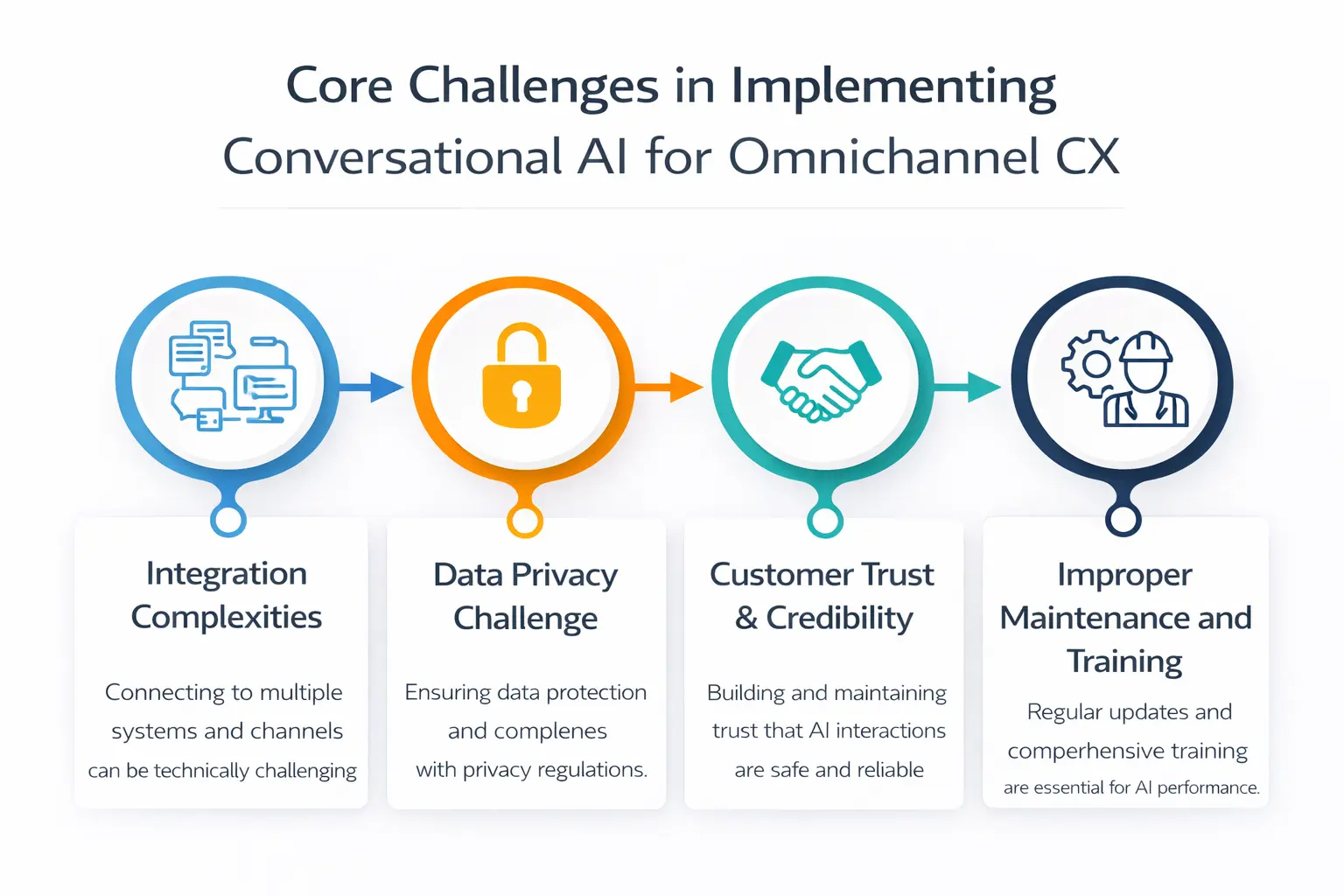
Integration Complexities
The implementation of conversational AI across different communication channels presents substantial integration difficulties due to its requirements to connect with existing customer service systems, CRM platforms, and database systems.
Data Privacy Challenge
The implementation of conversational AI across different communication channels presents substantial integration difficulties due to its requirements to connect with existing customer service systems, CRM platforms, and database systems.
Customer Trust & Credibility
Several customers exhibit distrust toward AI-based systems when they need assistance with complicated or sensitive matters. The transparent delivery of information to customers serves as the fundamental method for establishing their trust in the organization.
Improper Maintenance and Training
The operational efficiency of conversational AI systems depends on their need for continuous maintenance and training activities, which sustain their operational capabilities over time. The system requires updates of new information, language model enhancements, and solutions to any problems that emerge during user interactions.
Choosing the best conversational AI chatbot software for customer service
While choosing the best conversational AI software for AI-driven customer support, enterprises must consider numerous factors:
| CHALLENGES | DESCRIPTION |
| Ease of Integration | Look for AI systems that can easily integrate with your existing platforms, along with customer service tools. |
| Multichannel Support | Multichannel Support encompasses all the channels your customers use, including live chat, social media, and voice assistants. |
| Natural Language Understanding (NLU) | Choose a platform that excels in understanding and processing human language, providing accurate and relevant responses. |
| Scalability | As your business grows, the AI system should be able to scale accordingly, handling increased interactions without compromising quality. |
Enhance your Service Operations with Conversational AI
By successfully integrating conversational AI into the system operations, businesses can enhance their customer service operations in multiple ways. The AI-powered chatbots and virtual assistants can tackle a wider range of customer queries. From simple requests to more complicated troubleshooting tasks, automation allows enterprises to free up human agents, enabling them to focus on achieving high-value interactions.
Therefore, conversational AI systems can effectively gather valuable insights about customer preferences, behaviors, and pain points, enabling businesses to constantly improve their products, services, and CX.
Best Practices for Successful Implementation
The most effective strategy for omnichannel customer service requires your organization to implement effective execution practices for optimal results.
Define your Objectives
The process of implementing conversational AI requires organizations to establish specific targets, which include achieving particular goals and measurable results like faster response times, better customer satisfaction, and improved process efficiency.
Train Your AI System Regularly
The systems that operate through conversational AI need constant education and development throughout their entire operational lifespan. Your AI system requires you to keep expanding its knowledge base by adding fresh content, new product information, and customer feedback data.
Ensure Smooth Handoff to Human Agents
The AI system needs human assistance when it encounters issues that go beyond its ability to solve them. The system prevents customer disappointment because it provides complete solutions for all their problems.
Monitor and Optimize Performance
The agency must create regular AI system performance monitoring procedures, which will use customer feedback and performance data to improve system performance.
Future of Conversational AI in Omnichannel CX
The upcoming advancements in conversational AI systems will completely transform customer interactions with businesses by implementing various communication methods. The future of conversational AI includes:
Hyper-Personalization
AI will use data analysis to create personalized recommendations and services that match individual customer preferences and their specific behavior patterns.
Voice Commerce
The increase in voice assistant usage will enable customers to use voice commands for shopping and brand interaction through conversational AI technology.
AI-Driven Customer Insights
Companies will employ AI technology to study customer behavior, which will enable them to create new products, develop successful marketing strategies, and improve their customer support operations.
Conclusion
Last but not least, conversational AI represents the next significant advancement in customer service operations. These systems are reshaping the way businesses approach customer service in the age of omnichannel engagement. Consequently, these systems provide 24/7 availability, personalized interactions, and seamless integration across multiple platforms. Along with this, conversational AI boosts customer satisfaction, reduces operational costs, and delivers helpful data for regular improvement.
Thus, embracing conversational AI technology is no longer a choice for retail businesses but also a necessity for businesses looking to stay highly competitive and meet the rising demands of today’s customers
In case you need genuine assistance for AI chatbot services, book your consultation session with Esferasoft Solutions Today.
Faq’s:
What is the difference between conversational AI and chatbots?
Chatbots follow pre-programmed contexts and scripts with restricted responses. On the other hand, Conversational AI uses natural language processing along with machine learning to deeply understand context. handle complex queries, and have more human-like chats across multiple turns.
How does conversational AI learn from customer interactions?
The system makes use of exceptional conversational patterns and user intent, along with sentiment analysis, to enhance its core language model result evaluation. Furthermore, machine learning algorithms recognize which responses work fine and adapt to new phrases and questions to improve accuracy over time through continuous training on real interaction data.
Can conversational AI replace human customer service agents?
The AI system manages basic customer service functions because it can handle standard customer requests. Human empathy and judgment remain necessary for handling complicated problems together with emotional situations. The best approach combines both.
What are the key metrics to track for successful conversational AI implementation?
The main measurements that need to be monitored for successful conversational AI deployment include:
- The containment rate shows how many cases were solved without needing human intervention.
- The customer satisfaction score (CSAT) measures how satisfied customers are with their experience.
- The first contact resolution rate shows the percentage of cases that get solved during the first customer battle.
- The average handling time measures how long it takes to handle each customer request.
- The escalation rate shows how many cases need to be sent to higher authorities for resolution.
- The system measures how accurately it can identify user intents.
- The system measures how successfully users complete their conversations with the AI.
- The cost per interaction specifies how much each customer interaction costs the organization.
How can conversational AI personalize customer interactions?
Customer interactions receive AI-based personalization through its ability to access customer history and purchase data, together with customer preferences and past interactions, for personalized response creation. The virtual assistants in the system can identify returning customers who should get personalized product recommendations, together with sentiment-based tone adjustments and resolution of their unique requirements.
How can conversational AI improve customer satisfaction across different channels?
AI-based conversational systems enhance customer satisfaction across multiple channels by delivering consistent experiences to customers using chat, voice, email, and social media. These systems provide 24/7 access to instant answers, allowing customers to switch between channels without losing their current conversation. Additionally, their unique customer information remains accessible for personalized assistance at any contact point.
What industries benefit the most from implementing conversational AI for omnichannel CX?
E-commerce/Retail (product queries, order tracking), Banking/Finance (account inquiries, transactions), Healthcare (appointment scheduling, basic triage), Telecommunications (billing, technical support), Travel/Hospitality (bookings, reservations) and Insurance (claims, policy information)
How can businesses ensure smooth handoffs between AI and human agents during customer interactions?
Businesses need to establish specific procedures that allow their employees to utilize AI-powered systems for customer service work, which requires both AI systems and human agents to work together. The organization should implement proper escalation rules, which require agents to receive complete conversation details together with background information about the customer. Also, they should implement proper escalation rules and train AI systems to identify situations when human assistance is necessary.