
Automation and smart technologies rule the world lately, making one question the agenda – that is, not whether to deploy AI, but how to do so in a meaningful context. One of AI’s most significant transformational applications is the AI agent: intelligent conversational agents capable of simplifying customer service automation, eliminating repetitive tasks, and even ganging up with management as autonomous decision-makers.
Machine intelligence now presents a backdrop for individuals, small startup founders, or developers to create AI assistants of their own. From ameliorating opportunities to now being grounded as a practical consideration are the possibilities of the agent made real by various open-source frameworks, cloud platforms, and no-code tools operating today, leaving the last question of agent construction to be based on the purposes you have in mind.
This all-inclusive guide then walks the reader through every aspect related to AI agent development, from setting out the purpose to choosing tools, determining logic, and deploying a custom AI bot into the real world.
Why Build My Own AI Agent?
An AI agent is basically a software program that can execute tasks or specific functions on an autonomous or semi-autonomous basis, depending on the input given by users or data sources. This includes chatbots, virtual assistants, and intelligent agents that execute decisions in complex workflows for customer enquiries, managing appointments, and giving solutions, respectively.
Organisations are increasingly resorting to AI agents to transform their operations. Just think: a virtual assistant that answers queries, schedules appointments, or recommends personalised content without human supervision. Companies employ AI agents across various departments, such as healthcare for triaging, e-commerce for recommendations, and HR for onboarding.
The most important benefit to build AI agent from scratch, though, is its customisation. Rather than relying on generic, off-the-shelf solutions, the AI assistant can be built to your precise specifications in terms of brand voice, customer base, and operational need. Such a close fit can have remarkable effects on efficiency, operational expense reduction, and the overall user experience.
Need a customised solution for your business? [Talk to our team] — we’re here to help you map out your AI journey.
Defining the Purpose and Goals
Before diving into code or tools, take a step back to answer a critical question: What should your AI agent do? Your agent’s functionality needs to stem from clear, tangible goals. Will it answer customer FAQs? Automate backend admin tasks? Or provide intelligent recommendations to users?
Once the purpose is clarified, envision the user’s interaction with your agent. Is it voice-activated? Does it operate via web chat or inside a mobile app? Will it work reactively or proactively? Set success criteria: better response time, lower support tickets, higher user retention?
Knowing your goals now will inform all future choices, from model selection to training and deployment.
Choosing the Right Type of AI Agent
AI agents are not generic. The choice of an appropriate type begins with the understanding of three broad categories:
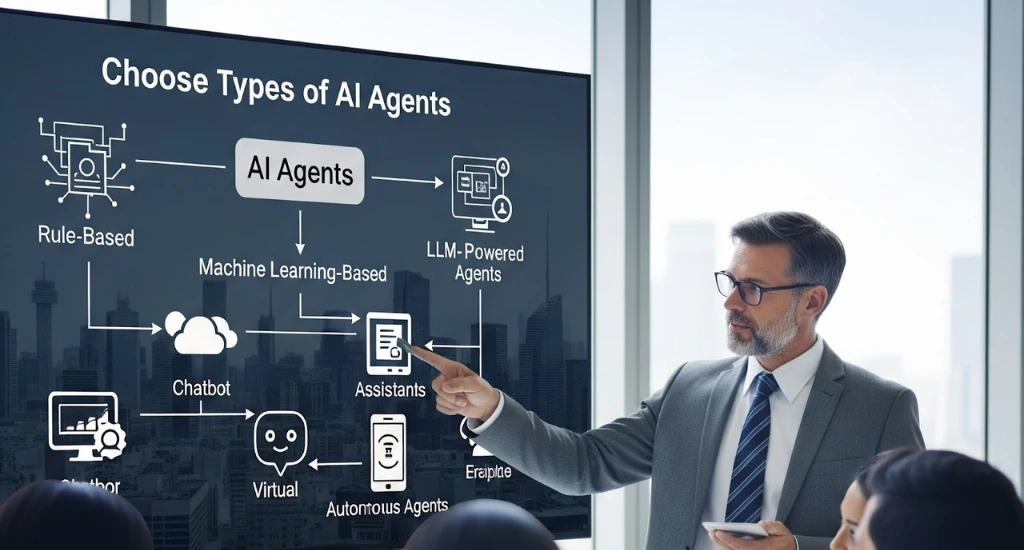
Rule-Based agents: Agents operating on some predefined logic trees. These agents are simple to set up, but their applications are limited. Such agents work well for simple FAQ bots or form-filling assistants.
Machine Learning-Based Agents: These learn from data and keep improving. They are more setup- and training-intensive and, hence, more adaptable.
LLM-Powered Agents: These agents provide superior natural language understanding and generation by leveraging large language models like OpenAI’s GPT. They can process complex queries, generate content, summarise information, and even have two-way interactions.
Form factors will also need to be considered:
- Chatbots for web or mobile interactions.
- Virtual assistants perform personalised tasks.
- Autonomous agents are making decisions or performing multiple-step workflows.
For most businesses in their beginning stage, the best mix of control and intelligence is to set up a rule-based framework along with a pre-trained LLM.
AI Agent Development Tools – Feature Comparison Table
| Platform / Tool | Best For | Skill Level | Key Features | Pricing Model |
| OpenAI (GPT-4) | Natural language interaction | Intermediate–Advanced | Pre-trained LLM, Assistants API, fast integration | Pay-as-you-go |
| LangChain | Logic-driven and multi-step AI agents | Advanced | Chain-of-thought logic, memory, external tool and API integration | Open-source / Paid cloud plans |
| Dialogflow (Google) | Multilingual chatbots and voice agents | Beginner–Intermediate | NLP engine, Google Cloud integration, voice + text channel support | Free tier + usage-based paid plans |
| Rasa | On-premise, private AI bots | Advanced | Open-source NLP pipelines, full data control, custom workflows | Free (community) / Enterprise license |
| Microsoft Bot Framework | Enterprise-grade bots | Intermediate–Advanced | Azure hosting, multi-channel deployment, SDKs in C# | Free framework / Azure costs apply |
| Botpress | Visual builders with modular logic | Beginner–Intermediate | Flow-based editor, analytics, multilingual NLP | Free (open-source) / Pro subscription |
| Voiceflow | Voice-enabled assistants | Beginner | No-code interface, Alexa & Google Assistant design, team collaboration | Freemium + Pro plans |
| Tidio / Chatfuel | Customer service & e-commerce bots | Beginner | Prebuilt templates, CRM integration, drag-and-drop UI | Freemium / Subscription plans |
Tools and Platforms You Can Use
Once you’ve outlined what tasks your agent needs to perform, you can now choose the tools to build AI agent from scratch.
In case your application requires state-of-the-art functionality:
- OpenAI’s GPT models (like GPT-4 and later) have impressive natural language capabilities.
- You can create AI assistants using LangChain that can interact with APIs, documents, and logic-based reasoning.
- Rasa is great for building on-premise, highly personalised conversational AI in Python.
- Google Dialogflow has very nice integrations with Google Cloud and NLP capabilities.
- Microsoft Bot Framework has deep integration with Azure and Teams.
For beginners or non-developers, here are the following options:
- Voiceflow, Botpress, and Tidio provide intuitive no-code/low-code platforms.
- These allow drag-and-drop logic flows and simple integration with messaging platforms.
Advanced developers can dig deeper by means of:
- Python (via libraries, such as spaCy, Hugging Face Transformers, and Flask).
- JavaScript/Node.js for real-time web integration/UI embedding.
- Choose according to your comfort, use cases, and scalability requirements.
Need help picking the right toolset? [Book a consultation] and get a tailored tech stack recommendation.
Collecting and Preparing Data
Your artificial intelligence agent draws its strength from data. The larger the volume of structured, relevant and contextual data, the more effective your agent will be.
Start sourcing:
– internal knowledge bases or wikis.
– Previous chat transcripts and customer service logs.
– Public datasets (Kaggle and Hugging Face Datasets).
Ensure that you have clean data by removing duplicates, inconsistencies, and irrelevant noise. Structure your data appropriately as categories or intents. If you are fine-tuning an LLM or training a custom AI bot classifier, the training data needs to be well labelled.
Designing the Conversation Flow or Task Logic
So the first thing you want to do is map out the interaction flow. What will the user say? How might the agent respond? What potential follow-ups or branches might arise from here?
You could sketch out:
- Logic trees or flowcharts.
- Intent-response diagrams for an NLP-based agent.
Current AI agents mix scripted decision logic for the important stuff with LLMs for the flexible, natural engagement we all crave. So, perhaps the agent interacts with LLMs for casual chitchat and FAQs but uses hard-coded logic when, for instance, the user says, “Reset my password” or “What’s the status of my order?”
Training the AI Agent
Even without actual training wheels, an AI agent can begin on its learning path. Nowadays, one can:
- Make use of pretrained models, such as GPT-4, and customise their outputs using tools like OpenAI’s Assistant API.
- Fine-tune models on your dataset whenever a robust understanding of the subject domain is required (e.g., legal, healthcare, fintech).
- Train smaller models through supervised learning (with labelled inputs and outputs), reinforced learning (where feedback is in the form of rewards), or unsupervised learning (where feedback may be in the form of clustering or topic modelling).
This is made easy by tools like Hugging Face Transformers or spaCy, while Google Vertex AI or Azure Machine Learning provide training infrastructure as a cloud service for the same.
Testing and Iterating
The first incarnation of your AI agent is precisely that—Testing is key.
Deploy the agent into a lab. Observe how users interact, flag misunderstandings, and locate where misunderstandings are occurring. Logs, feedback forms, and analytics dashboards can also be inspected for metrics, like:
- Query resolution rate
- User satisfaction
- Confusion triggers or fallback rates
Iterate liberally, updating responses, modifying logic, or retraining as required. The most effective agents evolve.
Want expert feedback on AI prototypes? [Request an AI audit] and improve your agent’s accuracy.
Integration with Channels and Platforms
To make any powerful AI agent useful, users need to be able to easily access it. Select platforms where your users are already active:
- On websites, think of embeddable widgets or iFrames.
- Use SDKs or custom APIs for mobile applications.
- Consider using messaging apps such as WhatsApp, Telegram, Slack, or MS Teams.
- Email and CRM tools – HubSpot or Salesforce.
Use APIs to fetch or write data into the database. Trigger actions with webhooks. If your agent needs to interact with real-world systems, integrations play a crucial role.
Monitoring and Maintaining the Agent
AI is not set-it-and-forget-it. Continuous monitoring ensures your bot performs well over time.
Use tools like:
- OpenAI Usage Analytics, Firebase, or Mixpanel to monitor engagement and drop-offs.
- Sentry or Datadog to track errors or crashes.
- Custom dashboards to monitor KPIs like resolution time, escalation rate, and user retention.
Update the model or logic as your business evolves. Add new intents. Remove obsolete workflows. Keep your agent current, relevant, and useful.
Security, Ethics, and Compliance
As you progress towards automation, remember to prioritise trust. The trust includes:
- Data privacy: through encryption and secured storage.
- User consent before their information is collected or stored.
- Diversity in training data for bias mitigation and keeping an eye on outputs.
- Regulatory requirements vary by industry, like GDPR and HIPAA compliance.
Also, set limits. Make it clear when users speak to an AI. Avoid manipulative tactics or opaque decisions.
Unsure if your AI is compliant? [Ask our compliance experts] — we’ll help you assess your AI setup.
Understanding the Costs
Building an AI agent may indeed be very affordable or costly depending on the scope. Here’s a rough breakdown:
- OpenAI API: Free tier available; then around $0.001-$0.03 per 1K tokens.
- LangChain, Rasa, Dialogflow: Free or open-source with payment tiers for enterprise-grade features.
- Custom hosting/cloud: $10-$100/month based on usage (AWS/GCP/Azure).
- Developer hours are $30-$150/hr based on expertise and geography.
The no-code platform may charge $20-200 per month based on the features and limits set forth by the platform. Always begin small and increase in size and scope as the requirements grow.
Partner with Esferasoft: Your Trusted AI Agent Development Experts
If you truly intend to create an AI assistant that is ready for the future but do not have the resources or know-how to navigate through the entire development process in-house, Esferasoft is your strategic partner.
With decades of experience in developing DIY AI agent software and intelligent AI solutions, Esferasoft has helped startups and large enterprises develop, design, and deploy intelligent AI assistants that yield actual effects in the real world. Be it building an LLM-powered, sophisticated bot or automating internal workflows with intelligent task agents, our team would be there for you right from ideation through to post-launch optimisation.
Why Esferasoft for Each Development in AI Agents?
Full-Cycle Development: From defining goals to choosing the right tech stack, training models, and integrating with your platforms.
Customised Solution: Our approach is tailored to the particular needs and requirements. We design your AI agent to fit your specific use case, data, and goals.
Multi-Platform Integrated Device: We have done it all – be a website chatbot or a Slack bot for your internal team and a mobile voice assistant.
Post-Launch Reinforcement: Continual improvement via the use of analytics, monitoring, and model tuning.
We call ourselves somewhere between developers and AI advisors. We also advise you on what is achievable, scalable, and impactful for your business in AI.
Want to build AI agent from scratchwith confidence? [Talk to us at +91 772-3000-038] today and discover how we can transform your vision into a working intelligent solution.
From Vision to Reality: Your AI Journey Starts Now
Although it is no longer limited to the technological giants themselves, one need not be a high-tech corporate behemoth to build one’s own artificial intelligence agent. Anyone can have it, be they solo entrepreneurs or fast-scaling startups. They only need to understand guidance, tools, and attitude well.
Start with a clear objective. Build with tools that are appropriate for your skills; test, learn and iterate. Most importantly, remember that the first version is just beginning. An MVP modestly can grow into a full-size solution, enterprise-grade, with intention and extendibility.
In an age of automation where competitive advantage lies, your customised AI bot becomes the heart of your digital operations – within the region, offering 24/7 support, decreasing workload and providing better user experiences.
Ready to make your mark with AI? [Let’s build your agent together] — We are here to walk with you every step of the way.