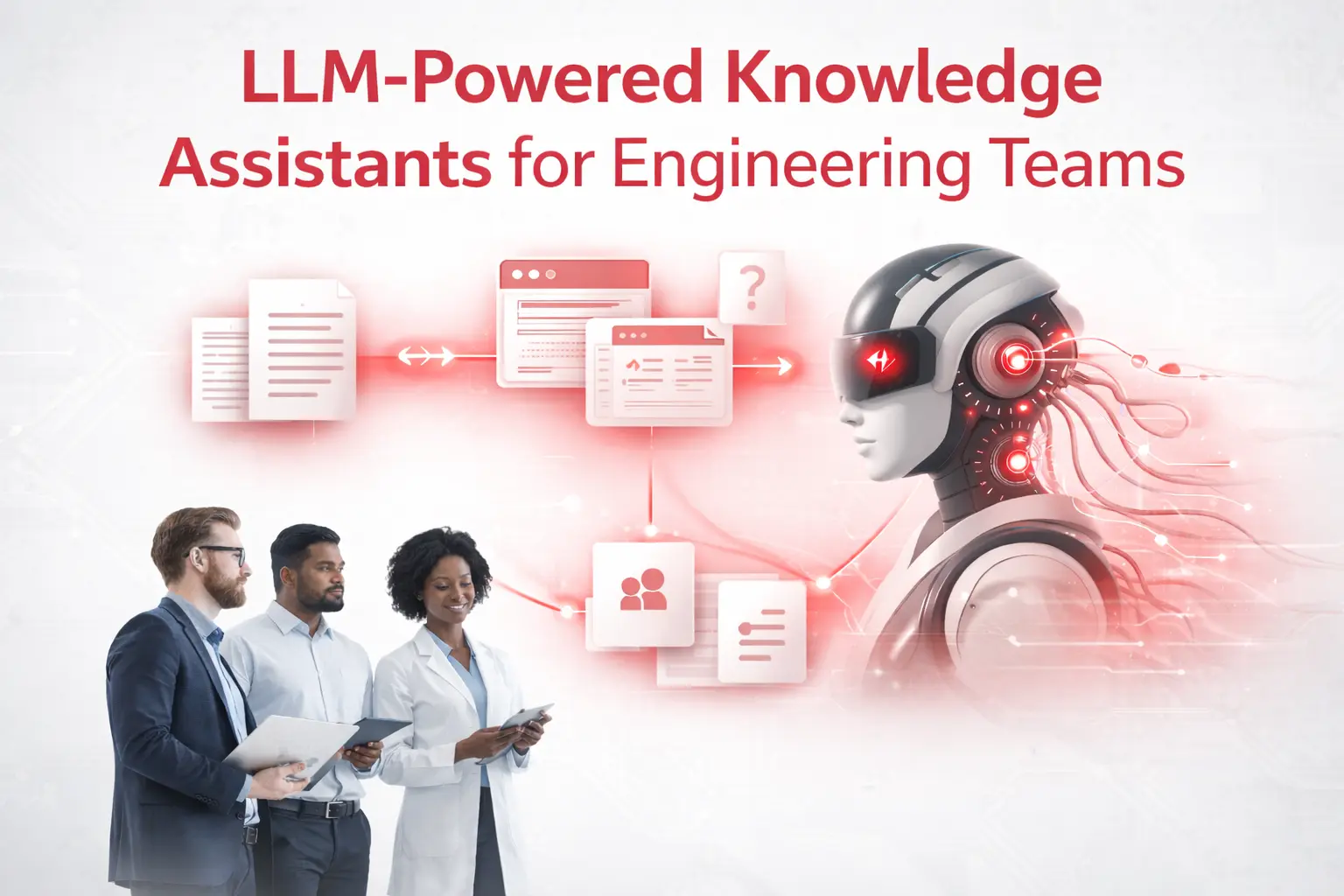
The modern software engineering teams work in a more complex environment where the codebases, documentation, infrastructure, and tools multiply at a very fast rate. During the expansion of organizations, knowledge is distributed in repositories, documentation systems, ticket histories, and internal communication channels. Instances include software developers wasting a lot of time in search of answers rather than developing features or technically addressing a problem. This is the place where the LLM-powered Knowledge Assistant is changing how the engineering teams are accessing and using technical information.
LLM-powered Knowledge Assistant is a system that retrieves real-time contextual responses based on internal documentation, code repositories, logs, and engineering materials by using advanced AI models. Instead of searching through documentation manually or requesting other personnel to clarify something to them, developers can engage with a system that is intelligent enough to learn about their engineering world and give them the correct insight immediately.
An engineering knowledge assistant is a key layer of intelligence to an engineering team dealing with large-scale systems, which can help them enhance productivity, reduce knowledge silos, and improve collaboration. From codebase exploration to debugging help and architecture insight, these assistants are potent support systems for contemporary development processes.
Let’s delve into this informational blog to get the idea of an LLM-powered knowledge assistant for engineering teams.
The Real Problem: Engineering Knowledge Loss
Hidden Cost of Knowledge Silos
The loss of technical knowledge over time is one of the biggest problems of contemporary engineering organizations. As developers switch positions, teams restructure, or engineers leave organizations, valuable information on architecture, design choices, and debug history tends to be lost. This issue brings significant inefficiencies to engineering teams that attempt to maintain or scale up complex systems.
In the absence of a central intelligence system, developers have to use scattered documentation, outdated internal wikis, and discussions lost in communication platforms. The resulting discontinuous information system will delay the process of development and expose the probability of mistakes.
The Implication on Engineering Productivity
An LLM-powered knowledge assistant can be used to solve this issue by converting dispersed knowledge into a searchable layer of intelligence. Rather than having to search through documentation manually, a developer can ask contextual questions and get the correct insight depending on the company knowledge sources.
An assistant engineer is able to process various data in parallel, such as repositories, design documents, and historical tickets, to bring out the most highly pertinent information. This saves the developers a huge amount of time in the process of seeking solutions and enables them to concentrate on engineering issues.
Companies that use an internal developer knowledge base AI tool solution observe a dramatic increase in developer productivity and onboarding time. In Esferasoft Solutions, the use of AI-based knowledge systems has allowed the teams to maintain institutional knowledge and has allowed engineers to retrieve technical knowledge within a short period of time and in an efficient manner.
What Exactly Is an LLM-Powered Knowledge Assistant?
Learning the Core Technology
LLM-Powered Knowledge Assistant is an AI-assisted knowledge tool that assists engineering teams in engaging with the internal knowledge in a conversational manner.
An AI knowledge assistant for developers can interpret context, unlike conventional tools of developer documentation. This implies that it is able to decipher technical questions and give answers to them according to the engineering environment in an organization.
How Does It Embed into the Engineering Systems?
Modern LLM for software engineering team solutions work with several engineering systems, including version control systems, ticketing, knowledge bases, and monitoring dashboards. These data sources can be linked to create a single knowledge interface for the developers.
As an example, a developer can request to know how a microservice communicates with the services within the architecture. The assistant is able to interpret internal documentation and dependencies between codes in order to present an explanation in detail in real-time.
Organizations implementing an enterprise AI assistant for engineering benefit from improved documentation access, faster troubleshooting, and better cross-team collaboration.
Practical Queries Developers Can Run Through a LLM-Powered Knowledge Assistant
On a daily basis, developers ask the following questions:
A powerful knowledge assistant based on LLM will allow developers to ask natural language questions to their systems and receive appropriate and valid responses. This alters the dynamism between engineers and complex technical situations.
The type of queries that are practical to the developers are of type:
-In which part of our system has the authentication logic been used?
-What services do you utilize the payment API for?
-What caused the database outage last quarter?
-Explain the architecture of the user notification service
These questions usually consume hours of reading documentation or consultations with senior engineers.
Intelligent Discovery of Your Codebase
With an AI assistant for codebase understanding, developers can quickly search and browse massive repositories and understand how the system works without reading the thousands of lines of code manually.
Dependencies and a summary of documentation of individual modules can also be elaborated by using an AI developer support tool, which can also detect and elaborate design patterns used in the codebase.
Incident Intelligence: Using Logs and Past Outages for Contextual Answers
Turning Historical Data Into Actionable Knowledge
The complex software systems are bound to experience production incidents and outages. As much as such events tend to interfere with services, they also come up with insightful information that can assist engineering teams to improve the reliability of their systems.
Each outage generates very big volumes of operational data, such as logs, monitoring notifications, incident reports, and internal communications. Nevertheless, such knowledge tends to be distributed among various tools and platforms, and developers will not be able to quickly derive useful knowledge.
An LLM-powered Knowledge Assistant can be used to convert this information into a source of knowledge. The assistant is able to offer contextual explanations of the previous system failures by examining historical logs, incident reports, monitoring dashboards, and engineering documentation. The developers can make immediate inquiries and get summarized insights in a few seconds rather than manually going through thousands of log entries or flipping through archived reports.
An internal developer knowledge base AI solution can also make various tools of operation interrelated so that engineers will obtain information on incidents through a single interface. It is not only better for accessibility, but it also allows one to make the lessons learned during past outages available to the whole engineering organization.
Intelligent Incident Analysis
The production problems can be analyzed and resolved by engineers using AI for debugging and incident analysis to investigate them much more rapidly than it could be done otherwise. Developers can just make queries like
-What was the previous service outage of payment?
-Have we been experiencing such a leak of memory?
-What was the triggering part of the alert, and why?
The assistant reviews the data concerning the occurrence of historical incidents, system logs, and monitoring alerts and gives a short description of the issue and the cause of its appearance. This saves a lot of time in the diagnosis of production problems.
Moreover, AI software development workflow solutions have the ability to detect repeated trends in the occurrences of incidents. As an example, it can point out common configuration mistakes, infrastructure bottlenecks, or common dependency failures. Such insights enable the engineering departments to take a positive initiative to fix the weaknesses in their systems before they develop more into bigger concerns.
Why Knowledge Assistants Reduce Meetings Instead of Replacing Engineers
Getting rid of repetitive knowledge requests
The engineering teams also tend to waste a considerable amount of time responding to repetitive questions regarding the system architecture, APIs, the configuration steps, or internal documentation. Although collaboration and communication are valuable, most of these interactions can disrupt the focus of developers and reduce overall productivity. Rather than wait for the response in chat tools or arrange a meeting, developers will easily access the information they require.
Some important methods by which a knowledge assistant gets rid of repetitive queries involve:
Immediate response to frequently asked questions
Some common questions that are often asked by developers include the position of specific services, the structure of the API, or which components are communicating in the system. The engineering knowledge assistant is able to give the correct answers immediately by checking the documentation of the company, the code repository, and the system architecture information.
Fewer interruptions in relation to senior engineers
The senior engineers tend to be the consulted source of technical clarifications. The knowledge system based on AI will enable junior developers to find information on their own, which will minimize the number of questions they are asked by the senior team members.
Access to knowledge is centralized
Instead of going through various tools/documentation sources, developers can access enterprise AI assistant engineering as a single interface to seek explanations of architecture, instructions to configure, and technical guidelines.
Enabling Developers to Get Access on the Spur of the Moment
The biggest benefit of an AI knowledge assistant among developers is that it gives the engineers the ability to work on their own without disturbing the rest of their team members.
Key benefits include:
Just-in-time knowledge retrieval
Technical insights are always available to the developers when they require it, as opposed to waiting until they get a reply through the chat threads or even a meeting.
Improved development focus
This reduces interruptions and context switching of engineers and allows them to spend a lot of time writing and refining code.
Faster decision-making
Real-time availability of correct information facilitates effective technical decisions to be made by the developers as they develop complex systems.
Most significantly, the systems are meant to assist engineers and not to substitute them. An LLM-powered Knowledge Assistant can automate repetitive knowledge retrieval tasks and provide developers with the opportunity to engage in more valuable engineering activities, creating scalable systems, resolving tough technical problems, and creating innovative software solutions.
Codebase Simulation: Analyzing Change Impact Before Writing Code
Predicting System Impact
Any changes when it comes to large software systems can be risky since simple changes can be experienced by many services. Before developers make changes, it is common to take a lot of time studying dependencies.
A knowledge assistant based on LLM can predict the possible effect of a change in the code by analyzing the architecture, dependencies, and past changes
Safety of Engineering Decisions
Developers can plot the interaction of services in the system using an AI architecture documentation tool. This assists in detecting risks that may occur prior to the implementation of changes.
The AI assistant for codebase understanding is also able to point out modules that are impacted by changes, and this can assist the developers to prevent unwanted system failures.
In Esferasoft Solutions, smart AI systems are applied in the engineering teams to examine the dependencies of the architecture and enhance decision-making in the development process. This feature allows the developers to develop with more confidence and reduced instability in the system.
Knowledge Assistants as an Organizational Memory Layer
Preserving Engineering Knowledge
Organizational engineering yields incredible amounts of technical knowledge in the long run. Each project, architecture decision, bug fix, and system update brings a new set of valuable insights, which teams can use to know how their software is changing. Nevertheless, in most organizations such knowledge gets dispersed in various forms, including documentation platforms, company wikis, emails, ticketing systems, chat rooms, and code archives. With the increment in teams and the movement of the developers or those who leave the organization, most of this valuable information becomes hard to find or is lost completely.
The LLM-powered Knowledge Assistant can help overcome this problem by serving as the organizational memory layer of engineering teams. Rather than working with disjointed documentation, the assistant collects and examines knowledge from various sources within the company and compiles it into a searchable and intelligent database. Developers are able to query previous architecture choices, feature implementations, or debugging plans and get the correct answer within seconds.
This kind of system will help in the preservation of knowledge that is valuable in engineering and will be available throughout the organization. The interaction with new developers in the team allows making decisions much faster than the reasons for past design decisions, and the experienced engineers find it easy to revise previous solutions to the same technical issue.
Living Knowledge Base of Engineering
With the help of the internal developer knowledge base AI, organizations can develop dynamic knowledge systems that are constantly developed as new information is generated. In contrast to the conventional method of documentation, which involves a manual update to the documentation, the AI-enabled systems can learn through new commits, documentation updates, technical discussions, and incident reports.
Minor structures such as engineering files can also be summarized by an engineering knowledge assistant to simplify elaborations on technical decisions, architecture diagrams, and complex historical discussions to assist the developers. A developer may, for instance, rather than having to read lengthy documentation threads to understand a specific microservice architecture selection or how a given module communicates with any other service, simply query the assistant to get the answer.
Pair Programming With the Codebase: A New Engineering Workflow
AI as a co-engineering Partner
The idea of pair programming has been regarded as one of the most effective ones in software development. This model involves pairing of developers in reviewing code, resolving problems, and knowledge sharing. Nowadays, artificial intelligence is advancing this idea by providing smart systems that can help the developer when developing the system. An LLM-powered knowledge assistant is an engineering partner that works with developers in real-time as they develop more challenging technical projects.
Rather than having to rely on another human team member to guide them, the developers have the opportunity to engage with an AI system that has the ability to comprehend the codebase, architecture, and documentation within the organization. Such an assistant will be able to describe the functioning of some of its components, locate appropriate files in large repositories, and propose some of the ways of implementing new features.
Consequently, developers start to understand the system better and spend less time on searching the documentation or trying to comprehend new code.
Quickening the Workflow of Developers
The second significant benefit of AI collaboration is that it can be used to accelerate development processes. With developer workflow automation with AI, engineers are able to examine code structures fast, detect dependencies between services, and interpret potential issues that can be managed before they grow out of proportion. This enables the developers to make better decisions when updating or developing the current systems.
Also, an AI developer support tool may present documentation summaries, describe architecture patterns, and suggest strategies of implementation, according to the existing code and technical conventions. During the development process, developers can acquire clear explanations in a few seconds instead of having to go through large volumes of documentation.
Being an efficient engineering ally, an LLM-powered Knowledge Assistant will contribute to the increased productivity and will enable the developers to concentrate on the innovative problem-solving and development of high-quality software solutions.
The Measurable ROI Engineering Teams Are Reporting
Measurable Productivity Enhancements
There are persistent reports of productivity improvements in engineering teams with an LLM-powered knowledge assistant. There is less time spent by developers in the search for the information and more time on software building.
Measures that are often enhanced are
-Faster onboarding
-Reduced debugging time
-Improved code quality
-Faster incident resolution
Knowledge Systems Business Impact of AI Knowledge Systems
The platform of a software engineering productivity AI enhances the efficiency of the development process to a greater extent by facilitating the access of knowledge.
There is also an onboarding tool that is an AI that helps developers speed up the time of integrating new engineers into the existing systems.
AI-powered engineering solutions are assisting business organizations to save on operational inefficiencies and also helping teams to create software more quickly.
Why Generic AI Chatbots Fail in Real Engineering Environments
Lack of Contextual Knowledge
In engineering contexts, generic AI chatbots are not very useful in offering meaningful insights due to their inability to access internal systems or to context.
Knowledge Assistant, powered by LLM, in its turn, is trained using in-house engineering sources.
Specialized AI for Engineering Workflows
A software engineering team specific LLM can comprehend architecture patterns, system dependencies, and engineering lingo.
An AI architecture documentation tool is also useful in assisting developers to understand technical diagrams and system structures.
The Future Direction of LLM-Powered Knowledge Assistants
Artificial Intelligence-based Engineering Intelligence
The future of the Knowledge Assistant, which is being powered by LLM, is more closely aligned with engineering systems and processes. Such assistants will become smarter engineering copilots that can assist with suggestions at development, testing, and deployment.
The Future of the developer tools
The future AI development assistance tools will combine real-time monitoring of the system, architecture modeling, and predictive analytics to allow the developers to be able to foresee problems before they arise.
Engineering AI assistants will also be significant in enhancing cooperation among large engineering firms.
Esferasoft Solutions is already putting efforts into state-of-the-art AI-driven engineering ecosystems that will define the future of software development processes.
FAQs
Q.1. What is an LLM-powered knowledge assistant for engineering teams?
Ans. An LLM-powered knowledge assistant is an AI-based system designed to assist engineering teams in finding and comprehending technical data by applying the techniques of analyzing internal documentation, codebases, and engineering data.
Q.2. How does a knowledge assistant differ from GitHub Copilot or code completion tools?
Ans. Code completions or GitHub Copilot can be used to write code, whereas a knowledge assistant helps a developer to comprehend architecture, documentation, and engineering systems.
Q.3. Can a knowledge assistant understand large and complex codebases?
Ans. Yes, modern AI systems will be able to read large repositories and give contextual explanations regarding the structure and dependencies of the system.
Q.4. What types of engineering questions can developers ask a knowledge assistant?
Ans. Architecture, debugging problems, system dependencies, deployment processes, and historic events can be asked by developers.
Q.5. Is company source code secure when using an internal knowledge assistant?
Ans. Yes, enterprise AI solutions are highly secured to withstand inner code and sensitive data.
Q.6 How does a knowledge assistant help onboard new developers faster?
Ans. It offers real-time definitions of architecture, documentation, and processes, which greatly shorten the time of onboarding.
Q.7. Can a knowledge assistant assist during production incidents or outages?
Ans. Yes, it can carefully inspect logs, incident reports, and monitoring data so that developers can easily find root causes.
Q.8. Does a knowledge assistant replace software developers or support them?
Ans. Knowledge assistants are helpful to the developers to enhance the information accessibility and productivity; they do not take the place of engineers.