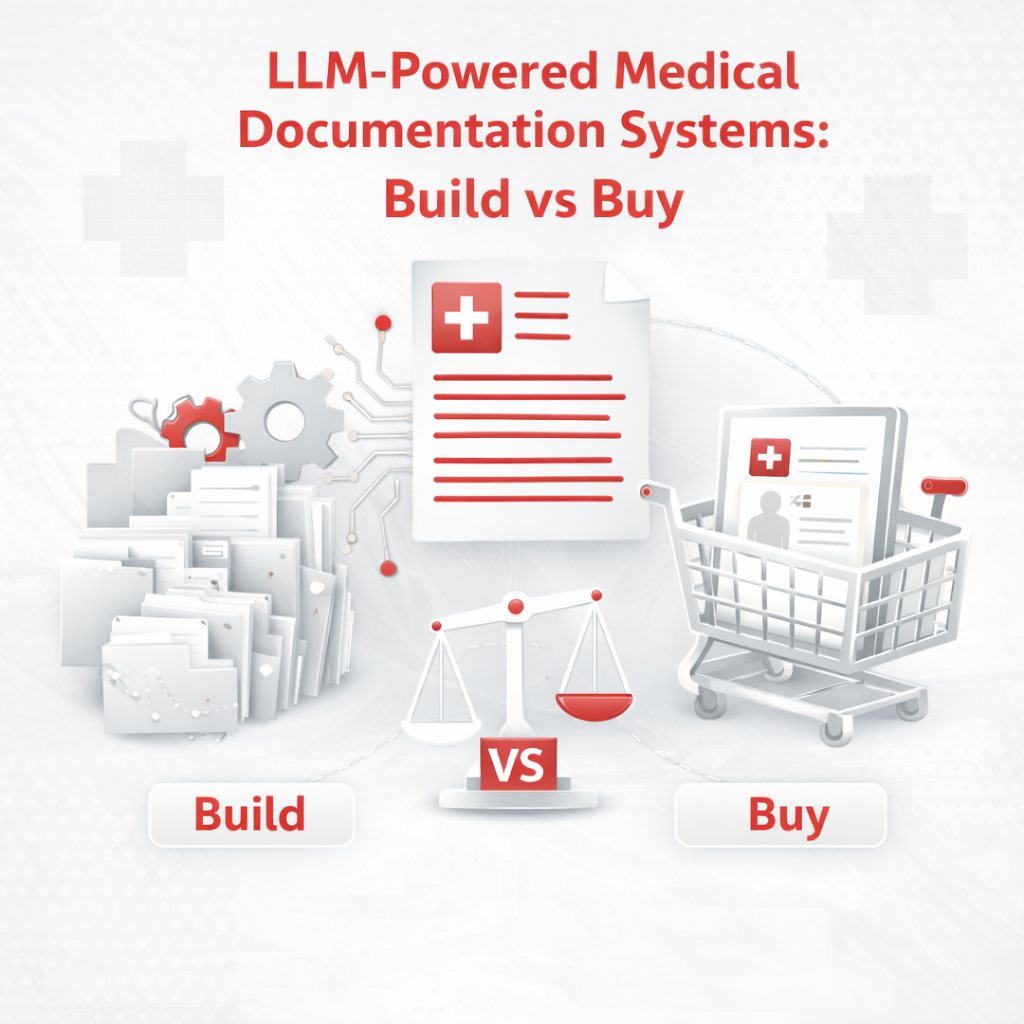
Medical documentation is one of the growing administrative burdens of healthcare providers today. Doctors and other medical personnel also spend much of their time documenting their communication with the patient, diagnosis, treatment, and follow-ups. Although proper documentation is crucial in ensuring quality care, compliance, and billing, the manual process is prone to inefficiencies and clinician burnout. This has pushed medical institutions to consider the use of new levels of technologies like LLM-Powered Medical Documentation systems.
This blog will discuss the way in which medical documentation using the LLM technology is changing the healthcare business. We are going to discuss the build-versus-buy choice, the supportive elements of the system, the real applications, and the future of healthcare LLM documentation platforms. This is aimed at assisting the leaders in healthcare to make wise choices when integrating AI medical documentation solutions.
What Are LLM-Powered Medical Documentation Systems?

LLM Medical Documentation systems are AI-driven systems that can generate, analyze, and manage clinical documentation automatically. Such systems handle medical conversations, physician notes, diagnostic outcomes, and patient information to produce structured and accurate documentation on a real-time basis.
Conventional medical records use a manual input method where health practitioners need to either type or dictate notes to Electronic Health Records (EHR) systems. It is a time-consuming process that tends to interfere with the interaction with the patients. In contrast, the LLC medical documentation systems process the verbal or written medical data and automatically produce an in-depth clinical note, summary, and report.
Essential Services of LLM Medical Documentation Systems:
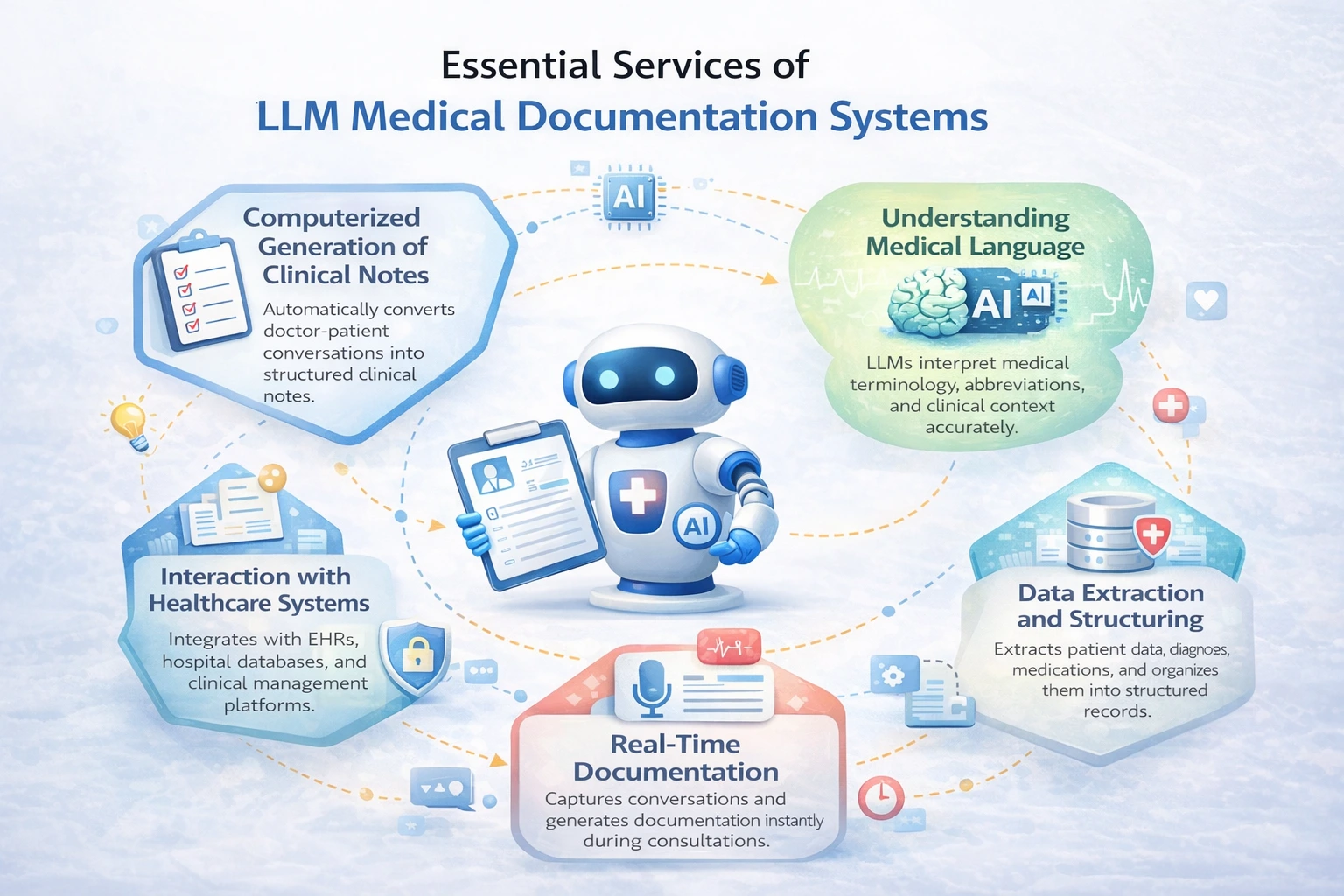
Computerized Generation of Clinical Notes
LLMs have the capability of transforming conversations between physicians and patients into structured notes like SOAP notes, progress notes, and discharge notes.
Understanding Medical Language
Medical terms and medical documentation guidelines are trained in AI models and make them understand complicated healthcare information correctly.
Data Extraction and Structuring
The unstructured data sources can be analyzed to identify the main information, including symptoms, diagnoses, medications, and treatment plans, by LLMs.
Real-Time Documentation
Other AI medical documentation systems include real-time translation and documentation in patient consultations.
Interaction with Healthcare Systems
These systems are connected to EHR platforms, billing software, and hospital information systems.
Medical documentation with LLM technology can lower the administrative load and enhance clinical productivity by automating repetitive documentation. Healthcare organizations may also improve the quality of documents, minimize errors, and be in compliance with regulatory requirements.
Why the Build vs Buy Decision Matters in HealthCare?
One of the most significant choices that healthcare organizations have to make when implementing the use of LLM-Powered Medical Documentation is whether to develop their own AI system or to buy a pre-existing one. This decision impacts implementation rates, costs, and capabilities of operations, scalability, and long-term technology.
Healthcare technology solutions should fulfil adequate data security, regulatory, and clinical accuracy needs. Thus, the approach to the implementation of LLM medical documentation systems might contribute greatly to the work of the facility in terms of efficiency and the quality of patient care.
Key Reasons the Decision Is Important:
Regulatory and Compliance Requirements
Patient privacy and data security are essential regulations that healthcare systems should adhere to. The creation of the system within the organization results in the organization creating compliance structures, and commercial solutions usually come with built-in compliance capabilities.
Financial Considerations
There is a significant financial implication of the build vs buy AI healthcare documentation decision. Building an in-house system involves heavy investment in AI development, infrastructure, and maintenance. Purchasing a commercial platform can save on start-up costs, but it has licensing fees.
Customization Needs
The workflows of some healthcare organizations are specialized and might not be facilitated by regular AI products. Under those circumstances, a tailor-made healthcare LLM documentation platform can be more flexible.
Implementation Timeline
Clinics and hospitals are regularly in need of fast solutions that will help to decrease the workloads of physicians. An acquisition of existing AI medical documentation solutions can be used to speed up deployment by a large margin.
Long-Term Innovation
Companies that are more interested in long-term AI innovation can choose to construct their systems to retain the ability to control improvement in the future.
Decision-Making Criteria for Build vs Buy Strategy
There are several factors that healthcare organizations need to put into critical consideration before making a decision on whether to develop or purchase LLM-powered medical documentation systems. Formal assessment will make sure that the solution obtained is programmed to meet business objectives, technical strengths, and long-term objectives.
Budget and Total Cost of Ownership
A custom healthcare LLM documentation system would demand a large initial investment in AI research, training models, infrastructure, and development. There are also the ongoing costs that need to be considered by organizations, i.e., maintenance, updates, and security management. A commercial purchase can be accompanied by subscription charges, but it can frequently be free of development expenses.
Technical Expertise
The creation of AI medical documentation systems needs specific knowledge in the field of machine learning, natural language processing, and data management in healthcare. It can be challenging to develop and support such systems when there are no experienced AI engineers in an organization.
Customization Requirements
There are some healthcare institutions in which the documentation workflow is very specific. In case these needs are complicated, it might be appropriate to create a tailor-made system.
Scalability and Performance
Massive clinical data are required to be processed by large healthcare networks on a daily basis. The adopted LLM-powered Medical Documentation system should be able to expand so as to cope with the rising workloads.
Integration Capabilities
The AI documentation systems should be integrated with the current EHR systems, telehealth solutions, and hospital management systems. The capabilities of integration must be thought out, and then a decision made.
The criteria analysis enables medical institutions to identify the most appropriate method of implementing medical documentation using the LLM technology.
How LLMs are Transforming Clinical Documentation Workflows?
Clinical workflows are being transformed by the introduction of the LLM-Powered Medical Documentation, which automates the process of documentation and makes the work more efficient. These AI systems are capable of handling volumes of healthcare information and creating the right documentation in a few seconds.
Reducing Physician Burnout
Among the major causes of physician burnout, administrative documentation tasks are listed. The LLM medical documentation system is used to automate repetitive processes and enable clinicians to pay more attention to patients instead of filling in forms.
Enhancing the Accuracy of Documentations
LLMs process medical data and produce standard documents. This minimizes the chances of human error and enhances the uniformity of medical records in medical organizations.
Real-time Clinical Documentation
The current AI medical record assistants have the ability to produce clinical records when a patient is being consulted. Documentation in real time will make sure that patient entries are made after meeting the patient.
Enhancing Collaboration
Proper and orderly documentation enhances teamwork in healthcare teams. Patient information can be accessed and understood easily by physicians, nurses, and other specialists.
Funding Telehealth Services
As telemedicine expands, the medical documentation of the virtual consultation is performed in a fast and efficient manner with the assistance of the medical LLM.
Generally, the use of the LLM technology is changing the way health care professionals handle the documentation procedures as well as enhancing patient care outcomes.
Common Use Cases for LLM-Powered Medical Documentation
Medical Documentation is being deployed in healthcare organizations using the power of LLM in different clinical and administrative operations. The applications aid in simplifying operations and improving the quality of the patient records.
Clinical Note Generation
Automated clinical note generation is one of the most prevalent ways of applying LLM medical documentation systems. AI models transform conversations between physicians and patients into formal notes like SOAP notes.
Medical Transcription
Voice recordings or consultations can be transcribed into detailed medical records with the assistance of AI-based transcription tools.
Discharge Summary Generation
To produce discharge summaries, LLMs are capable of summarizing historical records of treatment, diagnosis, and follow-up instructions.
Medical Coding Assistance
In AI medical documentation systems, clinical records can be analyzed and suggested with the right medical codes needed to be used in billing and insurance claims.
Summary of Patient Records
Doctors usually have to read extensive histories of patients. LLMs have the capability to produce summaries to emphasize important medical data.
Clinical Research Documentation
Medical documentation is a useful resource that the researcher can use in summarizing clinical trials, research findings, and study reports using the LLM tools.
These applications illustrate the way in which healthcare LLM documentation platforms enhance efficiency and help facilitate effective clinical activities.
Key Components of LLM-Powered Medical Documentation Systems
An effective Medical Documentation system that is powered by LLM must have a number of interrelated sub-elements that can facilitate an efficient and safe process of documentation.
Big Language Model Engine
The LLM engine is the primary technology that interprets medical language and generates documentation.
Layer of natural language processing (NLP)
Unstructured clinical data is processed by NLP algorithms, which then extract relevant information such as diagnosis, drugs, and symptoms.
Speech Recognition Technology
The voice recognition systems enable the doctors to give out dictations that automatically get into organized records.
Data Integration Framework
The AI platform is integrated with Electronic Health Records, hospital databases, and diagnostic systems via layers.
Infrastructure: Compliance and Security
The healthcare systems need to guarantee the privacy of data and their adherence to regulations.
Workflow and User Interface Integration
The system should give user-friendly dashboards that can easily blend with the prevailing clinical processes.These are the components that constitute good LLM medical documentation systems.
Build vs Buy: A High-Level Comparison for Healthcare Decision-Makers
In the analysis of LLM-Powered Medical Documentation, the leaders of healthcare have to determine whether to create a specific system or buy a ready-made framework.

Building a Custom Solution
The development of a custom healthcare LLM documentation system enables organizations to develop functionality that perfectly fits their processes. It is equally a guarantee of total data and system architecture control.
Nevertheless, the development of an AI platform demands more resources and time to implement.
Purchasing a Business Solution
Buying an off-the-shelf AI medical documentation system can enable organizations to implement the technology within a short period of time. Vendors may offer continuous updates, support, and compliance.
The primary weakness is less customization than the development of a system internally.
Hybrid Strategy
Other medical practitioners use a hybrid approach by acquiring a platform and configuring it to suit the particular features.
The most appropriate strategy would be based on organization priorities, budget, and technical skills.
Advantages of Building a Custom LLM Medical Documentation Platform
The development of a dedicated Medical Documentation system with LLM would offer a number of benefits to healthcare organizations that require personalized solutions.
It enables providers to create AI tools that are more customized to their business requirements and have more control over the information, processes, and enhancements of the system in the future.
Complete Customization
Organizations are also able to develop the features of a system that align with their clinical workflow, documentation style, and specialty needs. This would make sure that the platform does not interfere with the current processes to assist healthcare professionals.
Full Data Control
The healthcare providers retain the complete ownership and control of sensitive patient data and AI training models. This assists in reinforcing the security and compliance of privacy and internal data governance policy.
Long-Term Flexibility
Dedicated applications enable health institutions to keep on improving functionality and add new AI opportunities as the technology advances. This scalability and flexibility make the system relevant and scalable to the needs of the future.
Making an interconnection with Proprietary Systems
Home-built systems are easily integrated with in-house healthcare applications like the EHRs, billing systems, and hospital management systems. This allows a smooth flow of data and increases the efficiency of the clinical documentation processes.
To large healthcare networks, the strategic value of developing an LLM medical documentation system may be a long-term strategic value through enhanced innovation, scalability, and operational control.
Challenges and Risks of Building an In-House LLM System
Even with the benefits, a medical documentation platform that is based on an internal LLC has some disadvantages.
High Development Expenses
The implementation of AI models, infrastructure, and integration systems is extremely expensive.
Prolonged Development Period
The business-wise, viable healthcare LLM AI documentation system could require months or even years to get in place.
Complexity of Regulation
The internally designed systems might not be appropriate when it comes to ensuring that they comply with healthcare rules.
Constant Upkeep
AI models must be updated and checked on a regular basis to ensure they are always accurate.
Talent Requirements
The companies are required to hire qualified AI developers, healthcare information analysts, and compliance officers.
Due to these challenges, certain healthcare providers would rather buy the existing AI medical documentation solutions.
Benefits of Buying a Commercial LLM Medical Documentation Solution
Purchasing a commercial LLM-powered Medical Documentation system is associated with a number of benefits to healthcare organizations that are interested in quicker deployment.
Faster Deployment
Custom-built systems can be put into place very slowly in comparison to commercial platforms.
Reduced Development Costs
AI development and infrastructure are expensive, which is not the case with organizations.
Built-In Compliance
The majority of vendors develop their solutions according to the healthcare regulatory standards.
Vendor Support and Updates
The providers of technologies keep enhancing their LLC medical documentation systems.
Esferasoft Solutions assists healthcare organizations in adopting advanced AI medical documentation solutions that align with their operational needs. Our experience in AI and healthcare technology will allow hospitals and clinics to implement scalable documentation platforms without problems.
Future of LLM-Powered Medical Documentation in Healthcare
The future of LLM-powered Medical Documentation that is powered is likely to see a lot of improvements in the efficiency of healthcare and for the patients.
Timely Clinical Documentation
The systems of the future are going to produce documentation immediately when interacting with patients.
Artificial Intelligence-based Clinical Assistants
AI developed to the next level will support physicians by analyzing records and providing treatment insights.
Individualized Patient Summaries
LLMs will produce personalized summaries of clinicians as well as patients.
The Medical Devices Integration
The systems of AI documentation will be combined with monitoring tools and wearable devices.
With the development of AI technology, healthcare LLM documentation platforms will become vital in the current healthcare operations.
How to Choose the Right LLM Strategy for Your Organization?
The choice of the appropriate LLM-powered Medical Documentation strategy should be made in terms of the critical analysis of the organizational objectives, resources, and technical capabilities.
Specify Organizational Objectives
Some of the targets that healthcare leaders need to recognize include lessening administration and improving documentation.
Assess Technical Capabilities
Companies that have excellent AI can decide to develop their own LLM medical documentation systems.
Take into Account the Budget and Timeline
The decision should be affected by budget constraints and the schedules of implementation.
Collaborate with Established Technology Suppliers
The partnership with such established firms as Esferasoft Solutions will assist healthcare organizations in adopting useful AI-based medical documentation systems that support their operational requirements.
Conclusion
Implementation of Medical Documentation with LLM is changing the way healthcare documentation is done, as it is more efficient, accurate, and productive in regard to workflow. These systems save repetitive work and enable health care professionals to pay more attention to patients.
The build vs buy AI healthcare documentation choice plays an important role in companies that intend to use AI-based documentation decisions. Even though a homegrown platform is more flexible and has more control, a commercial solution can be deployed faster and at a lower cost.
FAQ’S
1) What are LLM-powered medical documentation systems?
Ans. Medical documentation systems with LLM are AI tools that assist in the automatic creation, summarization, and organization of clinical notes with the help of big language models. They assist healthcare providers in being more effective managers of patient records.
2) How do LLMs improve Clinical Documentation Accuracy?
Ans. LLMs process vast quantities of clinical data and make up structured and standardized medical notes. This minimises human mistakes and enhances documentation uniformity.
3) Build vs buy: which is better for healthcare AI?
Ans. The most suitable one depends on such factors as budget, customization requirements, and the presence of technical skills. Other organizations develop their own systems, whereas others opt to use existing solutions.
4) When should Hospitals build LLM Documentation Tools?
Ans. Hospitals can also think about constructing custom tools in case they need a specific workflow or sophisticated integrations. It is also applicable in organizations that intend to innovate AI in the long-term.
5) What are the risks of buying AI documentation software?
Ans. Any purchase of AI software can result in dependencies and reduced customization options with the vendors. Recurring subscription or licensing expenses may also be involved.
6) How much does LLM medical documentation cost?
Ans. Prices fluctuate based on the complexity of the system, the scale of implementation, and the need to customize the system. It also has different pricing according to the vendor services and infrastructure requirements.
7) Are LLM-generated clinical notes HIPAA compliant?
Ans. Yes, the notes generated by LLCM can be HIPAA compliant, provided that the system is adequately secured and provided with data protection measures. The adherence is determined by the way the platform is designed and operated.
8) How accurate are AI-generated medical notes?
Ans. Precision is a factor that relies on the quality of the AI model, training data deployed, and system integration. Professional models are able to generate very trustworthy clinical records.
9) Can LLMs integrate with existing EHR systems?
Ans. Yes, the vast majority of the modern systems of LLM medical documentation are oriented to the integration with Electronic Health Record systems. This enables the automation of workflow and data sharing.
10) Is a hybrid build-and-buy AI approach effective?
Ans. Yes, a hybrid approach of combining customization and fast implementation is embraced by numerous healthcare institutions. In this direction, they can utilize the existing platforms and customize them.