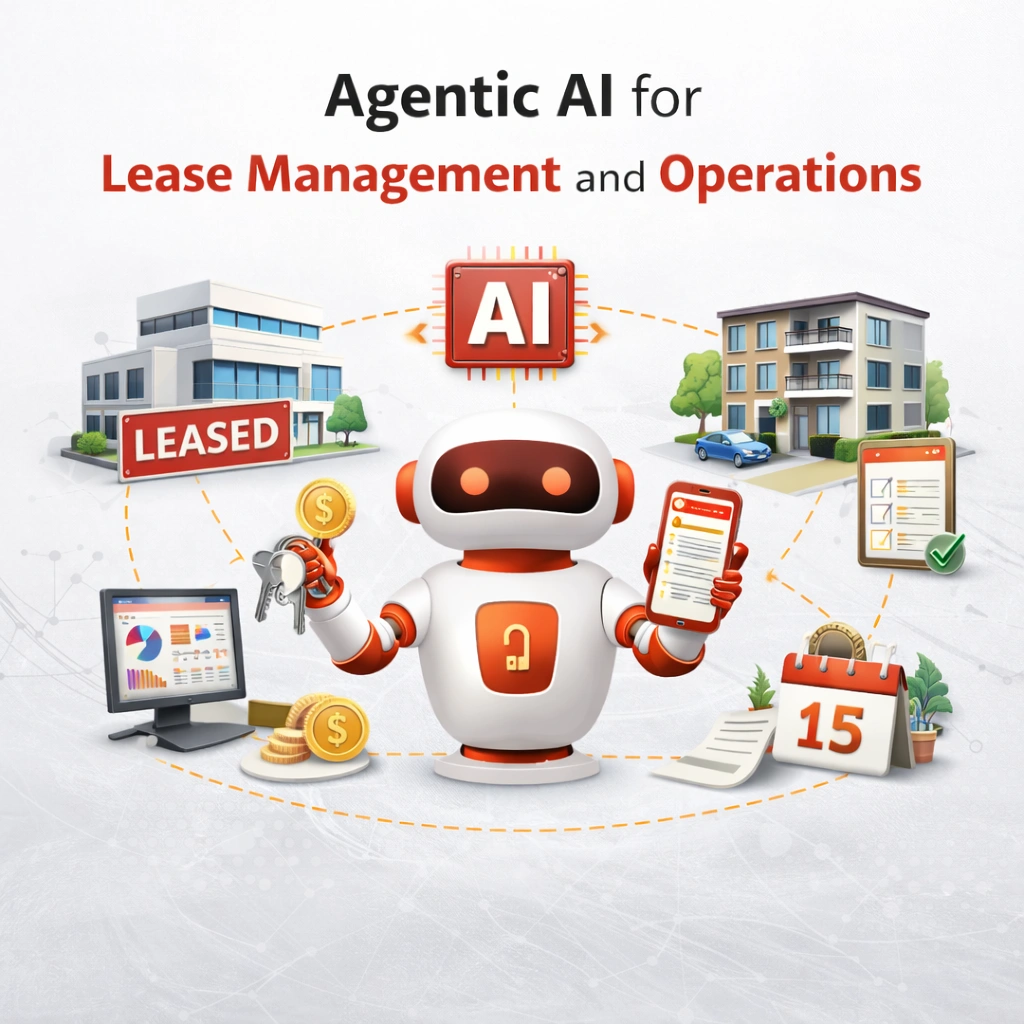
In the modern era, businesses achieve seamless growth, but the biggest and most complex operational issues are lease management. This task has quietly become the most critical challenge for both small and large businesses. But what looks like a pile of contracts controls millions of costs, compliance, and portfolio decisions. According to industry estimates, enterprises ended with a 5% annual lease value due to missed deadlines and small errors. This is where Agentic AI for lease management comes into play.
Unlike traditional automation or rule-based systems, agent-driven platforms won’t simply follow fixed guidelines. They are designed to think through tasks, plan next procedures, and take action across the overall lease management lifecycle. Instead of just storing lease data, these systems read and interpret contracts, track critical obligations, trigger required actions, and continuously optimize outcomes with minimal manual oversight.
For real estate teams and property operators, agentic AI marks a clear shift away from outdated lease administration processes toward intelligent, self-directed lease operations. The impact is practical and measurable: better-informed decisions, reduced manual effort, and smoother management of complex lease portfolios. This comprehensive blog explains the presence of Agentic AI for lease management and other operations in detail.
The Lease Management Problem in Real Estate The lease management looks strong and structured on paper, but when it comes to reality, it’s truly fragmented. However, most of the property managers handle the following metrics: Rent collection Escalation clauses Maintenance co-ordination Lease renewals Compliance monitoring Vendor payments
In reality, everything relies on manual processes.
Spreadsheets track deadlines. Emails manage tenant communication, and the staff cross-checks contracts line by line to identify clauses and obligations. So, the missed deadlines or renewal notices create financial leakage, and the operational restrictions appear in several areas:
• Expiring leases not flagged early • Rent escalations miscalculated • Compliance documents stored across systems • Tenant requests routed manually • Delayed reporting for ownership stakeholders
As portfolios scale, these inefficiencies multiply. So, the challenge is not a lack of software, but the problem is that software needs constant human monitoring.
Agentic AI models revolutionized the process by transforming it from a reactive management to an autonomous one.
What Is Agentic AI in Lease Management?
Generally, the Agentic AI for lease management refers to a system comprised of autonomous AI agents that can easily recognize lease documents, make better decisions, and also execute tasks to coordinate actions in the overall lease lifecycle. Further, the system also reads contracts, extracts clauses, and monitors compliance based on the changing business norms.
Additionally, the lease management automation using AI is ideal for managing leases by connecting everything into a centralized intelligent layer. As the system doesn’t wait for instructions at every step, it executes with defined metrics and goals such as risk reduction and improving occupancy.
How Agentic AI Works in a Lease Management Platform Agentic AI manages leases as active systems rather than just storing documents. Every lease is then treated as a live process that the AI lease management system can easily read, monitor, and work on without any kind of human interference or supervision. Here’s how the system actually works:
Step 1. Lease Ingestion and Semantic Parsing
Lease documents enter the system through ingestion services. Optical character recognition (OCR) is employed as necessary. A language model analyzes legal documents, pinpointing clauses, payment structures, notification timelines, and responsibilities. Each clause is assigned a confidence score and subsequently linked to a predetermined lease schema.
Step 2. Lease Static Modeling
Each lease is represented as a state machine. The state includes active status, compliance status, and financial standing. State transitions are initiated by either time-based occurrences or external stimulation. This functionality lets the system determine the current status of each lease at all times.
Step 3. Agent Execution Layer
AI Agents are deployed as independent services. Each agent works on specific lease state events. When an event occurs, the agent executes its logic. Abstraction agents refresh lease information. The compliance agents effectively assess obligations, and the renewal agents analyze notice conditions. Financial agents also verify charges.
Step 4. Decision & Policy Assessment
Before execution continues, a decision engine checks and evaluates risk thresholds and business rules. If the action falls within allowed limits, it proceeds. The action gets suspended for approval after assessing its increased risk. This process is both deterministic and version-controlled.
Step 5: Action Execution and System Synchronization
The automation services then execute the approved actions. Lease systems and accounting platforms receive their updates through API (Application Programming Interface) connections, which allow different software applications to communicate with each other. These connections facilitate communication between various software applications. The system sends notifications during necessary events, while each action generates a comprehensive execution report.
Step 6. Ongoing Evaluation Loop
The AI lease administration platform operates in an ongoing process that continuously assesses lease conditions at different time intervals. The system updates its rules when changes occur in lease language patterns and regulations. It continues to run after its initial start without needing any further manual reboots.
End Result
The system constantly monitors all changes in its operational state. Because it controls the system’s actions, government approval is required for its operations. This method allows organizations to manage their lease management systems independently, without needing outside help.
Core Capabilities of Agentic AI Lease Management Systems
The AI real estate operations platform totally differs from traditional AI automation. It not only provides answers to questions and generates reports but also executes various goal-driven tasks. However, in lease management, this means
|
Core Capabilities |
Description |
|
Contract Intelligence |
The AI model analyzes, reads, and extracts structured data from lease agreements, including rent schedules, escalation clauses, notice periods, and termination rights. and compliance burden. Also, the system creates a live operational model of each lease. |
|
Proactive Deadline Tracking |
Rather than waiting for the reminders, the AI-powered systems consistently scan timelines and move forward with the renewal alerts, Escalation updates, compliance reviews, and insurance verification checks. |
|
Automated Workflow Implementation |
The AI system has completed all required tasks for your rent escalation process because it has performed all calculations and billing updates, tenant notifications and financial record maintenance. |
|
Risk Detection |
The system detects lease violations through its analysis of document deficiencies, payment discrepancies, and regulatory risk assessments. |
Lease Lifecycle Automation Using AI
A lease isn’t a static contract. It moves through stages: acquisition, negotiation, implementation, active management, and renewal termination. So, the Agentic AI manages this entire lifecycle
Phase 1. Pre-lease Phase
During this stage, AI analyzes past portfolio data to inform negotiation strategies. It examines comparable rent benchmarks, vacancy trends, and escalation patterns. It also assesses tenant credit risk. This analysis leads to more informed deal structuring.
Phase 2. Lease Execution
Official signatures are affixed to the lease agreements. The AI system then begins the process of extracting structured data from these signed contracts. The goal is to eliminate the need for manual data entry. All contract clauses are transformed into a machine-readable format. The AI system, during the lease period, does the following tasks:
It maintains a record of payment dates
It determines the rate of price increases
It tracks the fulfillment of service agreements
It checks the responsibilities for equipment upkeep
The system will take action when it detects either of these two situations.
Phase 3. Renewal and Exit
The AI system evaluates the following factors before the contract ends.
Market rent trends
Tenant payment history
Occupancy strategy
Risk exposure
The system provides asset renewal options, which include renegotiation and asset repositioning.
AI Compliance, Auditing, and Risk Monitoring
Lease agreements serve as legal contracts that include financial commitments. The failure to meet a specific requirement or to adhere to mandatory standards results in both financial penalties and loss of income. An AI-powered lease operations platform, which works constantly, allows for digital monitoring to ensure that organizations follow their required rules. This system uses natural language processing to analyze lease documents on a large scale.
Furthermore, the system identifies essential contract components, such as escalation clauses, termination rights, renewal windows, security deposit requirements, and maintenance responsibilities. Instead of performing annual assessments, the AI system continuously monitors contracts. It also handles time tracking for lease agreements, which need a 90-day heads-up before renewal.
The AI system determines which agreements are susceptible to regulatory shifts and modifies specific contract terms accordingly. This is particularly important for portfolios spanning different regions, each with its compliance rules. Audits now follow established protocols.
Auditors still have to manually review payment documents, reconciliation reports, and the process of matching documents. In contrast, the AI monitoring system continuously compares lease agreements with current financial transactions. The system generates alerts for two situations, which include incorrect application of rent escalations and invoice discrepancies with contract requirements. The organization monitors risks that exceed the limits of compliance management.
Agentic AI, which refers to artificial intelligence systems that can act independently, can identify financial risk patterns. These include things like late payments, reduced engagement, and repeated disputes. Such indicators may direct potential tenant default or dissatisfaction. Early detection enables property managers to find solutions that help them prevent their financial losses from increasing.
Institutional investors, those managing hefty portfolios, are experiencing a decline in operational risk. This change is largely a result of increased operational transparency. Decision-makers now have access to real-time intelligence, a significant leap from the old days of waiting for quarterly reports.
Business Benefits for Property Managers and Owners
Agentic AI’s impact on lease management goes well beyond simple automation; it reshapes operational efficiency, cost control, and other vital areas. Here’s how it gives owners and property managers an advantage:
Reduced Operational Costs
The savings stem from eliminating numerous manual administrative tasks. Things like finding documents, setting reminders, and following up with tenants, which used to eat up a lot of staff time, are now handled differently. AI agents execute these tasks with immediacy and reliability. Teams can also shift their focus to optimizing assets and boosting tenant engagement.
Minimized revenue leakage is a clear advantage. Over time, factors such as overlooked rent increases, missed renewal deadlines, and billing mistakes can significantly impact profits. Careful attention to every detail is essential to make sure all contractual obligations are met.
Scalability is also a crucial consideration. A property management company handling 200 leases deals with a different set of challenges than one managing 5,000. Manual oversight simply isn’t practical for larger operations.
In contrast, agentic AI allows for expansion without needing to hire more administrative staff, as it refers to artificial intelligence systems that can act autonomously to assist in decision-making.
Data-driven decision-making is no longer a distant goal. Property managers now utilize dashboards brimming with predictive insights, a significant departure from the reliance on historical spreadsheets of yore. These visualizations vividly depict lease expiration patterns, their corresponding risk scores, occupancy trends, and potential compliance concerns. Quick responses, clear communication, and a proactive approach all make for a better experience for tenants. This, in turn, directly impacts property valuation and portfolio stability.
Technology Behind Agentic AI Platforms
The development of the Agentic AI for lease management platforms is not just restricted to a single technology; it includes a series of technological frameworks:
Large Language Models
Used for: Contract interpretation, Communication generation, Natural language understanding and
Retrieval-Augmented Generation (RAG)
Ensures responses align with: Lease documents Legal frameworks Company policies Vector Databases
Store contract embeddings for semantic search.
Workflow Orchestration Engines Trigger automated actions across systems.
Predictive Analytics Recognize historical portfolio performance to forecast risk
API Integrations Link up with: Accounting systems CRM platforms Maintenance software
Property management systems Agentic AI isn’t just one model. It’s a network, a coordinated ecosystem of artificial intelligence systems that collaborate. It’s a coordinated ecosystem.
Integrating Agentic AI With Property Management Software Most property management agencies currently utilize platforms like Yardi, Appfolio, and MRI software. But Agentic AI doesn’t replace them; it enhances them to the next level. Here is how you can successfully integrate this model into an autonomous lease management system:
Integration occurs through APIs (Application Programming Interfaces) and middleware layers, which are software that connect different applications or services.
Key Integration Points: Lease database synchronization. Payment system updates. Maintenance workflow coordination. Financial reporting alignment.
Thus, the AI integration enables systems to perform these activities:
PMS users can now receive updates through direct system updates. The platform shares analytics data in the dashboard. It also handles billing amendments through automated processes. The system detects compliance risks that need attention. Managers continue using familiar software, and AI operates autonomously in the background.
Future of Autonomous Real Estate Operations
The future of autonomous real estate operations is represented by agentic AI, which is a developing area. AI agents will gain new capabilities that enable them to perform operations beyond their current role of communicating and monitoring tasks within the next few years. They will handle vendor negotiations while using market signals to determine optimal lease rates and creating occupancy forecasts together with financial simulations, which will assist in renewal decision-making.
Smart buildings enable their autonomous systems to connect with Internet of Things (IoT) systems. AI agents will use energy consumption data together with occupancy sensor information and maintenance records to make real-time operational adjustments. Intelligent orchestration will link lease management with facility management operations, which will now function as one unified system.
The AI-powered lease operations platforms will help corporate real estate departments to improve their portfolio optimization process. The team will assess space utilization to develop consolidation plans while discovering cost-saving options that stem from lease conditions, together with operational data. The study of how multiple agents work together is a new area of research. One AI agent is responsible for monitoring compliance. Another agent manages tenant interactions. A third agent handles financial reconciliation. This team operates under human supervision, using their own systems for constant monitoring. Regulatory frameworks will also evolve.
The growing use of AI technologies in lease management processes will make organizations need to enhance their compliance with requirements concerning system explainability and decision-making transparency. Organizations that implement Agentic AI technology at an early stage will establish the standards for responsible technology implementation.
Conclusion
The lease management is most often seen as an admin task, but in reality, it’s the financial and legal backbone of real estate operations. Missed deadlines, compliance failures, and communication gaps create measurable risk. Agentic AI introduces structured intelligence into this environment. By combining reasoning, automation, continuous monitoring, and adaptive communication, it turns lease management into a proactive, data-driven operation. Tenant communication becomes contextual and efficient. Compliance monitoring becomes continuous rather than periodic. Risk detection becomes predictive instead of reactive. Modern business choices are increasingly guided by immediate data, rather than waiting for reports that arrive well after the fact. If you want to build an AI lease management system for your business, feel free to reach out to Esferasoft Solutions, as we specialize in delivering top-notch solutions catered to every business need. For property managers and owners managing growing portfolios, the question is no longer whether AI will influence operations. What matters most is the swift deployment of autonomous systems in a responsible and strategic manner. Agentic AI is not just a technology upgrade. It represents a shift toward intelligent, scalable, and resilient real estate management.